Published on 6/30/2026
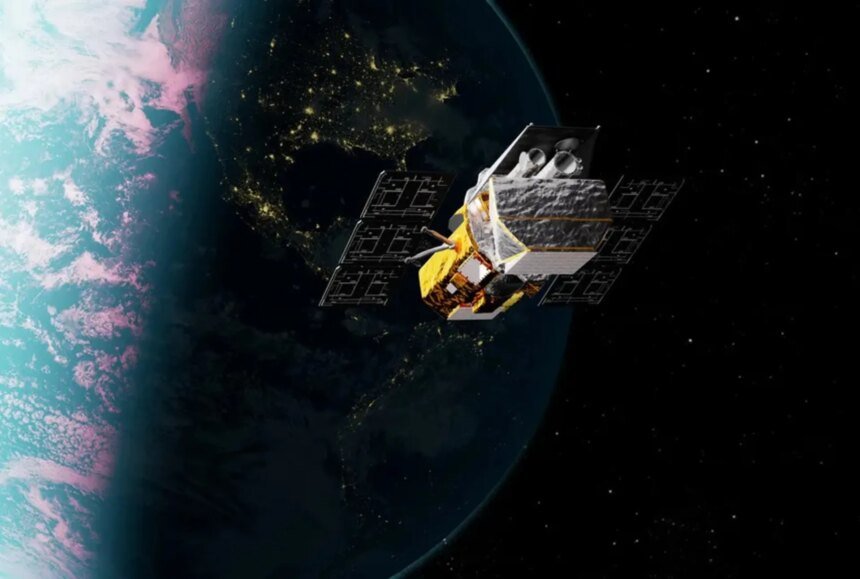
More than 20 years ago, in 2004, NASA launched the Swift space observatory at a cost of about $250 million, setting before it a mission not exceeding two years to monitor gamma ray bursts, which are the most violent explosions known in the universe. But the success of the observatory exceeded all expectations, and its mission continued for more than 22 years, becoming one of the most important observatories specialized in observing the changing sky.
Today, the observatory is facing a real danger after the resistance of the Earth’s upper atmosphere, which has increased due to solar activity and solar storms, has begun to gradually pull its orbit towards Earth, which threatens to burn it up in the atmosphere before the end of this year if rapid action is not taken to save it.
Read also
list of 2 itemsend of list
An unprecedented rescue mission in the history of space observatories
Instead of letting the observatory end, as usually happens with many satellites, NASA decided to carry out a bold rescue mission called Swift Boost, at a cost of $30 million, in cooperation with the American company, Space Catalyst.

The mission is scheduled to launch today, Tuesday, June 30, 2026, at 1:23 pm Mecca time, aboard a “Pegasus XL” missile, which will be air-launched from the “Satrgizer” plane over “Kwajalein” Island in the Marshall Islands, on the last flight of this historic missile.
The company will use a new spacecraft called LINK, a small robotic vehicle approximately the size of a refrigerator, equipped with ion engines, robotic arms, and precise sensors, to dock with the Swift Observatory and then gradually raise its orbit over several months, ensuring that it continues to operate for at least an additional five years if the mission succeeds.
This is the first attempt in history to raise the orbit of a space telescope that was not originally designed to receive maintenance or rescue operations in space.
Why is SWIFT worth the investment?
Spending $30 million to save an observatory that has outlived its design may seem counterintuitive, but scientists say SWIFT still does a job that no other space observatory can do.
While the Hubble Telescope sometimes needs two days to redirect itself towards a new target, Swift can change direction in just a few minutes, to capture gamma ray bursts that may last a few seconds and then disappear forever.
“The universe is a very dynamic place. Almost every second, a massive star explodes somewhere in the universe,” said Brad Sinko, the mission’s principal investigator from Pennsylvania State University.

He added: “SWIFT has become NASA’s first responder, and through its integration with the rest of the observatories we can study phenomena that are impossible for one observatory to understand alone.”
During its years of operation, the observatory helped scientists confirm that heavy elements such as gold and platinum are formed in cosmic explosions resulting from the merger of neutron stars and stellar explosions. It also observed in 2022 the brightest gamma ray explosion recorded to date, which scientists called “Brightest Of All Time,” or “BOAT.”
A race against time…and a calculated risk
NASA began planning for the mission in September 2025, less than a year before launch, a record amount of time to build an entirely new spacecraft capable of docking with an observatory that was not designed for this mission.
“Every part of this mission is governed by the extraordinary urgency imposed by the SWIFT observatory situation,” explains Kern Wilson, LYNC principal investigator at Space Catalyst.
He added that the company relied on NASA expertise to avoid errors and conducted a long series of tests and simulations before launch.

After the spacecraft reaches orbit, it will spend several weeks testing its systems, then begin the process of approaching and holding Swift with its robotic arms, before slowly raising its orbit for up to three months.
If the mission fails, the fate will not change much, as the observatory will return to the atmosphere and burn up, as it would have happened anyway, which makes the scientific risk acceptable compared to the potential gains.
More than saving a telescope…a test for the future of satellite maintenance
The importance of the mission is not limited to saving one observatory, but rather represents a test for a new future in the space industry, which is to maintain vehicles and satellites and extend their lives instead of replacing them.
Space Catalyst believes that the success of the mission will open a new market for satellite maintenance services, and it has already received a contract from the US Space Force to develop a larger version of this technology for a mission scheduled for 2027.
As for the Director of the Astrophysics Department at NASA, Sean Domagal-Goldman, he explained that the agency does not intend to rescue every satellite that falls into orbit, but he stressed that “Swift is not an ordinary vehicle, but rather an observatory that possesses unique capabilities that cannot be replaced.”
Meanwhile, the mission team has halted most science operations since February 2026 to reduce energy consumption and slow the orbit’s decline, hoping to buy time until the rescue vehicle arrives.
In conclusion, the Swift rescue mission represents more than just an attempt to extend the life of a space telescope; It reflects a new philosophy in investing in knowledge, where the value of devices is not measured by their chronological age, but rather by the discoveries they continue to provide that change our understanding of the universe.
If the mission succeeds, it may become the beginning of a new era in which observatories and satellites are maintained just as laboratories on Earth are maintained, so that human knowledge continues to advance in more sustainable steps, and confirms that the real investment is not in the equipment, but in the continuation of the journey of exploration.