


Published On 7/3/2026
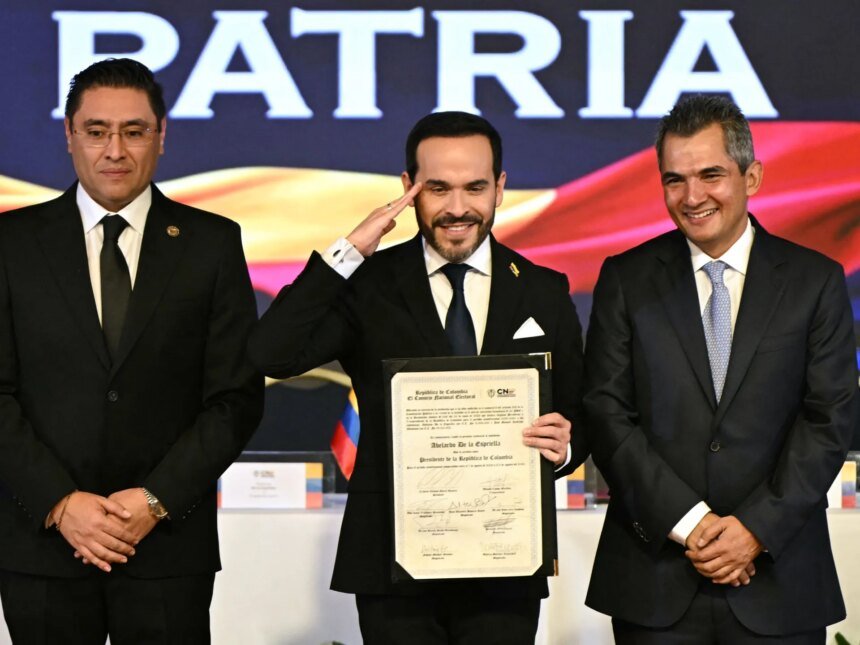
He was neither a movie star nor a veteran party leader, yet he entered the presidential palace amid massive displays of giant screens, fireworks and bulletproof glass platforms. Thus, Abelardo de la Esprilla, nicknamed “The Tiger,” announced his arrival to power in Colombia, after an exceptional journey that began in the courtrooms, passed through the world of finance and media, and ended with an electoral victory that reflects the rise of a new wave of the extreme right in Latin America.
A report by Al Jazeera indicates that de la Esprilla was born in the capital, Bogota, in the late 1970s, but he grew up in the city of Montería, in the north of the country, a city that played a pivotal role in shaping his political and intellectual personality. The city, located in the province of Cordoba, is a stronghold of large landowners, and its name was associated during the 1980s and 1990s with the rise of right-wing militias and one of the bloodiest stages of Colombia’s internal conflict.
In that environment, the influence of former President Alvaro Uribe, the godfather of the Colombian right and a friend of de la Esprilla’s father, was strongly present. As for his father, he combined law and politics, as he worked as a lawyer, a local representative, and then a judge, which opened the doors to the political and economic elite for his son from an early age.
The true source of power
De la Esprilla narrates that his father did not push him to study law for love of legal texts, but rather to master the art of persuasion and communication, a skill that he believed since his childhood was the true source of power. At the age of ten, he presented a radio program on “Voice of Monteria,” and only two years later he appeared on a television program on the “Telecaribe” channel, beginning the journey of building his media presence early.
After graduating from the Faculty of Law at Sergio Arboleda University in 2000, he opened a small law office in the capital, Bogota, but his name quickly rose to prominence when the government of Alvaro Uribe began a program of negotiations with right-wing militias to disarm them in exchange for reduced sentences.
At that stage, the young lawyer saw an exceptional opportunity, so he took up the defense of a number of the most prominent militia leaders, demanding that they be dealt with as political parties, not criminals, and opposing their extradition to American judiciary, a position that sparked widespread criticism that was considered to be in the interest of persons wanted by the United States.
But these cases opened the doors to both fame and fortune for him. In just two years, his company’s revenues jumped from 11 million pesos (about 5,500 dollars) to 2 billion pesos, or about a million dollars at the time, turning him into one of the most famous and richest lawyers in Colombia.
As his influence expanded, his name was associated with the defense of controversial figures, from representatives who were convicted of ties to right-wing militias, to David Murcia, the mastermind of the largest pyramid fraud operation Colombia has ever witnessed, to businessman Alex Saab, who is accused of managing a financial network for the regime of Venezuelan President Nicolas Maduro, a case that pursued him even after he reached the presidency.
Despite the criticism, de la Esprilla adhered to his defense of his professional record, stressing that every accused has the right to a lawyer to defend him, denying his knowledge of any illegal connections between his clients.
In parallel with his professional success, his economic empire expanded, and he opened branches of his company in Bogotá, Barranquilla, Medellin, and Miami. He said that he was receiving between one million and three million dollars per case. Cambio magazine also described him as the only lawyer in Colombia who owns a private plane.
Not only did he practice law, but he turned his name into a brand that includes luxury clothing, restaurants and drinks, released two albums, and wrote 5 books, in an attempt to build the image of a successful, multi-talented businessman.
However, this image was called into question after a press investigation that tracked 35 companies linked to him in Colombia, Panama, and the United States, which concluded that most of them suffered losses and debts, estimating his actual wealth at about $5 million, a number that is far less than the image he sought to establish.
Defenders of the homeland
But money and fame were not the end of his ambition. In 2023, he founded the “Defenders of the Homeland” movement, and announced his candidacy for the presidency despite his lack of any previous political experience, raising the slogan, “Politics needs more businessmen and fewer politicians.”
He campaigned with extreme right-wing rhetoric, inspired by the experiences of Argentine President Javier Mele, El Salvador’s President Nayib Bukele, and US President Donald Trump, who expressed explicit support for him, describing him as a “smart, strong, and strict leader,” and calling on Colombians to elect him.
De la Esprilla pledged to bomb the camps of armed groups, build 10 giant prisons, and eliminate drug gangs within 90 days, in addition to cooperating with the US army to stop drug smuggling, and opening the oil sector to foreign investments, in a clear break with the policies of outgoing President Gustavo Petro.
This discrepancy extended to foreign policy. At a time when Petro’s government took positions supportive of the Palestinians, which included severing relations with Israel, suspending the purchase of weapons from it, banning the export of coal to it, and joining South Africa’s lawsuit before the International Court of Justice regarding the war on Gaza, de la Esprilla pledged to rebuild the alliance with Israel, move his country’s embassy to Jerusalem, and defend what he described as Judeo-Christian principles.
Despite his victory by a margin of no more than one percent of the vote, Al-Nimr’s rise to the presidency is not seen only as a local event, but rather as a new episode in the wave of the rise of the populist and extreme right sweeping Latin America, driven by voter anger at traditional elites, security and economic discourses, and the support enjoyed by candidates who present themselves as men from outside the political establishment.
The question remains today: Will “The Tiger” succeed in translating his promises into reality, or will his rise to power be the beginning of a difficult test for a man who came from the world of the courts to the presidential palace?