

Features of old tension are renewed in East Asia, but in different patterns, as the Sino-Japanese relationship, burdened by the legacy of World War II, returns to the forefront with escalating mutual suspicions.
While Tokyo seeks to redefine its military role, Beijing views these moves through the lens of history and national security, raising questions about whether the region is headed toward a new arms race.
Read also
list of 4 itemsend of list
The Chinese media is following Japanese moves as indicators of a change in the regional security structure and the possibility of the region sliding toward military buildup, as every Japanese step is read in a broader context than being a “traditional defense modernization” or a reset of Tokyo’s position in the Asian deterrence equation.

From the restrictions of peace to militarization
The People’s Daily newspaper pointed out that Tokyo is using the rhetoric of “surrounding threats” to justify raising defense spending to more than 3% of GDP within 5 years, bypassing the principle of “pure defense” which has formed the core of Japanese security policy since 1945.
The newspaper links this path to the passage of a package of laws allowing the expansion of the role of reserve forces and the integration of intelligence systems under the direct authority of the Prime Minister, in a step that can be placed within the framework of an attempt to build a “comprehensive national military system.”
An analysis published by the NetEase news website also indicates that these transformations are taking place in light of a confrontational political discourse adopted by the current Japanese Prime Minister, Sanae Takaichi, especially with regard to linking the “Taiwan issue” directly to Japanese security, which is seen in Beijing as a departure from the consensual framework that has governed relations since the signing of joint political documents between the two countries.
Military-economic geography
In operational depth, Minamitori Island stands out as a symbol of a qualitative shift in Japanese military deployment, as a report by the Chinese Huanqiu newspaper explains that building the first testing field for missiles with a range exceeding 100 kilometers, and deploying Type-12 anti-ship missile platforms there, aims to solve the complex of testing offensive weapons locally, away from external pressure and oversight.
The Paper newspaper adds that the island is practically turning into an advanced firepower in the Western Pacific, by linking it to a missile network with a range of up to 1,000 kilometers, including hypersonic systems under development, which creates a new depth of deterrence capabilities and strikes far from main Japanese territory.
This structure does not only serve the military dimension, but is also linked to the issue of control over the island’s resources, such as rare earth elements, which may exceed 16 million tons according to research estimates, which means adding an economic element to the tension.
Threat to aircraft carriers
The Paper expands on the development of the Japanese multi-domain combat system, from long-range Type-25 missiles, to hypersonic glide missile projects with a range exceeding 2,000 or 3,000 kilometers, all the way to the government’s consideration of introducing unmanned submarines capable of carrying torpedoes and sea mines.
The report quotes military experts that these capabilities are formulated within the vision of an “anti-aircraft carrier system,” in which the system of satellites, aircraft, ships, unmanned submarines, and long-range missiles is integrated, forming an attack network that can target military bases and major naval formations.
With the documentation of cases of extensive Japanese reconnaissance, and the simulation of the attack on the aircraft carrier “Liaoning” during its exercises on the high seas, Japanese behavior – in Beijing’s eyes – has become a transition from the observation phase to a “practical test” of the effectiveness of the new deterrence systems.
Colonel Chen Xi:
Increased military spending, easing arms export restrictions, development of long-range missiles, and attempts to amend the constitution make Japan a “powder keg” in the Asia-Pacific region.
Alliances and the internationalization of tension
The People’s Daily’s coverage also highlights the scale of joint exercises between Japan and the United States, such as “Heroic Shield 2026” and “Resilient Dragon 2026,” which included island attack and defense scenarios, long-distance naval warfare, and a naval closure of large areas in the Western Pacific.
This type of training, in addition to opening bases to American medium-range missiles, is read in the Chinese media as transforming Japan’s functional role into an “advance base” within a broader containment network targeting China.
At the same time, Chinese media reports highlight Tokyo’s efforts to expand arms exports, through its offers to the Philippines, Australia and New Zealand, which reinforces the idea of building “small alliances” of military partners around China, and linking their defense interests to the products of Japanese military industries.
Arms race or regaining position?
And describe Statements by Chinese Ministry of Defense spokesman Colonel Chen Shi – as reported by the Huan Chiu newspaper – stated that Japan is turning into a new “powder keg” in the Asia-Pacific region, with successive steps to increase military spending, ease arms export restrictions, develop medium- and long-range missiles, and attempts to amend the peaceful constitution.
As for the Chinese Foreign Ministry, it believes, through statements by spokesman Guo Jiaqun, that bilateral relations are going through “serious difficulties” caused by Tokyo’s moves in the Taiwan and regional security files, while warning that continuing this behavior may open the door to questioning the legitimacy of the Japanese political approach, especially if it comes close to reproducing “old militarism” patterns or engaging in a new form of it.
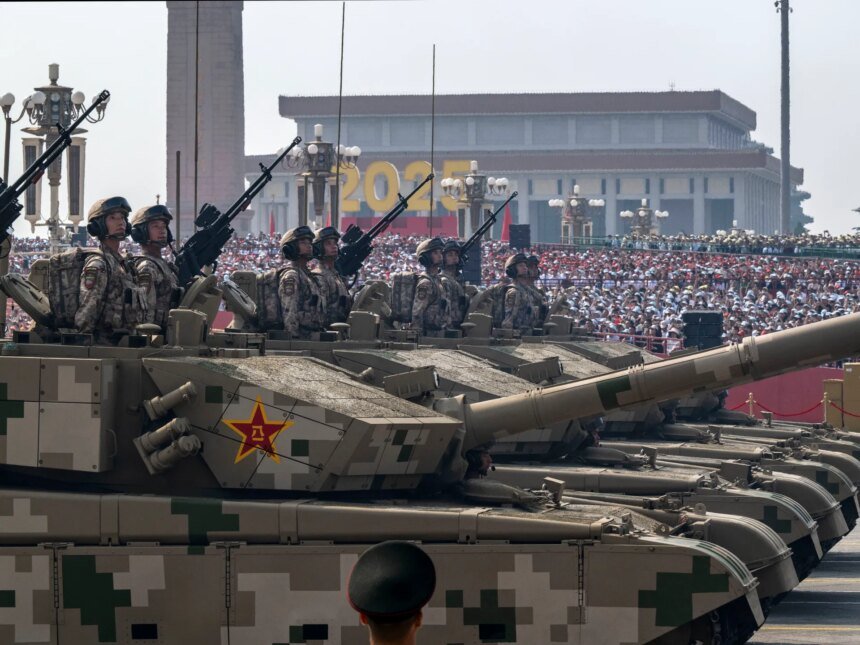
In light of this reading, the Japanese moves are not presented as an innocent defensive repositioning, but rather as part of a broader dynamic that may lead to a regional arms race, especially if China responds with corresponding steps to offset what it sees as a growing threat near its maritime borders.
However, the outcomes of this path remain dependent on the parties’ ability to control escalation and avoid miscalculation, and on whether Tokyo will continue to expand its military margin, or will seek a balance between strategic ambition and the requirements of stability in a highly sensitive environment.