

Tehran – In light of the increasing military escalation between Washington and Tehran following attacks targeting oil tankers in the Strait of Hormuz, the US Treasury Department withdrew the temporary general license it had granted last month to lift oil sanctions on Iran, which raises a question mark about the repercussions of the step on the Iranian oil sector in the coming period, and on Tehran’s markets today.
On a field tour in Tehran’s markets and streets, Al Jazeera Net’s correspondent observed a mixture of signs of anxiety, dissatisfaction, and indifference among citizens, a large segment of whom hoped that the oil exemption would constitute a window of hope to breathe life into the exhausted economy, while another group of them believed that their country had become accustomed to sanctions and that “the path forward does not pass through Washington.”
Read also
list of 4 itemsend of list
In a scene that reflects the division of the Tehrani street between those who bet on diplomatic paths and the policy of openness to the world and those who cling to the option of resistance and the language of force, financial market indicators in the wake of the issuance of the American decision revealed the extent of the shock, as the exchange rate declined from one million and 740 thousand riyals to one dollar yesterday evening, Tuesday, to one million and 810 thousand riyals as of Wednesday afternoon, with expectations of a continued pace of decline in the value of the national currency.
Exchange rate
In the exchange market on Ferdowsi Street in central Tehran, Kambiz (39 years old and works as a money changer) noted the unprecedented acceleration of the rise in the price of the dollar since this morning, adding that the decline witnessed in the price of the dollar after the signing of the recent memorandum of understanding between Iran and America was imaginary, as the price quickly returned to what it was, and this confirms that the market does not trust these temporary agreements.
In an interview with Al Jazeera Net, he explains that despite the rise in the price of the dollar, the market has entered a state of anticipation and relative stagnation, due to the weekend, as customers usually wait for Saturday transactions until the fate of the tension becomes clear until then. However, he quickly adds that Trump’s recent threats have increased speculation of continued tension and an escalation of the exchange rate, anticipating new peaks for the dollar in the coming days and weeks.

Stock market
As for the Tehran Stock Exchange, the indicators witnessed sharp fluctuations that reflect the state of anticipation experienced by investors, as the market’s performance fluctuated between ups and downs. After the general index recorded an increase of more than 120 thousand points in yesterday’s session, the market today faced an intense wave of supply that led to its decline by 24,741 points, to settle at the level of 5 million and 286 thousand points. The equal-weighted stock index also fell by 5,419 points to reach 1 million and 384 thousand points.
For his part, Yasser, a stock market activist, explained, “The Tehran Stock Exchange started today’s session on a balanced note, and even returned to the green zone temporarily with the decline in military tensions during the morning hours, but things turned upside down with Trump’s announcement of ending the framework agreement with Iran.”
Regarding his expectations for next Saturday’s session, Yasser continued in his speech to Al Jazeera Net, that the market stands at a crossroads: If tensions calm down and Washington withdraws from its position, we may witness a recovery and a return to a positive trend, but if the escalation continues, Saturday will be a bloody day with severe downturns that may exceed what we saw today.
Previous box
On Hafez Street, east of the capital, Tehran, Al Jazeera Net met Iranian citizen Hoshanak (62 years old, an employee in the Ministry of Education), who considered Washington’s decision to cancel the oil exemption “a return to a square of no understanding” and suggested that the release of frozen Iranian funds would likely be frozen as a result, which will leave the memorandum of understanding merely a fragile framework for managing navigation in the Strait of Hormuz in exchange for continuing to ease the blockade on Iran and reducing the pace of the war in Lebanon.
While Hoshang warned that the continuation of skirmishes in the Strait and mutual attacks could lead at any moment to the collapse of this entire framework, he expressed his hope “if Tehran had waited a little in responding to the American behavior in the Gulf waters until the funeral and burial ceremony for the body of former Supreme Leader Ali Khamenei was completed.” He accused Israeli Prime Minister Benjamin Netanyahu of betting on the collapse of the agreement between Tehran and Washington to redirect the policies of US President Donald Trump towards further escalation.
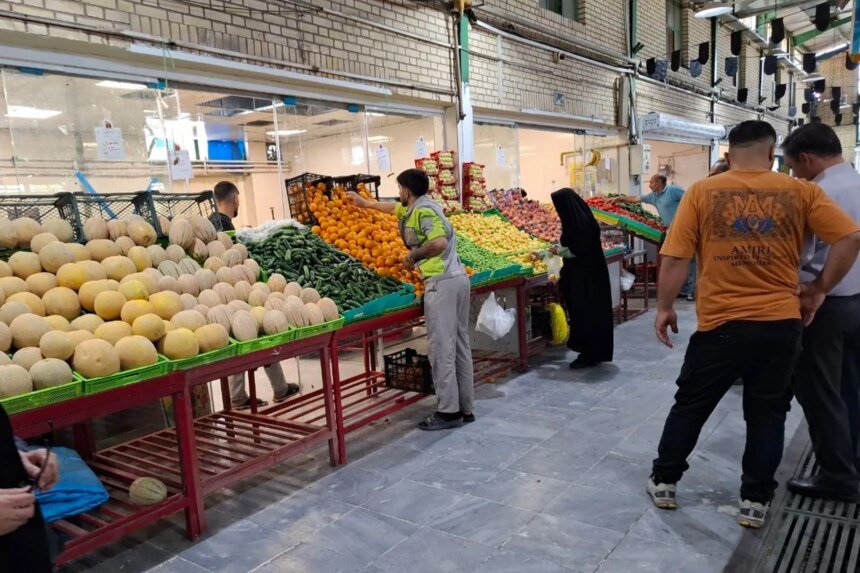
In order to determine the repercussions of canceling the oil exemption on prices, Al Jazeera Net spoke with a number of citizens and grocery owners in Tehran, and it became clear that the prices of basic commodities and foodstuffs, as well as fruits and vegetables, did not have immediate repercussions as a result of the American decision, while imported goods recorded an almost immediate increase in proportion to the change in the exchange rate.

Basic commodities
Mah Laqa (36 years old), a housewife and mother of a child, says: So far, we have not witnessed any change in the prices of vegetables and fruits or basic materials, because the government controls the prices of these goods directly, but everyone knows that this stability is temporary. Mah Laqa added in her interview with Al Jazeera Net, “The problem is not in the first day, but in the coming weeks. When the dollar rises, its impact must reach us, even after a while.”
In another corner of one of the markets, the young man Parviz (26 years old, owner of a food store) offers a different reading. He says, “Food and basic commodities are still at yesterday’s prices, but do not be fooled by that, as government support hides the true picture, and the problem is that some merchants will raise prices as a precaution, even if the cost of the commodity does not change.” He added – to Al Jazeera Net – that “any increase in the price of the dollar will eventually be reflected in everything, and the question before us as sellers is: when will we be forced to raise prices, not “Are we going to have to?”
Imported goods
In the electrical goods market, the scene was completely different, as the effects of the decision seemed immediate and severe.
One of the traders in the Bastan Electronic Appliances Market says, “Hours ago, the prices of imported home appliances such as refrigerators, washing machines, and air conditioners rose almost instantaneously, because they are denominated in dollars, so any movement in the currency price is reflected directly on the bill,” adding, “Customers today compare prices with astonishment, and many of them hesitate to buy, while others rush to buy what they need before an additional rise.”
The store owner adds, “It is true that we imported these goods at lower exchange rates, but the distributors raised the prices today based on the new dollar price, under the pretext that the upcoming quantities will cost them more,” indicating that if he sold his goods at the previous prices, he may not be able to buy other goods because of the expected insane rise in the dollar in the event of a return to war.

Oil sector
As for the repercussions of the step on the Iranian oil sector, an analysis published by the “Eqtisad Online” website, which specializes in economic affairs, considered that the cancellation of the previous exemption practically closed the short-term window for Iranian oil exports before the suspended shipments were able to find a buyer for them, indicating that the new license gives only 10 days to settle previous transactions, on the condition that their proceeds are deposited in frozen accounts within the United States, which deprives Tehran of any immediate cash liquidity.
According to the same analysis, which did not mention the name of its author, “Iran was unable to exploit even the short exemption period,” based on reports indicating that there were between 58 and 68 million barrels of Iranian oil “stranded on ships,” with “an 18% growth in shipments without a specific destination within one week.”
The economic analysis concluded that Iran, with the closure of official sales routes, faces two main options:
- The first is a return to the informal and gray market using “shadow tanker fleets, ship-to-ship transfers, and attempts to hide the origin of cargo,” which raises transportation and insurance costs and increases the risk of confiscation.
- The second is to increase discounts to attract risky buyers, especially refineries that may accept the risk of purchasing Iranian oil at competitive prices, but this will put Iran in fierce competition with Russian and Iraqi oil, which also offer discounts.
The analysis warned that “failure to achieve the oil revenues expected in the budget, and the blockage of official funds transfer routes, will increase pressure on the exchange rate in the local market,” with “a direct impact on inflationary expectations in the medium term.”