

Published On 7/7/2026
Since its launch in December 2014, the Japanese probe Hayabusa2 has become one of the most successful asteroid exploration projects in the history of space science. He succeeded in collecting samples from the asteroid Ryugu and returning them to Earth in 2020, an achievement that made Japan at the forefront of countries capable of returning materials from a celestial body to terrestrial laboratories.
Today, the probe adds a new achievement to its record, after it approached the asteroid “Torifune” and took high-resolution images of it during a quick pass that is considered one of the closest rapid flybys carried out by a spacecraft around an asteroid.

The Japanese Space Agency (JAXA) announced that the probe succeeded in carrying out the flight as planned, and sent the first scientific images to the control center, in a step that gives researchers a new opportunity to study small objects near the Earth.
Read also
list of 2 itemsend of list
Images reveal a bilobed asteroid and a striking thermal contrast
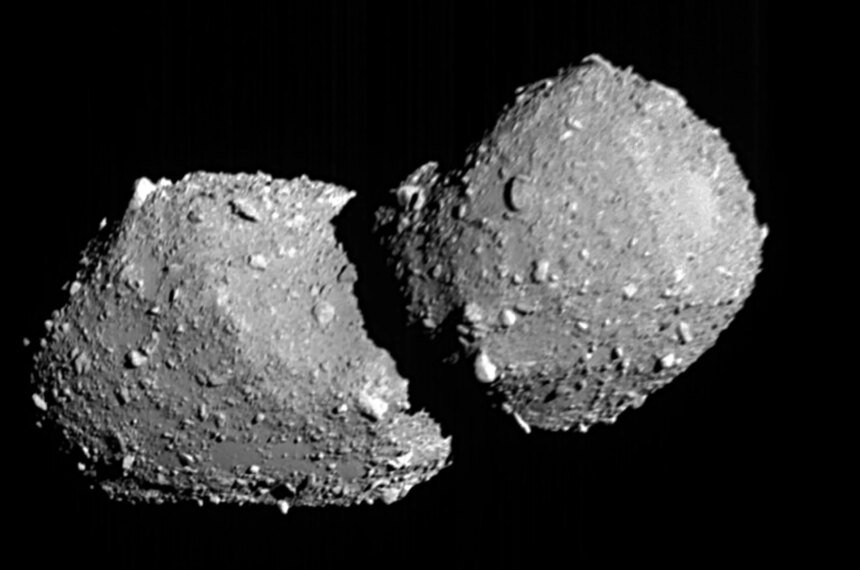
The probe made its pass near the asteroid “Torrefoni” on July 5, 2026, while the object was about 100 million kilometers from Earth. The diameter of the asteroid is about 450 meters, and it is characterized by a bi-lobed shape, as it appears as if two rocky bodies have fused together over time, a shape that was previously observed in a limited number of asteroids.
The probe’s optical camera captured a detailed image that showed a surface full of rocks and craters of different sizes, while the mid-infrared camera was used to draw a thermal map of the asteroid.

This image revealed that the areas in the shadow are clearly cooler, while temperatures have risen in the parts facing the sun, which allows scientists to study surface roughness, thermal inertia, and the properties of the rocky material that makes up the asteroid.
JAXA confirmed that other scientific measurement data collected by the probe will be transferred to Earth during the coming period after processing.
A risky operation outside the original mission plan
Passing by “Torifune” was not part of the original plan for the “Hayabusa-2” mission, but was added later after the end of the main mission for “Ryugu.” Therefore, a member of the probe’s scientific team previously described the operation as a “high-risk operation” due to the limited information available about the asteroid before approaching it, and the possibility of surprises that might affect the safety of the vehicle or the quality of observation.
“Torrevoni” belongs to the Apollo asteroid group, a group that includes asteroids whose orbits cross the Earth’s orbit around the sun, which makes studying it of great importance for understanding the evolution of near-Earth asteroids, as well as for improving future risk assessment models.
The asteroid revolves around the sun once every 383 days (one year and 18 days), while it completes an orbit around itself approximately every 5 hours, which is information that helps scientists explain the distribution of heat on its surface and its geological nature.
Ryugu’s legacy continues to reveal the secrets of the solar system
This Hayabusa-2 mission is a natural extension of the probe’s great success with the asteroid Ryugu, as it returned samples from it to Earth in December 2020 after a six-year journey.
Since then, scientific studies on the samples have revealed valuable information about the beginnings of the solar system. Researchers have also found all five nitrogenous bases that are involved in the synthesis of the two nucleic acids, DNA and RNA, a discovery that has strengthened interest in studying asteroids as repositories that preserve primitive materials dating back to the origins of the solar system.

The probe’s journey does not stop there, as it is currently heading towards its final goal, the asteroid KY26 (1998 KY26), whose diameter does not exceed 11 meters, becoming the smallest asteroid visited by a spacecraft if the mission succeeds upon its expected arrival in 2031.
JAXA hopes that the probe will orbit this object and then attempt to land on its surface, providing unprecedented data on the structure of small asteroids and their internal cohesion.
Science is a never-ending journey
The success of Hayabusa-2 proves once again that space exploration is not limited to reaching planned goals, but extends to seizing new scientific opportunities even after the end of the original mission.
Each asteroid that is studied adds a new page to the story of the origin of the solar system, and enhances our ability to understand near-Earth objects and prepare for any future dangers. Investing in scientific research and space exploration is an investment in knowing our cosmic origins and creating a safer and more advanced future.