


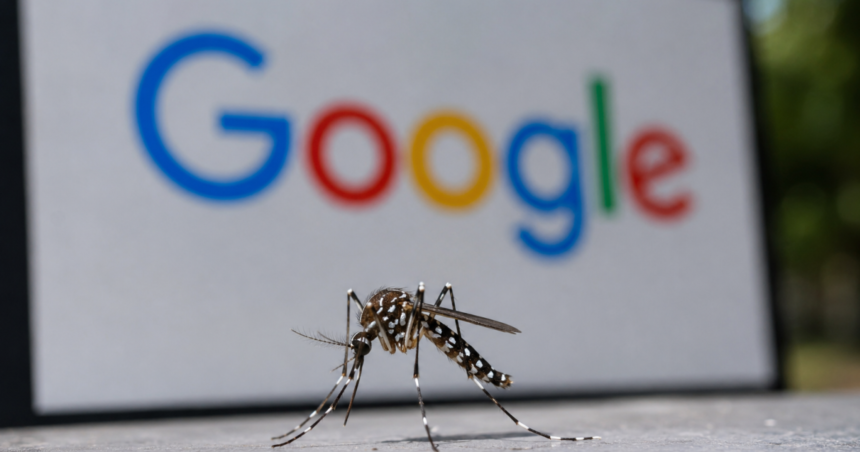
What is the best way to combat disease-carrying mosquitoes? The unexpected answer may seem to be to release more mosquitoes, but this is the approach adopted by researchers at the “Debag Project” of the giant technology company “Google”, which has entered the field of managing biological programs, to limit the spread of mosquito-borne diseases around the world by combining the expertise of software engineers, biologists, robots specializing in insect breeding and artificial intelligence techniques.
In an application submitted to the US Environmental Protection Agency, Google, through its parent company Alphabet, is seeking approval to allow it to release a total of 64 million sterile mosquitoes over two years in the states of Florida and California, with 32 million mosquitoes in each state during two successive phases, in a step that may seem at first glance closer to science fiction movie scenarios, but in reality it is part of its research program that aims to “stop bad insects by using good insects.”
Setting the goal
Although trying to reduce the number of mosquitoes by adding millions more seems like a contradictory idea, understanding the project requires distinguishing between two types of mosquitoes: the first is the type that scientists seek to eliminate, and the second is the type they intend to release into the environment. In short, it’s a battle between “good mosquitoes” and “bad mosquitoes.”
Despite their small size, mosquitoes are the most deadly animals to humans in the world, as they transmit a group of dangerous diseases such as dengue fever, yellow fever, West Nile virus, Zika virus, malaria, chikungunya, and other deadly diseases that cause the death and infection of millions of people around the world every year.
From this standpoint, the Debag Project seeks to limit the spread of these diseases by targeting a specific type of mosquito known as “Aedes aegypti,” whose harm is not limited to annoying bites, but is also capable of transmitting a group of dangerous viral diseases.
Chad Huff, Public Education and Information Officer for the Florida Keys Mosquito Control Authority, explains, “This targeted species of mosquito is not an indigenous part of the ecosystem in California or Florida. It is an invasive species that is native to Africa. It is believed that it arrived in the region centuries ago via ships, and has spread to nearly half of California’s counties since it was first detected there in 2013. Therefore, there are no animals that depend on it as a main food source.”
Speaking to Al Jazeera Net, Chad added, “This mosquito prefers to live in areas inhabited by humans, and reproduces in containers and small stagnant waters. Residential areas provide it with a large number of hidden breeding sites that are difficult to discover or reach, and humans also represent its preferred source of blood.”
According to the “Debag” program, about 40% of the world’s population is at risk of contracting diseases transmitted by this type of mosquito, which is active during daylight hours and has succeeded in invading tropical, subtropical, and even temperate regions around the world.
“Aedes aegypti represents only a small percentage of the total mosquito population in the region,” Chad points out. “However, it is responsible for transmitting most of the recorded diseases, and controlling it is a difficult task due to the nature of the habitats it chooses.”
He adds, “In contrast, the black salt marsh mosquito (Aedes taeniorhynchus) is the most annoying species of local mosquitoes, as it constitutes approximately 90% of the total mosquito population in the region, but it is often found in wide open spaces, which makes it relatively easier to treat and control.”
The sense of urgency to control this invasive insect has increased in California since 2023, when the state recorded its first locally transmitted cases of dengue fever. The following year, the number of local infections rose to 18, including 14 in Los Angeles County alone.
A recent study also found that about 18.2 million people in California, especially in the Central Valley, Los Angeles, and San Diego regions, live in areas where conditions are suitable for local transmission of dengue fever.
The study indicates that under moderate scenarios of climate warming and urbanization, an additional 4.1 million people may be at risk of exposure to the disease by the middle of this century. However, researchers stress that the risk of disease transmission now and in the future remains generally low, except for summer periods in the Central Valley and Southern California.

How does the “Mosquito Army” work?
The initiative relies on releasing large numbers of only male Aedes aegypti mosquitoes – which do not feed on blood, so do not bite humans, and do not transmit diseases – into natural mosquito populations.
Chad explains this plan by saying: “These males are infected with a bacteria known as Wolbachia, which is a bacteria that is naturally found in other types of insects, and affects the reproductive process, making the males unable to produce viable offspring.”
He adds, “When these sterile males mate with wild Aedes aegypti females that are already present in a certain area, the resulting eggs do not hatch, and no offspring result from this mating, because the females do not carry the bacteria themselves.”
According to Chad, this incomplete biological compatibility, and the resulting absence of offspring, leads to a gradual decrease in the number of females capable of biting in the targeted area, and thus a decrease in the number of bites to which humans are exposed, and a decrease in the chances of transmission of diseases transmitted by this type of mosquito.
The success of this strategy depends on an important biological fact, which is that most female mosquitoes only mate once throughout their lives, and when a single female chooses a male infected with Wolbachia bacteria, she lays more than a hundred unhatched eggs, without having the opportunity to produce other offspring later.
With up to 16 million male mosquitoes carrying the bacteria released annually in California, and another 16 million in Florida, over a two-year period, the cumulative impact of this process on the target mosquito population is enormous.
A well-known technology that is not without its challenges
Google’s approach is not unique. The company is based on a scientific method known as the “sterile insect technique,” which has been used for decades to combat various types of problem insects and is seen as an effective alternative to traditional chemical treatments.
Chad explains that “sterile insect techniques, including the Wolbachia technique, represent an additional tool within a relatively limited set of available control methods,” noting that “they are currently used as a supplement to insecticides and not a complete substitute for them.”
The International Atomic Energy Agency describes this technology as “an environmentally friendly way to combat harmful insects,” and in recent years it has proven successful in controlling multiple pests, including the Mediterranean fruit fly, which was threatening large agricultural areas, and the new American screwworm, which attacks livestock and pets through open wounds, often leading to their death.
Although the technique has been successful with many agricultural insects, its application to mosquitoes is more complex. The main difference is that some agricultural pests, such as fruit flies or screwworms, only pose a threat to crops, while mosquitoes can transmit serious diseases to humans.
Chad points out that the use of this technology faces increasing challenges, including the ability of this type of mosquito in many regions of the world to develop resistance to some insecticides that are widely relied upon over time, so the existence of another method that does not depend on pesticides is desirable and necessary.
He added, “There are other biological obstacles that complicate the task of controlling this species, as mosquitoes have very high reproductive rates, and their breeding habitats are practically difficult to discover and completely eliminate,” stressing that “some sterilization methods may negatively affect the lifespan of mosquitoes, while effective programs require the release of very large numbers of males for every wild female present in the environment.”
He explains, “Unlike the sterile insect programs used with agricultural pests, mosquito control programs rely on releasing males only. This makes mass breeding operations, especially separating males from females, more difficult, time-consuming and more expensive.”
This is why Google seeks to employ technology, artificial intelligence, bioengineering, and data science to reduce the number of disease-carrying mosquitoes. Debag researchers are working to develop technologies based on sensors, algorithms, and advanced engineering to separate males from females quickly and with high accuracy before they are released, to ensure that female mosquitoes do not leak into the batches designated for release.

Not the first attempt
In 2014, Google began studying ideas to address the global mosquito problem. In approximately the same period, Google Life Sciences, which later became known as Verily, was founded with the aim of solving complex problems in science and biology and contributing to the prevention of diseases and other global health problems.
The current request represents an extension of previous efforts by the Debag project, which was officially launched about a decade ago to explore technology-based solutions to combat mosquitoes that transmit deadly diseases. About a year later, it announced a partnership with MosquitoMate, a company specializing in mosquito control technologies.
In 2017, Verily – which had previously been a frontrunner behind the DEBAG program for many years – released 14.4 million male Wolbachia-infected mosquitoes into three residential neighborhoods in Fresno County, California, which is an ideal location for such programs, as it contains some of the oldest and largest populations of Aedes aegypti mosquitoes in the United States.
A study published in 2020 stated that during the peak of the mosquito season, the number of females decreased by 95.5% in release areas compared to areas that did not witness releases, while the percentage of decline in the most geographically isolated neighborhoods reached 99%.
The DEEBAG project has also achieved promising results in Singapore, which has become the initiative’s first international research and development center, and since 2018 has been supporting the Singapore National Environment Agency’s Woolpacia project.
According to a blog post published by the project on May 11, 2026, the release of millions of sterile male mosquitoes helped reduce the number of Aedes aegypti mosquitoes by between 80 and 90%, in addition to reducing the incidence of dengue fever by more than 70% during a period ranging between 6 and 12 months of regular releases.
A study published in the April issue showed that in 2025, Singapore recorded the lowest number of dengue fever cases since 2018. Based on these results, Google announced the expansion of its operations there last May.
Google is not the only entity using Wolbachia bacteria to combat diseases. The Global Mosquito Programme, run by Australia’s Monash University, applies similar strategies in 15 countries across Asia, Oceania and the Americas, and confirms that no dengue outbreaks have been recorded in areas where the bacteria’s prevalence is high.
Environmental and ethical debate
The most controversial question remains: Do humans have the right to interfere with nature in this way? Is it acceptable to reduce the numbers of an entire species of organisms just because we have the technical ability to do so?
For many entomologists, using bacteria for sterilization represents a promising solution, especially with the increasing resistance of mosquitoes to conventional insecticides, a phenomenon that occurs when intensive use of pesticides leads to the survival and reproduction of more resistant individuals, in a way similar to the development of bacterial resistance to antibiotics in humans.
Some believe that this technology raises much fewer concerns compared to genetically modified mosquitoes, which have been the subject of widespread controversy in the region, as they have been associated with negative impressions and rumors about what has been called “Frankenstein mosquitoes,” while Wolbachia is a registered product and is already found in some species of mosquitoes.
The potential environmental risks of this technology remain limited as long as targeting remains limited to invasive species that pose a real threat to human life and require the intervention of competent authorities to reduce their effects. However, this approach is not a comprehensive way to eliminate all mosquito species, as targeting local species may lead to a series of unexpected environmental impacts as a result of disturbing existing natural balances.
Despite the potential benefits, some experts, such as Stanford University law and bioethics professor Henry Greeley, have raised ethical questions about intentionally taking steps that could lead to the extinction of a biological species, stressing the need to hold a broad societal debate and reach social consensus about such decisions.
On the other hand, Chad asserts that “protecting public health remains the top priority of modern mosquito control agencies, including the Florida Keys Mosquito Control Authority.” He points out that “during the limited experiments carried out by the Authority, no negative environmental effects resulting from the use of these technologies were recorded or documented.”
He explains that “current control measures do not aim to eliminate any specific species, but rather to reduce its numbers to levels that are safe and acceptable for residents and visitors.” Pointing out that “all sterile insect programs target invasive invasive species that were not a natural part of the local ecosystem to begin with.”
Another team of scientists believes that humans bear a moral and practical responsibility to control this type of mosquito and limit its spread, especially since humans themselves have historically contributed to its spread around the world through trade and human movements, as well as the appropriate climatic conditions from which it has benefited to spread around the world.
So far, the timeline for the mosquitoes’ release remains unclear. US federal records indicate that the Environmental Protection Agency is currently reviewing the company’s application, and is currently receiving public comments and comments on the project until June 5, 2026.
While final US approval is still awaited, documents submitted indicate that Google was hoping to begin large-scale launches from the year following approval.