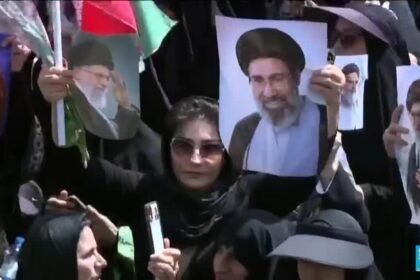


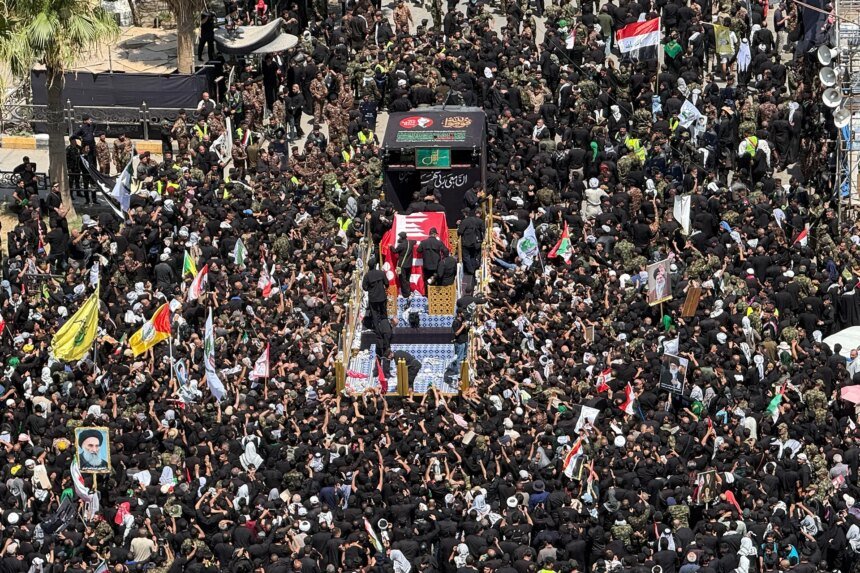
Najaf/Karbala- With the first streaks of dawn, the city of Najaf woke up to an exceptional day. The streets, which used to receive millions of visitors on religious occasions, wore a different scene this morning, with Iraqi and Iranian flags fluttering along the roads, and pictures of the late Iranian leader Ali Khamenei filling the squares.
Early, thousands of mourners lined up waiting for the coffin procession to pass on a farewell journey through the city to Karbala, before heading to the city of Mashhad in northern Iran, where it will be buried.

Human wave
At six o’clock in the morning, the convoy set off, which included a truck carrying Khamenei’s coffin wrapped in the Iranian flag. Crowds gathered around him, and some tried to approach him to touch him, while others carried pictures of him as well as pictures of Iranian leaders and others from the “resistance axis” led by Iran.
The truck moved from the Imam Ali Bridge in Najaf, making its way among the crowds of mourners, through Al-Sadrin Square and the 20th Revolution Bridges, all the way to Al-Midan Square, before reaching the shrine of Imam Ali bin Abi Talib, where the first farewell ceremonies were held.
At each stop on the procession’s route, the scene looked like a continuous human wave. Men and women, old and young, came from different Iraqi governorates, along with visitors from outside the country, to participate in the funeral ceremony, which is one of the largest the two cities have witnessed in recent years.
Mr. Muhammad Taqi al-Hakim, one of the senior professors of the Supreme Religious Seminary, prayed at the funeral, with the participation of the two sons of the supreme religious authority, Mr. Ali al-Sistani. The prayer was held in the honorable Haidari courtyard inside the shrine of Imam Ali bin Abi Talib in Najaf.
Next stop
At four o’clock in the afternoon, Khamenei’s coffin was transported to the city of Karbala by an Iraqi army helicopter to begin the ceremony of the second leg in Iraq, where the procession roamed the streets of the city, starting from the “Sayyid Judah” intersection, then the governorate street “the court intersection”, towards the shrine of Imam Hussein bin Ali, and then the shrine of his brother Abu Abbas.
There, the scene was no different: waves of people were waiting for the funeral of Khamenei and his family, and mourners wailed and cried with their bodies between the two shrines.
Between Najaf and Karbala, queues of mourners and members of the Popular Mobilization Forces extended on both sides of the roads, while Husseini processions continued to provide services to the arrivals, in a scene similar to the organizing methods that accompany the millions of visits, especially in the months of Muharram and Safar of the Hijri year.
The two cities have a special religious status among Shiite Muslims in the world, which gave the funeral ceremony a dimension that goes beyond the limits of the funeral event, becoming an occasion that attracted wide popular and official attention.

Advance preparations
Preparations did not begin with the arrival of the coffins, but were preceded by extensive security, service, and organizational arrangements days before. In Najaf, pictures of Khamenei and Iraqi and Iranian flags spread in the streets and squares, while red carpets were spread in a number of locations designated for receiving delegations, in addition to preparing reception halls and platforms for the ceremonies.
The Iraqi authorities also prepared plans to organize the movement of crowds and secure the roads leading to the holy shrines, while deploying large numbers of security forces along the funeral route to secure the ceremony, coinciding with the arrival of official and religious delegations from inside and outside Iraq.

High official participation
The funeral ceremony witnessed a prominent Iranian official presence, as Iranian President Masoud Pezeshkian headed the official delegation accompanying the body of the late Iranian leader. The delegation included Parliament Speaker Mohammad Bagher Qalibaf, Foreign Minister Abbas Araqchi, Quds Force Commander Ismail Qaani, and a number of prominent Iranian figures.
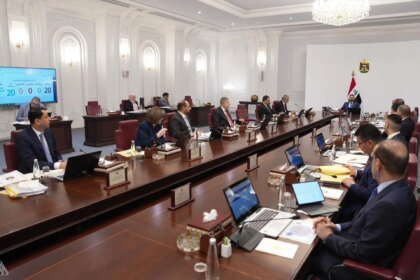
Immediately upon Bazashkian’s arrival at Najaf airport, he was received by Iraqi Prime Minister Ali Al-Zaidi, who stressed the depth of relations between the two countries and the keenness to enhance and strengthen them in various fields.
For his part, Pezeshkian expressed his country’s thanks for the “honorable” position of the Iraqi government and people, and for the efforts and facilities provided to hold the funeral ceremony, and extended an invitation to Al-Zaidi to visit Tehran, in order to activate more bonds of cooperation and partnership in facing the challenges.
The commander of the Iranian Quds Force, Ismail Qaani, who also participated in the ceremony, praised the arrangements made by the Iraqi authorities, considering that they reflect the level of coordination between Baghdad and Tehran to make the event a success.
The leaders of the Coordination Framework, the head of the State of Law Coalition, Nouri al-Maliki, the Secretary-General of the Badr Organization, Hadi al-Amiri, the Secretary-General of the Asaib Ahl al-Haq movement, Qais al-Khazali, and the head of the Wisdom Movement, Ammar al-Hakim, along with the leader of the Taqaddam Party, Muhammad al-Halbousi, the head of the Supreme Judicial Council, Faiq Zaidan, as well as a number of other political leaders, also participated in the reception.
The Popular Mobilization Forces announced that the number of mourners for the body of the late Iranian leader Ali Khamenei in Karbala exceeded 4 million participants, based on preliminary estimates.
Coinciding with the funeral ceremony, the Iraqi government declared Wednesday, July 8, an official holiday throughout the country, in a move aimed at facilitating the movement of participation in the ceremony, as well as supporting security and organizational measures for the event. The Iraqi Ministry of Communications issued a postage stamp on the occasion of the funeral.

How does the Iraqi station end?
After holding a farewell ceremony in Najaf and then Karbala, the convoy will continue its final journey to the city of Mashhad in northern Iran, where the late Iranian guide Ali Khamenei will be laid to rest.
The burial ceremony was postponed during the past months due to the security conditions that accompanied the American-Iranian war, before a temporary ceasefire was reached, which allowed the current funeral ceremony to be organized.
On February 28, 2026, Iranian Leader Ali Khamenei was assassinated in a joint American-Israeli air strike that targeted his compound in the Iranian capital, Tehran, as part of a wide wave of raids that targeted Iranian leaders and facilities during the war.