

Al Jazeera correspondents
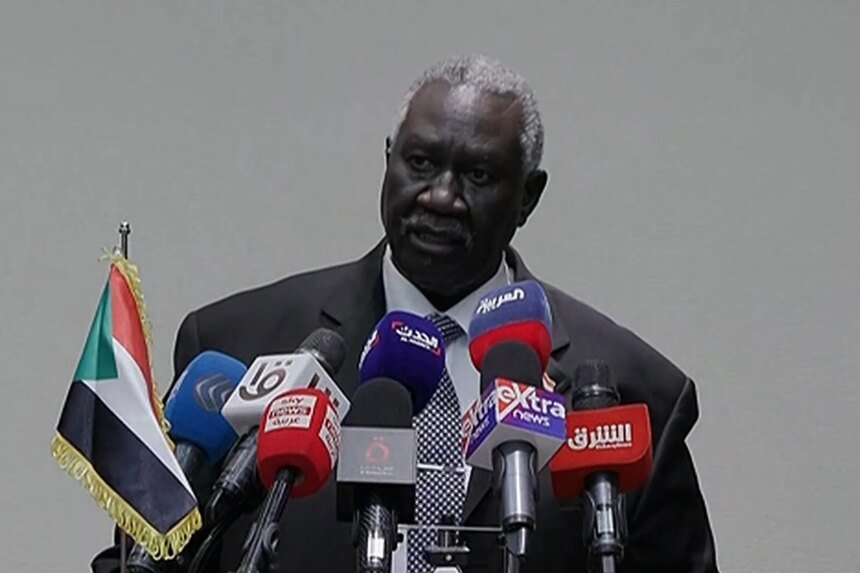
Khartoum- The Vice-President of the Sudanese Sovereignty Council and the head of the Popular Movement-North, Malik Aqar, presented a paper to the political and civil forces to resolve the Sudanese crisis through a Sudanese dialogue to discuss the issues of disagreement between the parties.
Al Jazeera Net obtained a copy of the paper that Malik Agar – in his capacity as head of the Popular Movement – handed over to the Sudanese parties and asked for a response to it before holding a consultative dialogue on the nature of the war and the controversial issues that obstruct the peace process and the questions of the day after the war.
The paper suggests that the dialogue or a series of meetings begin “away from polarization and media noise,” with a basic and unavoidable question: “What is the position on the nature of the current war in Sudan? Is it a war between the army and the Rapid Support Forces, or a war against the state, or a war between two political and social projects, or a war that reflects a struggle for contradictory visions for the future of Sudan?”
The paper considered these points to be the most complex questions, and getting closer to a common understanding of the nature of war is the necessary gateway to any understanding on how to end it and build sustainable peace.
Controversial issues
According to the paper, after agreeing to describe the nature of the war, the dialogue addresses the five issues that remained the core of the dispute between political parties and civil society organizations, which are:
- The position of the army and its leadership.
- The position on the Rapid Support Forces, factions and military formations.
- The position on Islamists.
- The position on the role of the regional and international community.
- And the position on how Sudan is governed (the relationship between the center and the margins).
The paper calls for a distinction between the military and political tracks to avoid confusion:
- The negotiation path between the army and the Rapid Support, which is primarily technical and professional, as expressed by the Jeddah platform, is concerned with a ceasefire, security arrangements, protection of civilians, and the delivery of humanitarian aid.
- The path of comprehensive political dialogue, concerned with the future of governance, the re-establishment of the state, the democratic civil transition, and issues of the constitution, justice and peace.
Mixing the two paths – according to the paper – complicates the political process and may be interpreted by political forces as a form of exclusion. The army should act as a guarantor of the transitional period by carrying out its security function and protecting sovereignty to prevent a slide back into chaos and violence until elections are held.
As for the political dialogue, it should remain inclusive of all Sudanese forces that declare their clear commitment to ending the war, dissolving the militias, the unity of Sudan, the nature of the civil state, democratic transformation, and the rejection of hate speech and violence, according to the paper.
External factor
The paper says that no serious national dialogue can ignore or underestimate the external factor in this war, as regional and international interventions, through financing, arming, political and media support, have become one of the most important reasons for prolonging the war and complicating its solution.
Restoring Sudanese national decision-making requires a clear stance against all forms of external support for parallel forces and militias, and a refusal to turn Sudan into an arena for settling disputes and proxy wars or engineering regional influence, according to the paper.
Aqar’s paper believes that the armed struggle movements that signed the Juba Peace Agreement in Sudan bear a special responsibility at this stage, adhering to security arrangements, and strengthening the unified professional national army. The popular movement he leads has moved forward in this regard and has achieved great progress in integrating its forces into the government forces.
She explains that it cannot be ignored that the implementation of security arrangements continues to face real obstacles from all parties, including the slowdown or obstruction of integration and demobilization procedures, and this issue should not remain a subject of mutual accusations, but rather it must be discussed transparently and responsibly between the government and the parties to the Juba Agreement, through a clear mechanism and a specific timetable, so that the security arrangements do not become a new source of tension, and accelerating the implementation of these arrangements will send a strong message to the people that “we are serious about ending the phenomenon of multiple armies.” “We are serious about building the state, not about staying outside it.”

Save Sudan
According to the initiative’s paper, ending the war cannot be reduced to military solutions alone, but rather requires stopping the war by dismantling its causes:
- Ending the multiplicity of armies.
- Restoring the state’s monopoly on arms.
- Protecting civilians and holding perpetrators of crimes accountable.
The war will also not stop – according to the paper – by weakening the state until it collapses, nor by excluding an entire component of society, nor by subservience to foreign powers. Rather, ending it requires political and moral courage, and a willingness to acknowledge mutual fears, search for common ground, and agree on a minimum level of national consensus that will save Sudan and reopen the path for the people to decide their future through a political process and free elections.
In his paper, Aqar expressed his conviction, after a long experience in government and the armed opposition, that the future of Sudan cannot be built on the multiplicity of armies, nor on the existence of armed movements outside the legitimacy of the state, nor on the continuation of weapons as a permanent means of achieving political goals.
He added that the war, which has been going on for more than 3 years, threatens the unity of Sudan, deepens the suffering of citizens in cities, villages, and displacement and refugee camps, and exposes state institutions to unprecedented risks.
Political leaders in the loyalist and opposition groups – with whom Al Jazeera Net spoke – avoided commenting on Malik Aqar’s paper before studying it and submitting their response to the initiator.