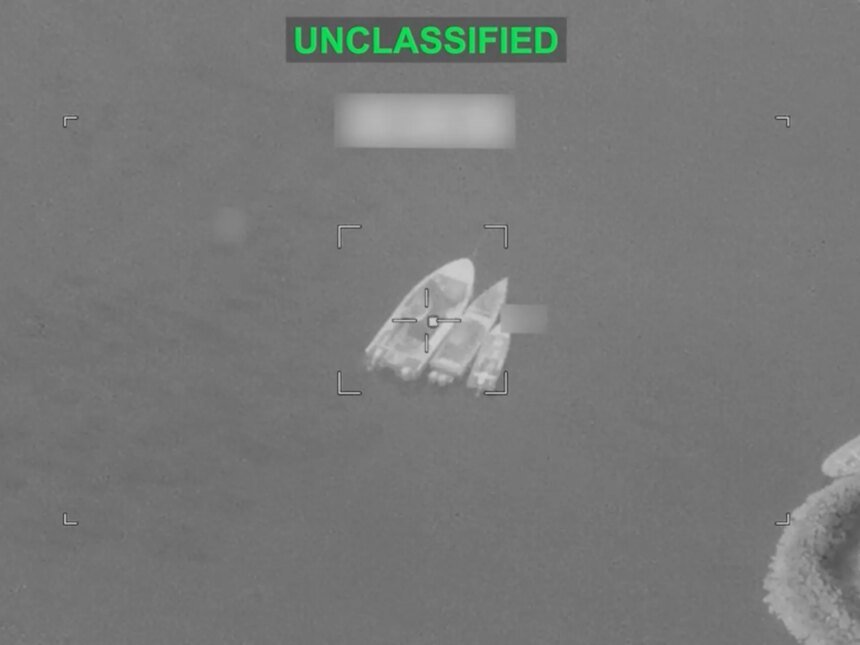
The United States of America launched strikes on Iran, at dawn on Wednesday, after 3 commercial ships were attacked in the Strait of Hormuz, which led to a new escalation and Iran targeting what it said were American facilities in Kuwait and Bahrain, amid Tehran’s accusation that Washington violated the Islamabad Memorandum of Understanding.
The US Central Command (Centcom) said that the US strikes, which it described as “retaliatory”, came in response to the Iranian attacks on three commercial ships that were crossing the Strait of Hormuz, threatening Iran to “pay a heavy price for targeting and attacking commercial ships.”
Iranian television reported that 6 explosions were heard on the Iranian island of Qeshm and 7 in the city of Sirik, and explosions were also heard in the coastal Bandar Abbas.
It was also reported, hours later on Wednesday morning, that several explosions sounded in the city of Bushehr and its surrounding areas.
What were the targets of the strikes?
The US Central Command explained that it targeted more than 80 sites with precision munitions.
It also indicated that the strikes targeted more than 60 small boats belonging to the Iranian Revolutionary Guard in and near the Strait of Hormuz, and also targeted Iranian air defense systems, command networks, coastal radar sites, and anti-ship missile capabilities.
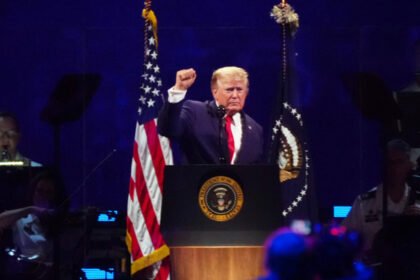
Axios had quoted an American official as confirming that President Donald Trump had approved a plan to strike Iran and issued an order for its implementation while he was in Turkey to attend the NATO summit.
The Iranian Ministry of Foreign Affairs reported that the American army’s attacks at dawn targeted a number of monitoring centers on the southern coast.
Iranian television said that American projectiles hit the commercial pier in Sirik and the fishing pier in the village of Ziart, in addition to hitting a commercial pier and another fishing pier in the city of Sirik in the south of the country, saying that the raids did not target military sites.
He also pointed out that the American attacks targeted the area where communications towers are located in Hormozgan Province, in the south of the country.
Regarding the losses, the security assistant to the governor of Khuzestan confirmed that one person was killed and two wounded in the American attacks on Mahshahr, Khomeini Port, and Hamidiya in southern Iran, while the Iranian News Agency indicated that a member of the Revolutionary Guard Navy was killed in the city of Mahshahr.
How did Iran respond?
After Washington launched raids on southern Iran, the Iranian Revolutionary Guard said on Wednesday that it targeted “dozens of American military facilities in Bahrain and Kuwait in response to the American strikes,” in a statement broadcast on state television.
The statement stated, “In an initial response to this aggression, the naval and aerospace forces of the Revolutionary Guard carried out a joint operation using missiles and drones, targeting 85 major American military facilities” in the two countries, and also shot down an MQ-9 drone, according to his statement.
The Revolutionary Guard stated that it “destroyed with missiles and drones 85 American military facilities at the headquarters of the Fifth Fleet in Bahrain and the Ali Al-Salem base in Kuwait.”
The Iranian headquarters of Khatam al-Anbia also confirmed that it would respond “strongly to the American terrorist aggression,” adding that Iran would not allow the United States to interfere in the affairs of the Strait of Hormuz or its management.
He added that the only safe passage for commercial ships and oil tankers in the Strait of Hormuz is the path determined by Iran.
The Iranian army stressed that “the United States bears the repercussions of its repeated and clear violations of the ceasefire,” adding that “all American bases in the region will be a legitimate target for our drones,” he said.
Politically, the Iranian Ministry of Foreign Affairs said that what it described as “American attacks” are a violation of the first clause of the memorandum of understanding that confirms the cessation of military operations, indicating that the United States bears responsibility for the serious repercussions of the recent escalation.
She considered that “the illegal attacks and the decision to cancel the license to sell oil emptied parts of the memorandum of understanding of their content,” saying that “all countries must prevent aggressor parties from using their lands to carry out aggressive acts against us,” as she put it.
Iranian Parliament Speaker and chief negotiator Mohammad Bagher Qalibaf said that the United States committed major violations of the memorandum of understanding by launching attacks on southern Iran and continuing the Israeli aggression against Lebanon.
He added that the US attacks on southern Iran, the re-imposition of oil sanctions, and threats to continue strikes represent violations of the memorandum of understanding.
Ghalibaf continued, “The era of bullying and blackmail is over. It does not lead to any results, and we do not surrender or back down.”

What did Kuwait and Bahrain say?
As for Kuwait, sirens sounded, and the Kuwaiti army announced that its air defenses responded to missile attacks and enemy drones, explaining that the sounds of explosions – if they were heard – were the result of air defense systems intercepting hostile attacks.
The Kuwaiti Ministry of Foreign Affairs condemned the repeated Iranian attacks on the country and the violation of its sovereignty, stressing that continuing the attacks while continuing efforts to calm the situation constitutes a systematic undermining of efforts to reduce the escalation.
It expressed its legitimate right to take all necessary measures to preserve its sovereignty and protect its security.
The Bahraini Ministry of Interior also reported that sirens sounded 3 times, calling on citizens and residents to go to the nearest safe place.
What are the international responses?
For his part, NATO Secretary-General Mark Rutte said on the sidelines of the bloc’s summit in Ankara that the night strikes carried out by American forces on Iran were “extremely necessary.”
Rutte told the media, “I think it was extremely necessary because when there is a ceasefire and Iran practically violates this ceasefire – we see what happened yesterday with ships being attacked – I think it is absolutely necessary for the United States to respond strongly.”
Dutch Prime Minister Rob Yetten also said that it is necessary to show rejection of any violation by Tehran of the “fragile” ceasefire in the Middle East, in response to a question regarding new American strikes on Iran.
Yaten added to reporters ahead of the NATO leaders’ summit in Ankara, “It is necessary to show that you do not accept violations of the ceasefire,” as he described it.

What is the context?
This came hours after the British Maritime Trade Operations Authority announced that 3 oil tankers were targeted while crossing the Strait of Hormuz, resulting in minor damage to them, without announcing their nationalities.
However, the Qatari Ministry of Foreign Affairs said in a statement that Doha summoned – yesterday, Tuesday – the Iranian Deputy Ambassador, Mohsen Mohammad Qaeni, and handed him an official protest note against the backdrop of the targeting of the Qatari tanker “Al-Rakyat” while it was crossing near the strait.
The Saudi Foreign Ministry also said in a statement that the Kingdom expressed its condemnation in the strongest terms of Iran’s targeting of the Saudi tanker “Wadyan” as it was crossing the Strait of Hormuz, and targeting the Qatari tanker “Al-Rakyat.”

Also yesterday, Tuesday, the US Treasury Department revoked a license under which oil sanctions imposed on Iran were temporarily lifted, describing what Tehran is doing in the Strait of Hormuz as “completely unacceptable.”
Navigation traffic resumed after the signing of a memorandum of understanding between Washington and Tehran on June 17, pending a permanent settlement.
But Iran asserts – despite the objection of the United States – that it will not return to the situation that existed in the Strait of Hormuz before the war, that is, when passage through the Strait was without fees. Iran threatens ships that attempt to navigate alternative routes to the only corridor it has allowed to sail off its coast.
These disturbances in navigation through the strait come at a time when Iran has been organizing – since Saturday, over a period of 6 days – a funeral ceremony for the Supreme Leader Ali Khamenei, who died on the first day of the war on February 28 in American-Israeli strikes.