

Continuous updatingcontinuous update,
Published On 7/7/2026
|
Last update: 7/8/2026 11:38 (Mecca time)
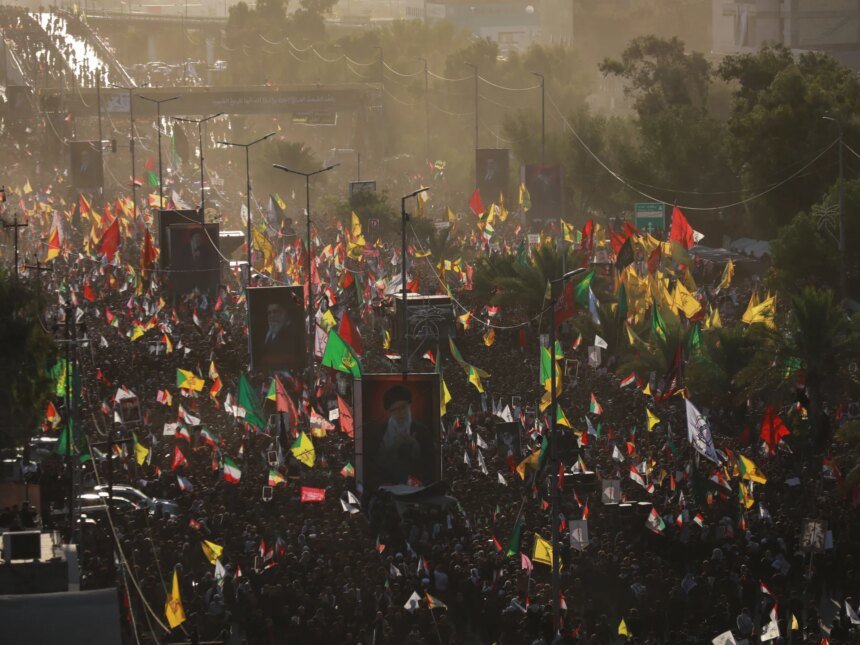
The funeral ceremony for the late Iranian leader, Ali Khamenei, began today, Wednesday, in Iraq, where crowds of mourners filled the streets of the city of Najaf, from which the coffin will be transported to the city of Karbala, before returning to Iran to be buried after a week-long funeral ceremony.
Khamenei’s coffin arrived at Najaf airport on Wednesday night, and was received by Iraqi officials, including Prime Minister Ali al-Zaidi and leaders of the Coordination Framework Alliance, as well as other politicians and leaders.
He was also received by Iranian President Masoud Pezeshkian and Commander of the Quds Force of the Iranian Revolutionary Guard, Esmail Qaani. Mustafa, one of Khamenei’s sons, also attended, and Mojtaba Khamenei, who succeeded him as guide, has not appeared in public since his appointment last March.
The Iraqi authorities declared Wednesday an official holiday, and the popular funeral ceremony began in the city of Najaf at six in the morning (03:00 GMT).
In the streets of the city, a truck carried Khamenei’s coffin wrapped in the Iranian flag, and crowds gathered around him, and some tried to approach him to touch him.
The funeral will end in the city of Najaf at the shrine of Imam Ali, where crowds will wait to pray over the body before it moves to the city of Karbala.

Khamenei’s coffin, along with the bodies of four members of his family who were killed with him in the strikes, were laid out on Friday in Tehran’s Grand Mosque, where official delegations and large crowds saluted him, before it set off on Monday in a funeral procession that made its way through central Tehran in crowds dressed in black and carrying red flags calling for revenge.
From Tehran, Khamenei was transferred to the city of Qom, where huge crowds gathered to pay their respects. Official Iranian media estimated the number of participants in the ceremony over the past few days in the millions, noting that the authorities have not yet issued any official estimated figures.

Khamenei has led Iran since 1989 following the death of its founder, Khomeini. The scenes of large crowds in the streets of Tehran brought to mind the farewell of Khomeini, in which official media said the number of participants reached nearly 10 million.
The city has symbolism for Shiites around the world. Many of them recommend that they be buried there, specifically in the vast “Wadi al-Salam” cemetery adjacent to the shrine.
The city of Najaf is the headquarters of the supreme authority in Iraq, Ali al-Sistani, and a number of major authorities. It is also considered a destination for students of religious sciences who are pursuing their studies in its seminaries.
A number of senior Shiite clerics studied and taught in Najaf, including Khomeini, the Supreme Leader of the Iranian Revolution.

After Najaf, Khamenei’s body will be flown to Karbala, located about 60 kilometers to the north, in another funeral procession that will conclude at the Hussein Shrine, the shrine of Imam Hussein, and the shrine of his brother Abbas.
Khamenei was killed at his residence in Tehran as a result of the American-Israeli strikes that targeted Iran on February 28, marking the outbreak of war in the Middle East.
Khamenei’s funeral in Iraq coincided with renewed tension and strikes between Iran and the United States around the strategic Strait of Hormuz, which constituted a major point of tension during this war.
The US Army announced launching strikes on more than 80 Iranian targets in response to attacks targeting 3 ships in the Strait of Hormuz attributed to Tehran, and the Iranian Revolutionary Guard announced targeting dozens of US military installations in Bahrain and Kuwait in response to the US strikes.

Khamenei’s burial ceremony was postponed until Iranian and American negotiators, with Pakistani and Qatari mediation, reached a “memorandum of understanding” in the hope of reaching a final agreement on the main controversial issues within 60 days.