

Since ancient times, Egypt has been characterized by the abundance of the papyrus plant, which grew densely in the Nile Delta and on the banks of its branches. The ancient Egyptians were able to invent a unique technology to transform this plant into a writing-like material similar to paper, about 25 centuries before AD. At a time when many peoples relied on rocks, wood, animal skins, and bones to preserve texts and record events, Egypt preceded others in using a writing medium that was easier and more flexible.
The use of papyrus was not limited to hieroglyphic texts and the languages and scripts that descended from them, but it was also used later to write down Arabic texts, a fact that is not well known to many people.
“Papyrus continued to play a pivotal role in the administrative, economic, and cultural life of Egypt even after the Islamic conquest.”
Papyrus continued to play a pivotal role in the administrative, economic, and cultural life of Egypt for many centuries, even after the Islamic conquest led by the companion Amr ibn al-Aas, may God be pleased with him, between the years 19 and 21 AH. Muslims found papyrus a material available at low cost compared to parchments made of leather and other writing methods available at that time. This was at a stage when the paper coming from China was not yet widely known in the Islamic world, as its true spread did not begin until during the second century AH.
Read also
list of 2 itemsend of list
The papyrus prepared for commercial circulation was manufactured in specialized workshops, and then put on the market in the form of scrolls, usually consisting of twenty sheets connected to each other. The first page of the scroll was known in Greek as the “Protocol,” meaning “the first sheet.” It was the page on which the official data and identifying marks of the document were written, which corresponds to the concept of “taraz” in later Arabic terminology. The Austrian orientalist Adolf Grohmann referred to this in his study of the Arabic papyrus papers preserved in the Egyptian Library.
Islamic papyrus
The discovery of Arabic Islamic papyri in Egypt in the late nineteenth and early twentieth centuries represented a major achievement. These documents, which were found in various regions of Egypt, such as Fayoum and Upper Egypt, revealed broad aspects of the life of the early Muslims in Egypt, including management systems, daily transactions, social customs, marriage and divorce contracts, and personal correspondence. Their importance stems from their being original and contemporary sources of events, which made them a basis for understanding history more accurately.
Among the most prominent documentary collections that researchers relied on to reconstruct aspects of Islamic history were the Arabic papyri, the Geniza documents, and the documents of the Holy Mosque, in addition to various groups of documents belonging to different Islamic eras. It is noteworthy that Egypt embraced two of the most important of these documentary treasures, namely the Arabic papyri and the Geniza documents. The latter refers to a huge collection of manuscripts and historical documents that were found in the Geniza (meaning the cemetery of books or the treasury) of the “Ben” synagogue. Ezra” in Old Cairo in 1896. It includes religious texts, commercial letters, marriage documents and judicial records written in Hebrew, Arabic and Aramaic.
“The Austrian orientalist Adolf Grohmann is considered the most prominent figure in the study of Arabic papyri.”
Regarding the Arabic papyri, the first attempts to study them date back to the early nineteenth century, when in 1824 two Arabic documents were found near the Saqqara pyramid inside a sealed pottery jar. These two documents were transferred to the French consul in Cairo at the time, Bernardino Drovetti, who referred them to the French orientalist Silvestre de Sacy, who studied and published them, marking the first scientific step in the field of publishing and verifying the papyri. Arabic.
This discovery aroused the interest of scientific institutions and European researchers, and large collections of papyri were formed in a number of libraries and museums, the most famous of which are the Heidelberg Collection in Germany and the Archduke Rainer Collection in Austria. The German orientalist Bernhard Moritz also played an important role in collecting the papyri and preserving them in the Egyptian Library during his management of it, while the Austrian orientalist Adolf Grohmann is considered the most prominent figure in the study of Arabic papyri. He devoted decades of his life to its investigation and publication, and issued a large number of scientific texts. He also continued his research on it during his work as a visiting professor at Cairo University between 1936 and 1955.

Interest in this field did not stop with the efforts of the pioneers, but rather continued at the hands of contemporary researchers who contributed to the cataloguing, verification, and study of the papyri, including Dr. Saeed Maghawri Muhammad and Dr. Jasser Abu Safiya, who devoted important studies to the papyri of Qara ibn Sharik al-Absi, the governor of Egypt in the Umayyad era. Thanks to these accumulated efforts, the Arabic papyri continue to reveal new information related to administration, economics, society, and daily life in the first Islamic centuries.
These papyri extend chronologically from the oldest known document dating back to the period between the years 20 and 22 AH during the reign of Amr ibn al-Aas, may God be pleased with him, all the way to the Fatimid era (358 – 567 AH). These documents gain their value from the fact that they convey details of daily life that were neglected by traditional historical sources preoccupied with news of caliphs, wars, and politics. They also reveal the prevailing administrative and financial systems, and the nature of official documents that were written on papyrus scrolls, as they were usually opened with a style or protocol bearing the name of the caliph or governor in Arabic and Greek, which reflects the continued use of Greek in Egypt during the first decades after the Islamic conquest.
“The papyri document the names of cities and villages, professions, prices, currencies, and methods of collecting taxes and customs.”
Dr. Saeed Maghawri Muhammad highlighted the exceptional importance of these papyri in reconstructing multiple aspects of Egypt’s Islamic history. It documents the names of cities and villages, professions, crafts, prices, currencies, and methods of collecting taxes and taxes. It also sheds light on the relationship of the Islamic administration with the Coptic population and the reality of their religious, economic, and judicial freedoms. These documents also revealed aspects of social interaction between Arabs and Copts through marriage contracts and various transactions, and the mechanisms for raising complaints and grievances to the rulers.
These papyri show the reliance of Muslims in Egypt during the first AH centuries on papyrus as a main means of writing and documentation, benefiting from an ancient Egyptian legacy that began with the Pharaohs, who wrote on this plant in their hieroglyphic language. Then its use moved to later eras, where it was used in Coptic and Greek writing, before it became a container for Arabic documents after the Islamic conquest of Egypt.

Papyrus of Abdullah bin Jabr
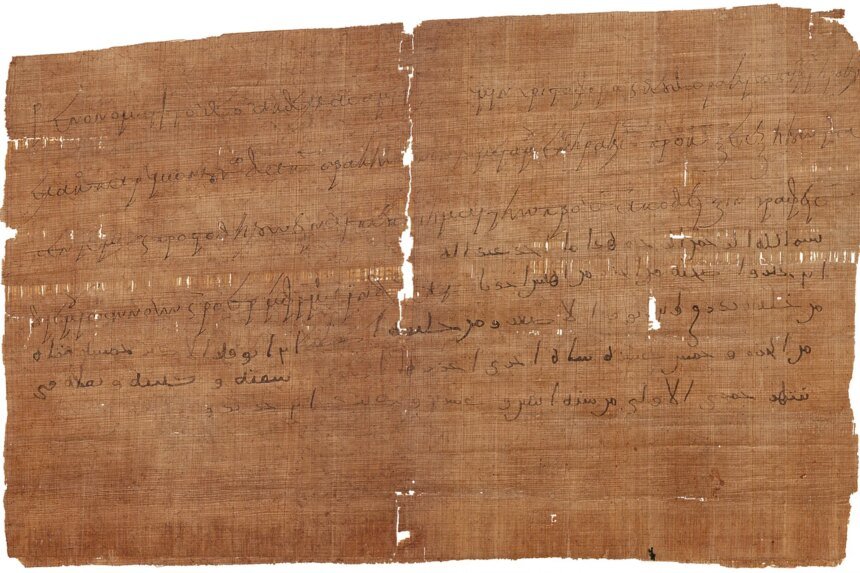
Among those documents that attracted the attention of researchers and investigators is the Abdullah bin Jabr papyrus, which is considered the oldest bilingual Arabic-Greek papyrus known to date, as it bears the date of Jumada al-Awwal in the year 22 AH, corresponding to the month of May in the year 643 AD. The Austrian orientalist Adolf Grohmann described it by saying that it is “the oldest documents from the era of Islam… and the oldest paper written in both languages from the era of the Arab conquest of Egypt.”
This early papyrus, preserved in the collection of Archduke Rainer in Vienna and known as Papyrus (PERF 558), reveals an important aspect of the nature of the relationship that arose between the new Islamic administration and the Coptic population of Egypt after the conquest. The document reflects the commitment of both parties to the administrative and financial arrangements that were approved at that time, and it also provides evidence of the participation of the local population in meeting the needs of the Islamic forces heading towards the regions of Upper Egypt. Therefore, its value is not limited to being one of the oldest known Arabic documents, but rather extends to the direct information it provides about the administrative and military reality in Egypt during this early stage of Islamic rule.
This document was written in Greek and Arabic, and the Arabic version on the back of the document in Greek reads as follows: “In the name of God, the Most Gracious, the Most Merciful. This is what Abdullah bin Jabr and his companions took from the islands – the camels prepared for slaughter – from Ahnas. We took from the successor of Thadraq bin Abi Qir the Younger and from the caliph of Mustafa bin Abi Qir the Elder, fifty sheep from the islands and another fifteen sheep that the owners of his ships slaughtered. His battalions and weights were written in the month of Jumada in the year twenty-two.

The Abdullah bin Jabr papyrus allows us to shed light on a number of important facts related to Egypt in the first years after the Islamic conquest, as the first thing that attracts attention about it is that it was written in both Arabic and Greek, which reflects the linguistic and administrative reality prevailing at that time, and confirms the continued use of Greek alongside Arabic during the first decades of Islamic rule, before Arabic gradually took over the function of official codification at the beginning of the second century AH.
“The Greek language continued to be used alongside Arabic during the first decades of Islamic rule in Egypt.”
The document also shows that the Islamic administration dealt with the local population according to the existing conditions without imposing a forced linguistic change. On the other hand, the papyrus represents an official receipt proving that Prince Abdullah bin Jabr received sixty-five sheep from the officials of the city of Ehnasia in central Egypt (Heracleopolis), to be allocated for the sustenance of the Islamic forces participating in the operations to conquer Upper Egypt, with their value calculated from the financial obligations owed by the people of the region, which reveals the accuracy of the financial and administrative procedures followed at that time.
The document gains additional importance because it was written during the campaign to conquer Upper Egypt, and it provides direct information about the nature of the Islamic army and its equipment, including the use of infantry, cavalry, and river ships. The orientalist Adolf Grohmann showed special interest in this papyrus, and considered it a unique source for determining some of the facts of the Islamic conquest of Upper Egypt, and the details of one of the battles that took place during the conquest of Upper Egypt. The document also clarifies that the sheep taken were considered part of the tax or agricultural land tax that must later be deducted from the financial obligations of the people of Ihnasia, which reflects a clear commitment to justice and preserving rights.
“The Ibn Jabr Papyrus provides information on the nature of the Islamic army and its equipment, including the use of infantry, cavalry, and river ships.”
This meaning is supported by the testimony of Bishop John of Nicosia, a contemporary of the Islamic conquest, as he mentions that Amr ibn al-Aas, may God be pleased with him: “He ordered the lifting of the taxes that were imposed on the churches, and he did not take anything from their property, nor did he commit any act of robbery or plunder, but rather he protected them during his rule,” which is a testimony that highlights an aspect of the nature of the relationship that existed between the Islamic administration and the population of Egypt in that early stage.

Papyrus of Abdullah bin Amis
Although Grohmann acknowledged the historical importance of this document or the Islamic papyrus, it seems that he did not come across another Islamic document written on papyrus that was older than it, or he came across it but was unable to verify it, as this papyrus represents the oldest dated Arabic documents that have reached us from Islamic Egypt. It dates back to the year 20 AH (641 AD), that is, to the beginnings of the Islamic conquest of the country. It is preserved in the Austrian National Library, which is considered one of the most important international collections of Arabic papyri.
The importance of the document stems from the fact that it is a contemporary witness to the events, written in his time and did not reach us through a late novel or a later historical source, which gives it exceptional value in knowing the beginnings of Islamic administration in Egypt and the development of Arabic writing in the first century AH, and how the conquerors dealt with the indigenous people of the country during the time of Muslim power and victory.
It was stated in the text of the papyrus: “In the name of God, the Most Gracious, the Most Merciful, this is what Abdullah bin Umays decreed for Asdra and his wife, from the people of Abu Maqrouf, from the district of Qahqawa, kingship in his city, for the twentieth year, three dinars.” Thus, it documents the debt of a Muslim man named Abdullah bin Umays to an Egyptian man and his wife amounting to three dinars.
“The Ibn Umays papyrus does not reflect the image of a conqueror imposing his will by the force of the sword, but rather reveals a reality based on the recognition, documentation and preservation of rights.”
This document does not reflect the image of a conqueror who imposes his will by the force of the sword, but rather reveals a reality based on the recognition, documentation, and preservation of rights. Abdullah bin Umays al-Madyan, a Muslim who lived during the time of conquest and who was certainly a soldier or a prince in the Muslim army, did not see in his power anything that justified wasting the rights of others. Rather, he confirmed his debt to the benefit of a man named Asdra and his wife from Qahquwa, an area located in Upper Egypt.
Thus, if history books are often preoccupied with mentioning battles, fortresses, and leaders, then such small previous papyri, which are documents of reality and daily life, reveal to us another facet of the Islamic conquest that was based on respecting rights and fulfilling obligations, even at a time when Muslims had power and authority. Therefore, their value is not limited to being among the oldest surviving Arab documents, but rather extends to being a living witness to the ethics of justice and fairness that were reflected in the practical practice of the first Muslims in Egypt.