

Gaza- On days like these every year, the laughter of children filled the squares, and the colors covered the walls of the summer camps in the Gaza Strip. Today, the swings are absent, the safe spaces are gone, and in their place are the arduous lines of bread and water inside the displacement camps, which have been ravaged by the harsh summer heat, robbing the children of their summer vacation and turning it into a daily survival journey.
Going back to before the war, the Gaza summer was a tumultuous arena for competition, in which the United Nations Relief and Works Agency for Palestine Refugees (UNRWA), civil society organizations, and Palestinian factions competed to launch the largest summer camps and summer games that accommodated hundreds of thousands of children.
But today, in light of the war of extermination and ongoing displacement, these institutional systems have completely disappeared, and with them budgets and safe spaces have vanished. What remains for the children are only simple volunteer initiatives born from the womb of tents whose makers try, with “zero capabilities,” to steal moments of joy extracted from the heart of suffering in order to revive the spirit of summer camps in attempts to rise up and create hope despite the wounds.

Temporary doses of joy
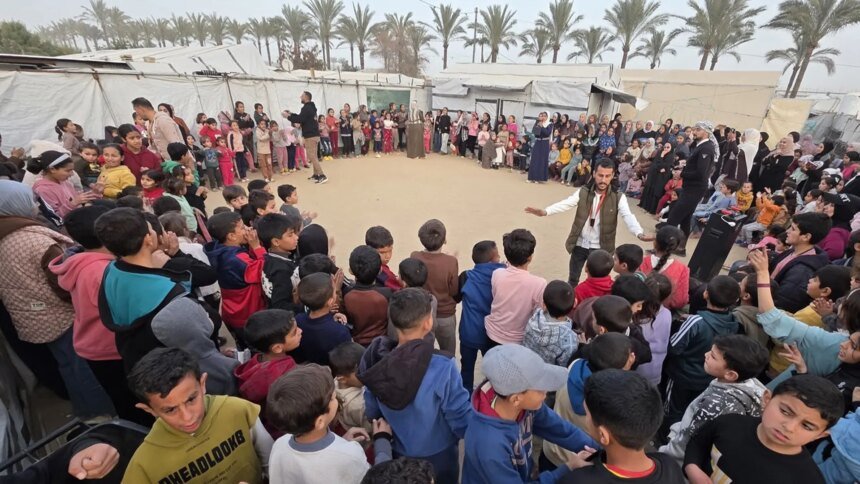
The owner of the “Qaderin Naghir” Center, Ahmed Al-Najjar, moves between the displacement camps to restore the children’s lost psychological balance, using some music and simple self-motion games in light of the complete absence of capabilities.
Al-Najjar told Al-Jazeera Net: “Summer activities for children today have become distant and temporary. We may visit the camp only once or twice a month because there is no support or capabilities, and we try, with our own efforts, to extract the children from the atmosphere of war.”
He added that they work in “very complicated” conditions, as “there are no umbrellas to protect from the scorching heat of the sun, nor are there real toys. We see in the children’s eyes an overwhelming desire for joy, but reality and continuous displacement besiege this desire day after day.”
He explained that these efforts do not stop at the borders of a single geographical spot, but rather turned into an “extended epic of steadfastness,” as they succeeded in these initiatives by implementing more than 100 entertainment events that traveled to the displacement camps from the north of the besieged Strip to its far south.
What is striking about these initiatives is that – according to Al-Najjar – they did not only target the minds of children, but also extended a helping hand to the younger generation, male and female university graduates, whose studies and professional dreams were interrupted by the bombing. The initiative was able to attract and target more than 500 young men and women and transform their paralyzed energies and pent-up feelings into a positive momentum to lead these activities, as he put it.

From an edifice to a humble center
The war was not just raids targeting stones, but rather it was a battle that obliterated the features of the future for the emerging generations, and the witness here is the “Anamal Educational Camp,” whose owner, Muhammad Al-Nazli, says: “The center before the war was a huge and integrated institution that annually accommodated more than 400 children, providing them with transport buses, an integrated club, and modern medical and scientific equipment that helped them discover and learn.”
Today – Al-Nuzli explained – that edifice has turned into rubble after the bombing completely targeted it, “But despite the ashes and wounds, we refused to surrender, so activity resumed to its minimum within a modest center.”
He added to Al Jazeera Net, describing the extent of the suffering, “The institution was bombed and we lost all the devices and equipment that we had spent years collecting. We tried to return to save what could be saved, but the capacity decreased sharply from about 400 children to only 50 children, due to the lack of security, which constitutes the greatest obstacle.”
The people of Gaza have also become afraid to send their children in light of the continuous bombing, in addition to the complete lack of means of transportation and fuel that used to transport them from distant areas. He added, “We are fighting with the least means possible to keep hope alive in the hearts of these children, but the reality is heavier than all of us.”
Trapped inside tents
As for Najla Al-Qudra, she bitterly tells Al-Jazeera Net about what mothers pay for inside the displacement tents in terms of daily confrontation with the broken hearts of their children. She is a displaced mother residing in a camp in the middle of Gaza City. She says: “My children are constantly crying. They are distressed and frustrated all the time. They have no toys and no place to release their energy. Empty and heat eat away at them.”
She added, while her eyes were watching the movement of her bored children: “Every now and then, an initiative or entertainment event comes to the camp that makes the children happy for a few minutes, but these temporary doses are never enough.
Mother Najla hopes for the return of organized and sustainable summer camps that are not only limited to entertaining children, but also embrace their talents and build their creativity that were erased by the war.

Shocks without discharge
Behind the details of the harsh field scene hides a deeper psychological bleeding that affects the minds and souls of the children of Gaza. Summer camps and recreational activities were not just times of fun, but rather served as a safety valve and a psychological wall that protected children from the repercussions of accumulated trauma.
Hanadi Skaik, a counselor for psychosocial support and family mental health in Gaza, explains the dangerous dimensions of this deprivation and says that the absence of summer camps and recreational and movement activities leaves children in direct confrontation with the traumas of war without any tools for psychological relief. Movement activities were the only natural way for children to release the energies of fear, anxiety, and tension stored inside their small bodies.
She adds to Al Jazeera Net that the tragedy extends to the depth of the child’s social formation. The continuous displacement and living in tents, in parallel with the absence of organized group activities, have caused a severe paralysis in the development of children’s social content, and the spaces in which the child learns the skills of communication, participation, and building relationships with his peers have also been lost.
According to her, this absence reinforces withdrawal behaviors, isolation, and behavioral disorders among young people, “and even leads them to a state of frustration and early loss of passion.”

Dangerous comparisons
Specialist Skaik draws attention to a dangerous psychological and educational dimension that is troubling families in Gaza, linked to what children see on phone screens and social networking sites. She says: “In the absence of alternatives, children are now watching, via social media platforms, video clips of their peers in countries around the world as they attend entertainment cities, amusement parks, and summer parks.”
She continues, “This inevitable visual comparison between their inflammatory reality and the normal reality of childhood outside the Gaza Strip creates in them an acute feeling of inferiority and inferiority.”
According to Skaik, this constant feeling of deprivation deepens the psychological gap within them and gradually turns into harsh questions that children ask themselves and their families: Why do we live like this while they live in peace? Stressing that “the inevitable result of these forced comparisons is the erosion of psychological stability and filling the souls of young people with feelings of helplessness, frustration, and pent-up anger toward a reality that was imposed on them and that they did not choose.”