

The political and military arena in the Middle East witnessed an escalation coinciding with the launch of the 2026 North Atlantic Treaty Organization (NATO) summit in the Turkish capital, Ankara.
Axios quoted American sources as saying that the Iranian Revolutionary Guard Navy targeted two ships in the Strait of Hormuz, in a move that Tehran has not officially commented on yet, which places the security of international navigation at a critical juncture in conjunction with the ongoing talks between NATO leaders.
Ship transit traffic in the Strait recorded a sharp contraction, declining from an average of 40 tankers per day to only 27 ships immediately after the attacks, which reflects the state of ambiguity and strategic complexity facing global shipping lines in the region.
In this context, the director of the Arab Center for Iranian Studies, Muhammad Saleh Sedqian, explained that one of the targeted ships is the Qatari oil tanker “Al-Rakyat,” noting that unofficial sources indicated that the tanker was trying to cross from the southern coast of the strait accompanied by American military vessels.
He added that the Revolutionary Guard sent advance warnings to the tanker not to pass because the route was unsafe, but failure to respond to these warnings led to it being directly targeted, in a message through which Tehran seeks to put pressure on the NATO summit and reject the deployment of French, British, or German minesweepers in the waterway.
For his part, former US Deputy Assistant Secretary of Defense Sergio de La Peña considered that the Iranian escalation represents an attempt to impose control over the Strait of Hormuz, stressing that Washington will not remain silent regarding the threat to international shipping.
De La Peña pointed out that Tehran had previously fired on a Saudi oil tanker, considering these steps as provocative behavior that requires an American military response, especially since Tehran is showing concern about the decline in oil prices and the decline of its negotiating position in international talks.
Oh
Ankara summit files
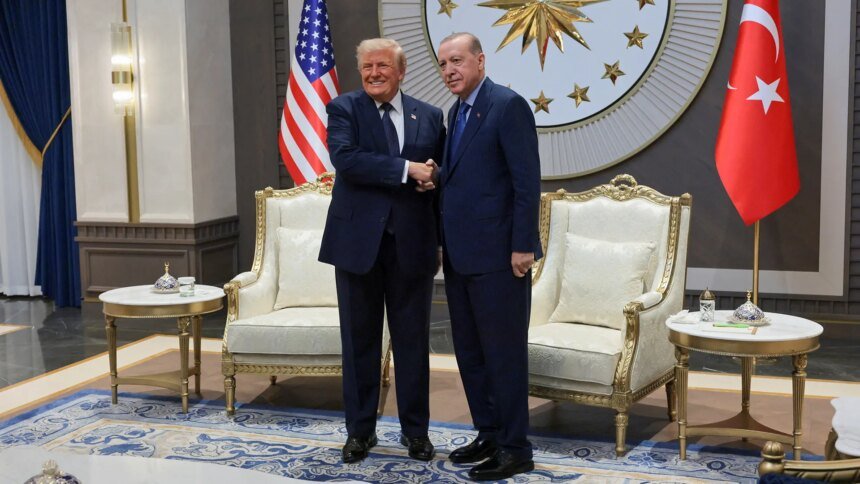
The summit witnessed the arrival of US President Donald Trump to hold bilateral discussions with Turkish President Recep Tayyip Erdogan, as Trump described bilateral relations as excellent, pointing out that Turkey’s hosting of the summit was the main motivation behind his personal attendance.
The joint coordination dealt with ways to strengthen Turkey’s defense industrial base and resolve the issue of supplying it with fifth-generation F-35 fighters, which the first Trump administration had stopped in response to Ankara’s acquisition of the advanced Russian S-400 missile defense system.
Washington is currently seeking to advance this file by finding a technical formula to fortify the sensitive technology of the American fighter, in addition to discussing a deal to supply Ankara with jet engines worth about 700 million dollars.
These facilities come in light of the pivotal role played by Türkiye as a financial diplomatic mediator between Washington and Tehran to put an end to the ongoing military conflict in the region.
Future scenarios
Based on the data of the missile escalation and the NATO meeting, three expected scenarios are looming on the horizon to outline the features of the maritime conflict, according to what analysts put forward on Al Jazeera:
- First scenario: Military internationalization and entry into a limited confrontation (medium weighting)
This scenario assumes that the Trump administration succeeds in extracting a collective mandate from the NATO summit to form a joint naval force to protect tankers and forcibly escort them across the international route and the southern Oman corridor with its deep draft (between 65 to 110 metres). This option would mean a direct tactical clash between the Western units and the Revolutionary Guard speedboats, which may require a broader military response.
- Second scenario: A proxy war of attrition and perpetuating the decline of navigation (higher likelihood)
It is based on Tehran continuing to activate its undeclared “missile veto” and radio jamming, which keeps transit rates low. This slow Iranian tactic aims to put pressure on global energy markets to accelerate access to the “Comprehensive Doha Round of Negotiations” scheduled for July 11, to extract financial gains and release frozen funds without making sovereign concessions in the Strait.
- Third scenario: Iranian retreat and adherence to cautious calm limits (low probability)
It includes Tehran’s response to the strict warnings of the Ankara summit, stopping attacks on ships to avoid stifling NATO sanctions, and returning to the “maintaining the status quo” protocol until the features of the grand deal with Washington become clear.
This scenario remains intractable and unlikely at the present time in light of Iran’s need to prove its ability to maneuver and destabilize energy markets as a final pressure card.
NATO naval capabilities
Regarding the consequences of escalation and the ability to mobilize a joint naval force to clear mines in the Gulf, the expert in security studies at the Doha Institute, Muhannad Salloum, presented a strategic reading that was different from within Europe.
Salloum stressed that the European countries, led by Britain, France and Germany, possess the full military and technical capabilities to intervene at sea and secure the Strait if the political decision is taken, denying that the Ukrainian war has exhausted their structural naval capabilities.
Salloum explained that the security of Hormuz directly affects the livelihood of European citizens and energy prices on the continent, in addition to its security obligations with allies in the Gulf such as Qatar, Saudi Arabia, the UAE and Kuwait.
If Tehran continues to use the Strait as a card for economic pressure, this may push the European system to position itself on the ground alongside America and Israel to engage in a comprehensive maritime confrontation that ensures that the Strait remains open in accordance with the international law of the sea. This is the scenario that Tehran is trying to avoid by restricting the security of the corridor in coordination between itself and the Sultanate of Oman.
Conflict of sea routes
In a related context, the coverage shed light on the sea routes that control traffic in the strait, and the implications of recent movements, as information indicated that the Qatari oil tanker “Al-Raqayat” was directly targeted in the waterway.
The incident re-highlighted the difficulties, after the tanker attempted to cross from the southern coast of the strait, escorted and secured by American military units, before the Iranian Revolutionary Guard issued warnings to prevent passage on the grounds that the route was unsafe, followed by targeting it after failing to respond to the warnings.
Specialists believe that the official Iranian silence regarding the incident reflects Tehran’s desire to send indirect political messages, especially since the attack coincides with the arrangements for the NATO summit in Turkey, and seeks to impose a reality on the ground that prevents the internationalization of the security of the Strait or the introduction of Western minesweepers outside the framework of the coordination of the coastal countries.
On the other hand, the American position was sharp and offensive, as Sergio de La Peña reiterated that America would not stand by and watch Iranian fire on ships crossing the Strait.
De La Peña revealed a sharp tactical decline in daily navigation rates in the strait, as traffic declined during the past 24 hours, considering that Tehran’s behavior stemming from anxiety due to the drop in oil prices weakens its negotiating position vis-à-vis the allies.
Burden-sharing disputes
At the level of NATO’s structure, NATO Secretary-General Mark Rutte announced the conclusion of a deal to purchase 12 A400M strategic military transport aircraft from Airbus to enhance the defense and logistical capabilities of the allies.
Rutte stressed the need to raise production and military efficiency because building a stronger NATO directly contributes to making Europe stronger and safer in the face of regional challenges.
On the other hand, Al Jazeera correspondent Fadi Mansour revealed the existence of discrepancies within the corridors of the alliance as a result of the US administration’s desire to reconsider the deployment of its forces on the European continent and implement a strict strategy for sharing financial burdens.
Washington calls on member states to commit to raising their defense allocations to 5% of each country’s gross domestic product, coinciding with the emergence of other disputes with some capitals such as Spain due to restrictions imposed on the movement of the US Air Force in its airspace and military bases.