

Published On 7/6/2026
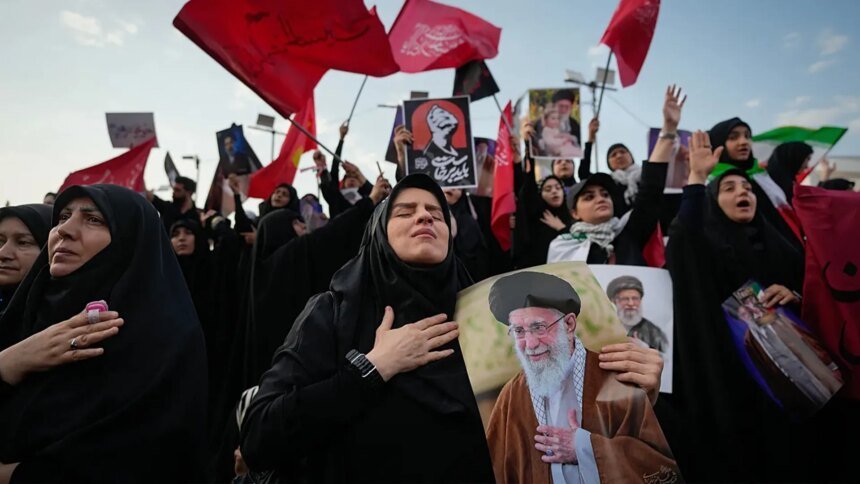
The funeral ceremony of the late Iranian leader Ali Khamenei was not just a passing religious ritual, but rather turned into a broad platform for displaying the Iranian regime’s organizational muscles and sending messages of challenge and steadfastness at home and abroad.
After months of bloody conflict, Tehran seeks, through crowds of millions, to prove the efficiency of the post-war government, and to confirm the regime’s ability to survive and the smooth transfer of power, according to what the American newspaper “Washington Post” reported about the regime, which has begun to describe itself as a “survivor.”
This trend is confirmed by a field report by Al Jazeera’s correspondent in Tehran, Rania Qasemi, as Iranian officials confirm the readiness of the armed forces to protect the country’s security, considering the large popular presence as a card of strength that supports Iran’s diplomatic position in any future negotiations.
Iranian Member of Parliament Hashem Khanfari explained the messages of strength reflected by the attendance of millions of mourners at the funeral ceremony, as they reflect the stability of security and the state’s lack of fear of any attack or military threat.
Citizens spoke during the funeral about their desire for the funeral ceremony to reflect Iran’s strong image, stressing their desire to end negotiations with Washington and Tel Aviv to serve Tehran’s interest and not harm the country’s dignity and pride.
The American President had questioned the loyalty of the crowds to the late leader, and said that these tears in Tehran might be “fake tears.” He had previously expressed his surprise at seeing Iranians crying at Ali Khamenei’s funeral, as he believed – according to him – that “people hated him.”
Trump added in a statement to Axios that Washington and Tehran decided to “take a week-long break from the talks until the end of Khamenei’s funeral ceremony,” stressing that neither side would fire on the other during the funeral period.
He also said that the Iranians are begging to conclude an agreement, and that he is following Khamenei’s funeral ceremony, and that he can eliminate everyone, “but there will be no one left to negotiate with,” as he put it.
The secret of Mujtaba’s absence
Iranian security sources attributed the absence of the new Supreme Leader Mojtaba Khamenei from the funeral ceremony of his late father, Ali Khamenei, to “preventive reasons and precautionary measures imposed by the circumstances of the country,” attributing this to the implementation of the ceasefire without a complete end to the war with the United States and Israel on their part.
Despite the participation of all members of the regime and the military and political leaders, especially the leaders of the Revolutionary Guard and the army, the absence of the new guide was the subject of global attention and attention.
The French newspaper “Liberation” wondered about the secret of Mujtaba’s absence from appearing, and described the man as “mysterious”, as he has never appeared in public and “his voice has not been heard since his appointment”, but at the same time he is the man who seems present in all of the country’s fateful decisions. This opens the door wide to speculation about his health and his ability to lead the country from behind the scenes.
The funeral ceremonies for the late Iranian leader, Ali Khamenei, continue for the fourth day, and farewell marches have been organized in the streets of the capital, Tehran, before the body is transported to the city of Qom, where another ceremony will be held on Tuesday.
Tehran will receive between 15 and 20 million participants, in a funeral that the authorities described as “the largest of its kind in the country’s history,” and will continue until the ninth of this month, and Khamenei’s body is scheduled to be buried on Thursday inside the Imam Reza shrine in the city of Mashhad.
Ali Khamenei was killed on February 28 in American and Israeli air strikes that targeted a complex containing his residence in Tehran, on the first day of the war that ignited the region 4 months ago.
His burial ceremony was postponed until Iranian and American negotiators, with Pakistani and Qatari mediation, reached a “memorandum of understanding” in the hope of reaching a final agreement on the main controversial issues within 60 days.