


Robots on the factory floor. Self-driving vehicles on the Las Vegas strip. Even a substitute for man’s best friend — the robotic dog.
They are all part of the physical artificial intelligence buildout that depends on high-tech, low-cost lidar, the critical sensors that allow these technologies to see their surroundings.
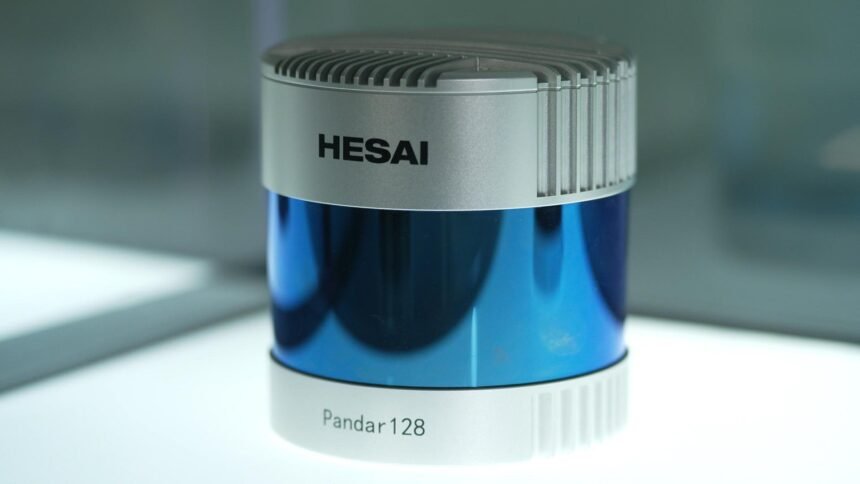
A Hesai lidar sensor.
CNBC
And at the heart of this buildout is Hesai Technology, a Shanghai-based lidar manufacturer blacklisted as a national security threat in 2024 by the U.S. Department of Defense, which designated Hesai as a Chinese military entity. While the blacklist prevents Hesai and the 187 other companies and subsidiaries on the list from securing Pentagon contracts, there is nothing illegal about using these products in nonmilitary applications. Hesai’s presence on the blacklist does not prevent U.S. companies from using Hesai’s technology.
Government officials and security experts say the use of Chinese lidar could open this new, critical infrastructure to cyberthreats with potentially serious consequences and become a backdoor for Beijing to access sensitive data collected by the lidar technology.
David Li, Hesai’s co-founder and CEO, says the narrative that his company poses a threat is fiction.
David Li, Hesai’s co-founder and CEO.
CNBC
“In the DOD case, I don’t feel there is sufficient evidence, and it’s not logical,” Li said. “We are frustrated by that.”
In his first extended interview about the blacklist designation, Li defended the company against allegations that its technology poses national security risks or could be used by the Chinese government to collect data.
David Li, Hesai’s co-founder and CEO, speaks to CNBC’s Melissa Lee in his first extended interview about his company’s blacklist designation by the U.S. Department of Defense.
CNBC
Despite the federal blacklist designation, Hesai’s reach is growing. Under an expanded partnership between Hesai and Nvidia, Hesai sensors will be one of the options automakers can choose to integrate into Nvidia’s autonomous vehicle platforms, which the chipmaker hopes will power the self-driving vehicle revolution.
“Our vision is that some day, every single car, every single truck will be autonomous. And we have been working towards that future,” Nvidia CEO Jensen Huang said in his keynote address at the Consumer Electronics Show in January, when the expanded partnership was announced.
Huang has said that robotics, which includes self-driving cars, is the company’s second most important growth category after artificial intelligence. In its latest annual filing, Nvidia reported automotive revenue for fiscal year 2026 was up 39% from a year prior, driven by the adoption of its self-driving platforms.
Hesai is one of the dominant suppliers in the global autonomous technology ecosystem. Its sensors are integrated into several autonomous systems in addition to Nvidia’s, including those of Amazon’s robotaxi company, Zoox; autonomous trucking companies such as Waabi and Kodiak; autonomous vehicle technology company Nuro; and agricultural automation firm Agtonomy. The sensors can also be found at New York’s John F. Kennedy International Airport, where they monitor passenger and traffic flow at security checkpoints and gate entrances, and even in autonomous lawn mowers.
The threat of weaponizing lidar
Not everyone is convinced that these data-collecting sensors should be integrated into U.S. autonomous systems.
Craig Singleton is a senior director for the China Program at the Foundation for Defense of Democracies, a conservative Washington-based think tank known for being critical of the Chinese government. His research has concluded that there are security risks in Chinese-made sensors operating in U.S. systems, including that lidar sensors could enable Beijing “to access sensitive U.S. data or disrupt critical operations.”
Craig Singleton, a senior director for the China Program at the Foundation for Defense of Democracies.
CNBC
Lidar — which stands for “light detection and ranging” — works by firing laser pulses and measuring how long it takes for them to bounce off an object and back to the sensors. The sensors then combine thousands of these measurements to create a “point cloud,” or three-dimensional map, which allows autonomous machines to see and navigate their surroundings.
Singleton told CNBC that as Chinese lidar sensors become more prolific across the U.S., they will move closer to defense nodes, utility grids and airports.
“That data is so sensitive and it’s so precise that it could be weaponized by a hostile foreign power if they ever wanted to target our infrastructure,” Singleton said.
Questions about how and where Chinese-made lidar sensors are being used come alongside broader concerns about Chinese government oversight and the potential for that government to access data collected by Chinese companies.
The U.S. Securities and Exchange Commission requires all China-based companies to disclose “the risk of Chinese government intervention or control.” In its SEC filings, Hesai has disclosed that the Chinese government has “significant oversight in regulating our operations and may influence or intervene in our operations at any time.”
Singleton said that in part means Hesai can be compelled to share data collected by its lidar sensors with the Chinese government.
“Whether they want to transmit that information or not isn’t a question, it’s mandated by law,” Singleton said.
Li said the company’s sensors hold no data because they lack the memory capacity to do so. He said Hesai’s partners are responsible for securing the data the sensors collect and that Hesai has no control over that.
Li also rejected concerns that the Chinese government could access data through the company.
But Singleton said the rapid deployment of autonomous systems is outpacing scrutiny over potential security risks.
“It’s a tale as old as time with Chinese tech,” he said.
‘Rip and replace’
Companies in the U.S. have previously embraced low-cost Chinese technology, even from entities that had been blacklisted, only to later spend billions replacing it after the products raised national security concerns.
Chinese telecommunications giant Huawei, for example, was placed on the Defense Department’s blacklist in 2021, but that did not stop U.S. companies from using Huawei products. The Federal Communications Commission, which had designated Huawei a “national security threat” in 2020, forced U.S. companies to “rip and replace” Huawei products from their networks beginning in July 2021. Huawei challenged both the decision to bar it from securing federal contracts and FCC’s designation of the company as a national security threat in court, but lost both cases.
Like Huawei, other Chinese companies have been found by the Defense Department to be national security risks only after their products made their way into U.S. homes and businesses.
Shenzhen-based DJI, the world’s largest drone maker, and Wi-Fi router maker TP-Link both sold popular consumer goods. DJI was blacklisted in 2022 by the Pentagon for its ties to the Chinese government, and TP-Link was added to the list in June.
DJI sued the Defense Department in 2024 to be removed from the blacklist, but a federal judge ruled there was “substantial evidence” that the company contributes to China’s defense industrial base. DJI is appealing the decision.
Unlike Hesai, which remains free to sell lidar sensors commercially in the United States, a separate FCC ruling in December banned DJI from selling new products to U.S. consumers due to national security risks, though existing models remain legal to use.
TP-Link was also barred from selling new models after the FCC determined foreign-made routers posed “an unacceptable risk to the national security of the United States.”
Inside a simulated lidar attack
National security concerns surrounding foreign-made lidar sensors have also spurred academic research on the potential risks posed by these devices.
Miroslav Pajic, a professor at Duke University who studies vulnerabilities in lidar sensors, told CNBC it’s “easy to physically spoof lidar.”
Miroslav Pajic, a professor at Duke University who studies vulnerabilities in lidar sensors.
CNBC
Pajic said any lidar sensor can be compromised with malware inserted at the factory during production or through firmware updates. Malware can be difficult to detect, since automakers and other manufacturers usually cannot access a lidar maker’s proprietary source code and malware can remain dormant until triggered.
Inside his lab at Duke, Pajic demonstrated one such attack.
On a computer monitor displaying a lidar sensor’s point cloud image, the room the sensor was capturing appeared exactly as expected. The sensor mapped its surroundings in real time, creating a 3-D picture of the space.
But after Pajic activated malware embedded in the lidar unit, a person appeared in the sensor’s point cloud. In reality, nobody had entered the room.
The system generated a phantom person — a false object created entirely through manipulated sensor data.
Pajic’s lab has also conducted demonstrations that have the opposite effect: manipulating lidar data to remove real objects from a sensor’s view. In that scenario, an autonomous system could fail to detect a pedestrian, vehicle or obstacle that is physically present.
Pajic said similar attacks could theoretically be used against autonomous vehicle fleets operating in cities, causing them to malfunction.
When asked about the simulation, Li said a system can be designed to be vulnerable in a lab setting.
But the risk of malfunction isn’t just theoretical.
Michael Robbins, CEO of the Association for Uncrewed Vehicle Systems International — a trade organization that represents companies in the industry, including U.S. lidar competitors — said that in 2024 Hesai pushed a firmware update to all its lidar sensors. The firmware didn’t take into account that 2024 was a leap year, so on Feb. 29, all of Hesai’s lidar sensors stopped working.
Michael Robbins, CEO of the Association for Uncrewed Vehicle Systems International.
CNBC
“In that case it was by error, but that could also be done intentionally, where every lidar in use in the United States could be turned off, or it could be used against us in a nefarious way,” Robbins said.
While the potential for a software error across autonomous vehicles is widespread, an error in lidar systems is grave considering its implementation in cars across America.
Li said that in the case of the leap year incident there was an overlooked coding bug in the firmware — not malware. He added that Hesai publishes all its firmware as open source data, so it can be publicly analyzed. In a statement to CNBC, Hesai said the issue was fixed within 24 hours.
“We are making ourselves transparent on what exactly this is able to do,” he said.
Li also said autonomous systems are designed with other sensors such as cameras and radar systems that can compensate for lidar failures.
“If any of them stop, the cars will have to reevaluate the situation to know whether it’s safe enough to continue the course or we’re gonna have to pull over,” he said.
Hesai’s sensors have also met the standards set by Tüv Rheinland and Dekra, which are independent third-party companies that specialize in product testing, safety validation and cybersecurity assessments.
Hesai’s U.S. partners
A person walks outside the headquarters of lidar sensor maker Hesai in Shanghai, China, Nov. 26, 2024.
Zoey Zhang | Reuters
Hesai, which is publicly listed on both the Nasdaq and the Hong Kong Stock Exchange, is one of the world’s biggest lidar manufacturers. It has one-third of the global automotive lidar market, the company told CNBC in a statement.
And autonomous driving is projected to become a massive global market. McKinsey & Company estimates the market potential for autonomous driving will be roughly $300 billion to $400 billion by 2035.
Hesai’s footprint inside the U.S. autonomous ecosystem has continued to grow.
CNBC reached out to Hesai’s U.S. partners about their relationship with the company.
CNBC asked Nvidia more than a dozen questions, including whether it was aware that Hesai had been blacklisted by the Pentagon and what safeguards are in place to protect the data the sensors collect.
Nvidia did not respond to CNBC’s specific questions and instead provided a statement:
“Automakers worldwide demand an open, vendor-agnostic reference architecture, so they can select components that are best for the markets they serve to build the safest cars. Our NVIDIA DRIVE Hyperion architecture provides that flexibility, ensuring that American industry competes worldwide, consistent with all regulatory and commercial requirements.”
In a statement, Kodiak wrote that its technology is designed “so that Hesai does not have access to the data from their sensors or any data produced by Kodiak’s autonomous system.”
A spokesperson for Waabi wrote that its “autonomous trucks utilize an array of sensors” and that it does not “comment on or disclose specific hardware being tested or used in our autonomous vehicles.” The spokesperson added, “We have rigorous data security protocols in place and thoroughly vet all third-party hardware to ensure the absolute integrity and safety of our systems as well as compliance with all applicable laws and regulations.”
Agtonomy, Nuro and Zoox did not respond to CNBC’s request for comment.
High-tech, low cost
Hesai’s expansion has been driven in part by pricing.
Hesai told CNBC it has reduced the cost of its lidar units from more than $10,000 each to less than $200. By comparison, U.S. lidar manufacturer Aeva told CNBC its automotive sensors cost “in the few hundreds of dollars” per unit.
Industry analysts say that the pricing advantage is reshaping the market. A 2025 automotive lidar report by the Yole Group, a global advisory and market analysis firm, said Chinese firms such as Hesai are “dominating due to cost, scale and government support” while Western players “face higher costs and slower adoption.”
In a statement to CNBC, Hesai said it’s among the first in the industry to mass produce its lidar systems due to its “innovation” and “automotive manufacturing capability.”
Critics say those lower prices are only possible because of Chinese government assistance.
“Chinese lidar companies have benefited from massive unfair state subsidies that have allowed them to scale production and control the market,” said Singleton, of the Foundation for Defense of Democracies.
Li denied his company receives support from the Chinese government.
“That’s an accusation with no evidence,” he said. “When you see a player being able to build sensors at a much more affordable level, you just assume that they get help.”
According to Hesai’s 2025 annual filing with the U.S. SEC, the company received Chinese government subsidies, preferential tax rates of 15% versus the standard 25%, preferential borrowing rates below benchmark, and a tax break that lets it deduct 200% of its research and development costs.
In a statement to CNBC, Hesai said those programs are not unusual, that “governments worldwide commonly offer tax incentives to technology enterprises as a standard measure to stimulate innovation” and that these incentives are “broadly available to all qualifying companies in China, both domestic and foreign.”
Hesai also wrote that “no government organization, including the Chinese government, holds any equity stake in Hesai.”
Ties to the Chinese military
At the center of Hesai’s legal battle with the Pentagon is whether the company contributes to China’s military-civil fusion strategy, a national initiative aimed at integrating civilian and military technological development. The Pentagon says Hesai is part of that ecosystem.
After the Defense Department blacklisted Hesai in January 2024, the company sued the department in federal court over the designation, in May 2024.
In court filings, the Defense Department cited several factors in support of the designation. Among them is that Hesai’s Chinese headquarters are in Shanghai’s Jiading district, an area associated with military-civil fusion initiatives.
Li rejected that argument. He said a military-civil fusion zone has not been clearly defined and that several of the companies in the area are American companies.
“For lack of a better analogy, just because the Pentagon is in Virginia, you think that Virginia is a place full of military,” Li said. “Anybody operating in the state of Virginia becomes military.”
The Pentagon also pointed to supplier relationships between Hesai and China Electronics Technology Group Corporation, or CETC, a state-owned defense conglomerate tied to the People’s Liberation Army. In a prospectus Hesai submitted for possible listing on the Shanghai Stock Market, CETC is listed as its third-largest supplier.
Li said none of the parts Hesai purchased from CETC have a military application.
In court, Hesai also said its sensors are “solely for commercial and civilian uses.”
Li also told CNBC that Hesai’s commercial agreement strictly prohibits customers from using its devices in military applications. However, he also said that, like any piece of hardware, once sensors leave the factory, it is impossible to physically control where they end up.
Hesai lost its lawsuit against the Defense Department in 2025 and remains on the blacklist. The company is appealing the decision.
Additional scrutiny
Beyond the courtroom, the company is also facing scrutiny from international policy groups.
In July 2025, the Prague Security Studies Institute — a nonprofit, nongovernmental public policy organization — published a white paper on Hesai. Among the findings: Hesai’s lidar sensor appeared on a military vehicle during a 2023 Chinese military television program. The program is called “Land Unmanned Systems Challenge,” a Chinese unmanned systems competition hosted by China’s Army Equipment Department and organized by a military research institute.
Chinese defense materials describing the event say its goal is to advance China’s military-civil fusion strategy. Participants included military and civilian universities, state-owned enterprises, private companies and research institutes testing unmanned vehicles.
Li confirmed that the sensor that appeared in the footage was Hesai lidar technology but said the company did not supply the sensor for the military competition.
“We shipped probably hundreds of thousands of lidars like this,” Li said. “So, there is a possibility that they end up somewhere that we are completely unaware of in the aftermarket.”
Li also said Hesai has no way to communicate with or trace the sensors once they are shipped out, that the sensors send the data to the company using them, not to Hesai.
Proposed legislation
On Capitol Hill, lawmakers are raising alarms about the use of Chinese lidar technology in the United States, warning the sensors could create both cybersecurity and national security risks.
“These sensors and the ability to transmit information is a huge concern,” said U.S. Rep. John Moolenaar, R-Mich., chairman of the House Select Committee on the Chinese Communist Party. The committee’s website says that it is “committed to working on a bipartisan basis to build consensus on the threat posed by the Chinese Communist Party.”
U.S. Rep. John Moolenaar, R-Mich., chairman of the House Select Committee on the Chinese Communist Party.
CNBC
Some of the committee’s work has focused on protecting U.S. automakers from Chinese competition.
The committee has proposed legislation that would phase out Chinese-made lidar technology in the United States, arguing that the Chinese Communist Party could otherwise exploit a fast-growing and strategically important industry.
In May, Moolenaar introduced legislation that would ban Chinese vehicles from U.S. roads.
Li said his company’s sensors are not capable of storing data and therefore could not transmit information to China. But Moolenaar said he is skeptical of those assurances, arguing that Chinese technology has been known to have back doors.
“We’ve seen back doors in robots that would transmit information back to these Chinese Communist interests,” he said.
No proposed legislation or existing laws currently prohibit blacklisted Chinese companies from being listed on U.S. stock exchanges or prevent American investors from buying their shares.
Moolenaar said companies focused on growth and shareholder returns may not prioritize national security concerns in the same way policymakers do.
“We need to consider what implications there are when we merge these Chinese technologies with American technologies,” he said. “Often legislation takes a while to catch up.”