

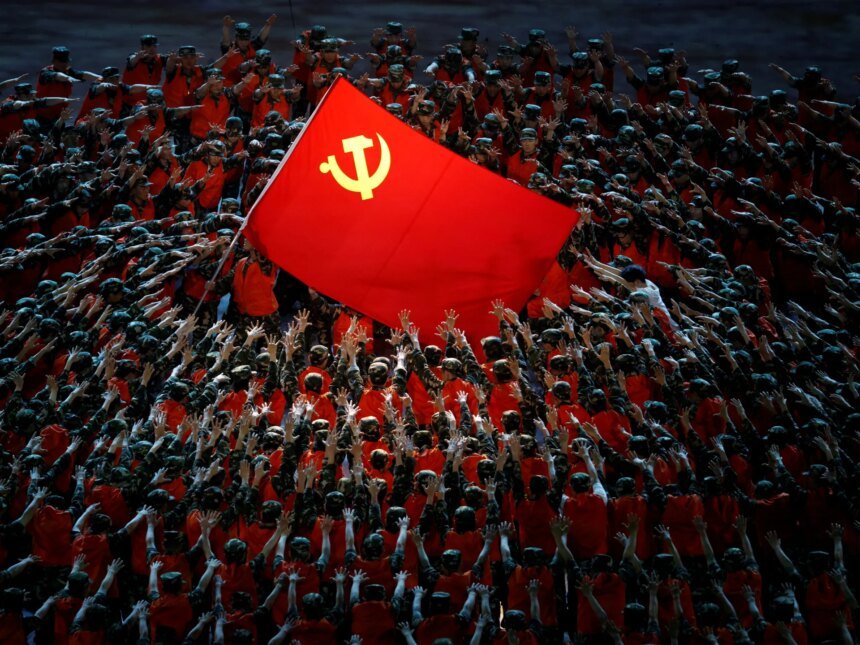
On the 105th anniversary of the founding of the Chinese Communist Party, the relationship between China and the West still needs frequent resets after every international crisis, from regional, security and technical wars to supply chain disruptions and slowing global growth.
I focused Official and unofficial Chinese newspapers noted this occasion and placed it in the context of the power of…Two thieves Economic, to prepare the ground for a broader discussion about the “orientation towards the East” as a search for an alternative model for state management and development, in the face of a Western world engaged in its internal conflicts and political tensions.
Read also
list of 4 itemsend of list
The East as a political destination
The Chinese People’s Daily described the rise of the idea of ”Looking East” as a tangible phenomenon and not just a slogan, as leaders’ visits to Beijing increase, global capital’s expansion plans in the Chinese market accelerate, and academic circles intensify their studies of the Chinese political experience.
The Chinese Communist Party’s mouthpiece newspaper quoted Western reports describing China as having become a “new diplomatic center of attraction,” indicating that part of the weight of global decision-making has shifted toward the East.
This turn towards China is not only read as a search for economic opportunities, but also for a different governance style, because the question that is repeated by the global academic community and in Western analyzes quoted by the People’s Daily is “Why did the Chinese Communist Party succeed?” and “What has China done differently?”
These questions may implicitly reflect a state of review among some political and intellectual elites outside China, motivated by the limitations of the Western model in managing protracted crises.
A recurring question among the global academic community is, “Why did the Chinese Communist Party succeed?” and “What has China done differently?”
The party as a civilizing actor
The People’s Daily presents the Chinese Communist Party as “the world’s largest party” in terms of membership, as well as in its ability to formulate a long-term project beyond the traditional electoral cycle.
It brings to mind the statements of diplomats and journalists from Latin America and Europe to confirm that the “password” lies in focusing party policies on the idea of serving the people, and its identification with the concept of a developmental state that subjects political decisions to considerations of the public interest and not to individual interests or party competition equations.

In this discourse, Western parties, subject to the pressures of capital and changing governments, are compared to a model of governance that considers “politics and strategy” a matter of life and death, while upholding the value of discipline and implementation as characteristics of “Chinese governance.”
This proposal explains with a critical view of liberal democracy the reasons for its inability to continue producing policies in the long term, without the discourse reaching the point of completely rejecting the Western model.
The philosopher Marcuse formulated the concept of “one-dimensional societies” as a criticism of modern industrial societies, both capitalist and socialist.
Breaking the centrality of the West
In the series “From Yan’an to the World” published in the Huan Qiu newspaper, the concept of “Chinese modernization” is presented as a civilizational path that competes with, and even surpasses, the Western model that has prevailed for at least two centuries. The title links the beginning of the revolutionary struggle of the Chinese Communist Party in the city of Yan’an with the path that later led to the renaissance of modern China and its global influence.
The writer stresses that modernization does not necessarily mean “moving towards the West,” and that the Chinese experience has provided practical proof of the possibility of building a major industrial country that started from a “poor and backward country” to become the second largest economy in the world, without adopting a traditional liberal template.
The analysis goes beyond the economic aspect by criticizing the idea of “hegemony of capital” that has characterized Western modernity and its environmental, social and cultural effects, citing the vision of the philosopher Marcuse, one of the most prominent figures of the Frankfurt School of Critical Theory, in which he formulated the concept of “one-dimensional societies” as a criticism of modern industrial societies, both capitalist and socialist.
While the writer – a professor of political science – presents Chinese modernization as a system that seeks a balance between matter and spirit, and between economic growth and environmental protection, by adopting the slogan “Man First” and considering man and nature as part of a single life system.
Pluralism in civilizations
A central idea in this speech is the rejection of the “clash of civilizations theory” formulated by Samuel Huntington, which holds cultural and religious differences responsible for international conflicts.
On the other hand, the Chinese project is presented as a call for “the exchange and blending of civilizations,” through initiatives such as the Global Civilization Initiative, which calls for respecting diversity, promoting common values, and expanding the scope of human dialogue through cultural exchange.
This proposal is not limited to the moral dimension, but rather carries a clear political dimension, as it places China in the position of a “civilizational mediator” capable of alleviating international tension through a discourse that rejects Western civilizational superiority, but it does not slide into a confrontational counter-discourse, but rather seeks to formulate a common value ground such as peace, development, and justice.
Long-term governance
The China Daily newspaper supports this picture from the perspective of governance, as it presents the Chinese governance model as being based on “continuation and experimentation” at the same time, and points out that the five-year plans are not just technical documents, but rather links in a strategic path that begins with long-term goals and translates into medium and short-term steps, with a wide margin for experimentation at the regional and sector levels before generalizing policies.
The newspaper also focuses on the idea that the legitimacy of governance does not necessarily require party competition, but rather the regime’s ability to achieve tangible results in people’s lives, with what it calls the “mass line” that transforms successful practices in the social base into national policies.
In this context, the Communist Party is presented as a “civilized party” that is the guardian of a long-term historical project, and not just a political organization that is based on its electoral power alone.
Behind this model stands an extended political culture, inspired by classic texts such as the book “Changes” to emphasize the idea of stability in goal and change in tools, in a way that makes stability a result of continuous adaptation away from stagnation.
Alternative or reference model?
According to what these readings reflect, China seems keen to formulate an integrated narrative represented by a historical party leading a long development project, a path of modernization that rejects the dominance of capital and the logic of the clash of civilizations, and a governance model based on long-term planning with a continuous capacity for reform and experimentation.
This narrative seeks to present the Chinese model as a potential alternative to the West, but at the same time, the official discourse tries to avoid presenting it as a ready-to-export template, preferring to talk about “quotable experience” and “multiple options” for developing countries.
Although this proposal remains selective in highlighting strengths versus internal challenges, it reflects a real shift in the balance of ideas at the global level, as the West is no longer alone as the exclusive reference for modernization paths.
At the conclusion of the scene, “looking towards the East” will not be a spontaneous impulsive movement towards a complete new model, but rather a gradual process of searching for alternatives in which considerations of development, stability and civilizational identity intersect, in a world that is gradually moving towards recognition of the inevitable pluralism of the paths of modernity.