

Published On 7/6/2026
|
Last update: 07:48 (Mecca time)
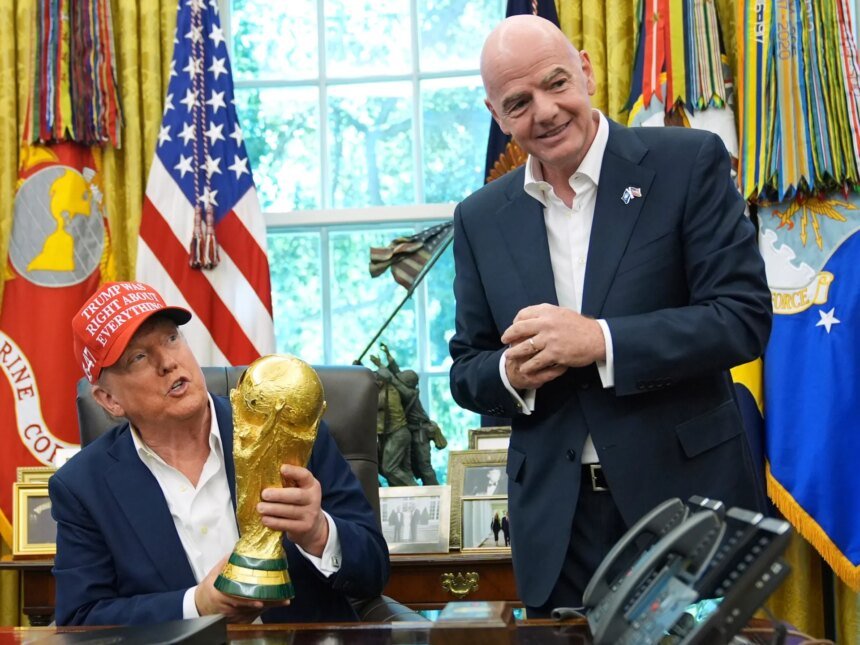
The controversial phone call made by US President Donald Trump to FIFA President Gianni Infantino, requesting that the red card received by striker Folarin Balogun be reconsidered, was not an isolated case or a unique precedent. The history of the World Cup in football is replete with incidents in which politics invaded the green rectangle, transforming the World Cup in some of its stages from a global sports wedding into an arena for settling scores or polishing regimes.
World Cup 1934: Fascist bias
Fascist Italy hosted the second edition of the World Cup, and the Duce, Benito Mussolini – who, unlike his people, did not like football – found in this event a golden and ideal opportunity to glorify his political system and show off his power. Mussolini was keen to attend all matches, and would personally go to the players’ dressing rooms. In that version, the arbitration seemed blatantly biased towards the host country that ultimately won the title, to the point that FIFA later took an unprecedented decision to ban two referees for life.

World Cup 1938: “Victory or Die”
One year before the outbreak of World War II, politics once again cast a dark shadow over heroism. Austria – which had recently been annexed to Nazi Germany – announced its withdrawal, and a number of its players were forced to play in the German national team’s jersey, while being forced to perform the Nazi salute in the Parc des Princes stadium. Despite this absurdity, Germany exited the tournament in the round of 16.
Read also
list of 2 itemsend of list
As for Italy, it retained its title in a tournament during which its players wore black shirts reminiscent of the uniforms of fascist militias. Before the start of the final match against Hungary (which ended with Italy winning 4-2), Mussolini sent his players a short telegram, but it carried a terrifying threat: “Victory or die.” Regarding this controversial telegram, Hungary’s goalkeeper at the time, Antal Sabo, made his famous statement: “It is true that I conceded four goals, but at least I saved the lives of 11 men.”

World Cup 1978: Argentina’s suspicious hexagon
The tournament was organized under the dictatorship of General Jorge Rafael Videla, and its primary goal was to burnish the image of the oppressive regime before the world. That edition witnessed Argentina winning its first title, but the joy of the coronation was shrouded in strong suspicions of political corruption. To reach the final, Argentina had to beat Peru by at least four goals in order to overcome Brazil. Ironically, the Peruvian team – which had shown remarkable defensive solidity at the beginning of the tournament – collapsed in a strange way and lost by six clean goals. Over the years, there have been many testimonies talking about a political deal between the two dictatorial regimes to achieve this outcome, despite the absence of conclusive proof.

World Cup 2026: Trump’s phone saves Balogun
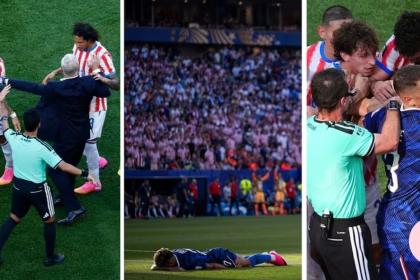
Political interference has returned to the forefront of the scene in the current edition, after US President Donald Trump expressed his strong dissatisfaction with the direct red card that American striker Folarin Balogun received during his country’s victory over Bosnia and Herzegovina in the round of 32, a card that meant his automatic suspension from the decisive match against Belgium.
Not only did Trump criticize, but he personally contacted FIFA President Gianni Infantino, demanding that the decision be reconsidered. Only four days passed until the International Federation announced, in a surprising step, that the punishment would be amended by the Disciplinary Committee, and the suspension would be converted into a “suspended execution with a probationary period extending for one year.” As a result of this blatant presidential intervention, the American national team’s top scorer is ready to lead his country’s attack in the upcoming Seattle battle against the “Red Devils.”