

It is 26 July, 1998. The Supreme Court has ordered the conversion of all public vehicles, including diesel-driven buses, taxis (diesel and petrol) and petrol-driven three-wheelers in Delhi to compressed natural gas (CNG).
Now, nearly three decades later, Delhi has another transition to go through – from petrol, diesel and CNG to electric vehicles. According to the Delhi EV Policy 2026, starting 1 January 2027, only new electric auto-rickshaws and N1 goods carriers will be registered. And, from 1 April 2028, only new electric two-wheelers will be registered.
Advertisement – Scroll to continue
Describing it as a “landmark initiative”, Delhi Chief Minister Rekha Gupta said it is “to curb vehicular pollution and accelerate the transition towards clean, sustainable mobility in the national capital.”
But can EVs solve the problem of Delhi’s infamous air pollution? Before we answer that, we need to understand the sources of air pollution in the capital.
What Pollutes Delhi’s Air?
As per the meta-analysis of source apportionment studies (2015-2025) submitted by the Commission for Air Quality Management (CAQM), particulate matter (PM 2.5) is the dominant pollutant impacting Delhi’s air quality.
The report indicates that during winter months, major contributors to PM2.5 include secondary particulates (transformed from gaseous emissions from transport, industries, power plants, biomass burning, among others] (27%), transport (23%), biomass burning (20%), dust (15%) and industry including thermal power plants (9%).
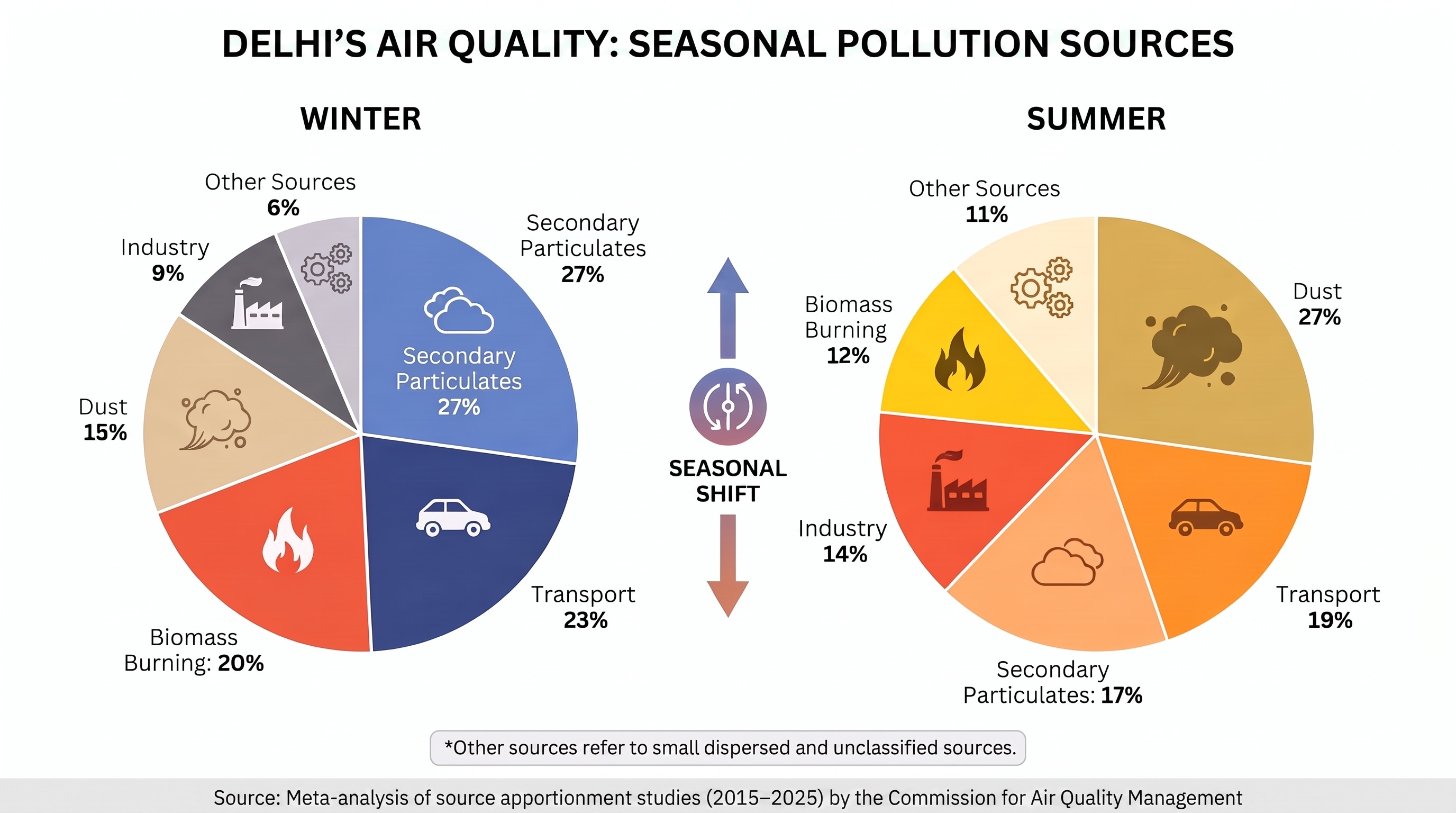
During summer months, dust emerges as the dominant contributor to Delhi’s air pollution at 27%, followed by transport (19%), secondary particulates (17%), industry (14%) and biomass burning (12%).
Blanket Ban, Too Harsh Of A Decision On Two- And Three-Wheelers?
Data from the VAHAN portal shows that Delhi has over 1.6 crore (1,62,45,341) registered vehicles as of 4 July, of which two-wheelers make up the largest share at 1,05,07,268, followed by 6,21,117 registered three-wheelers.
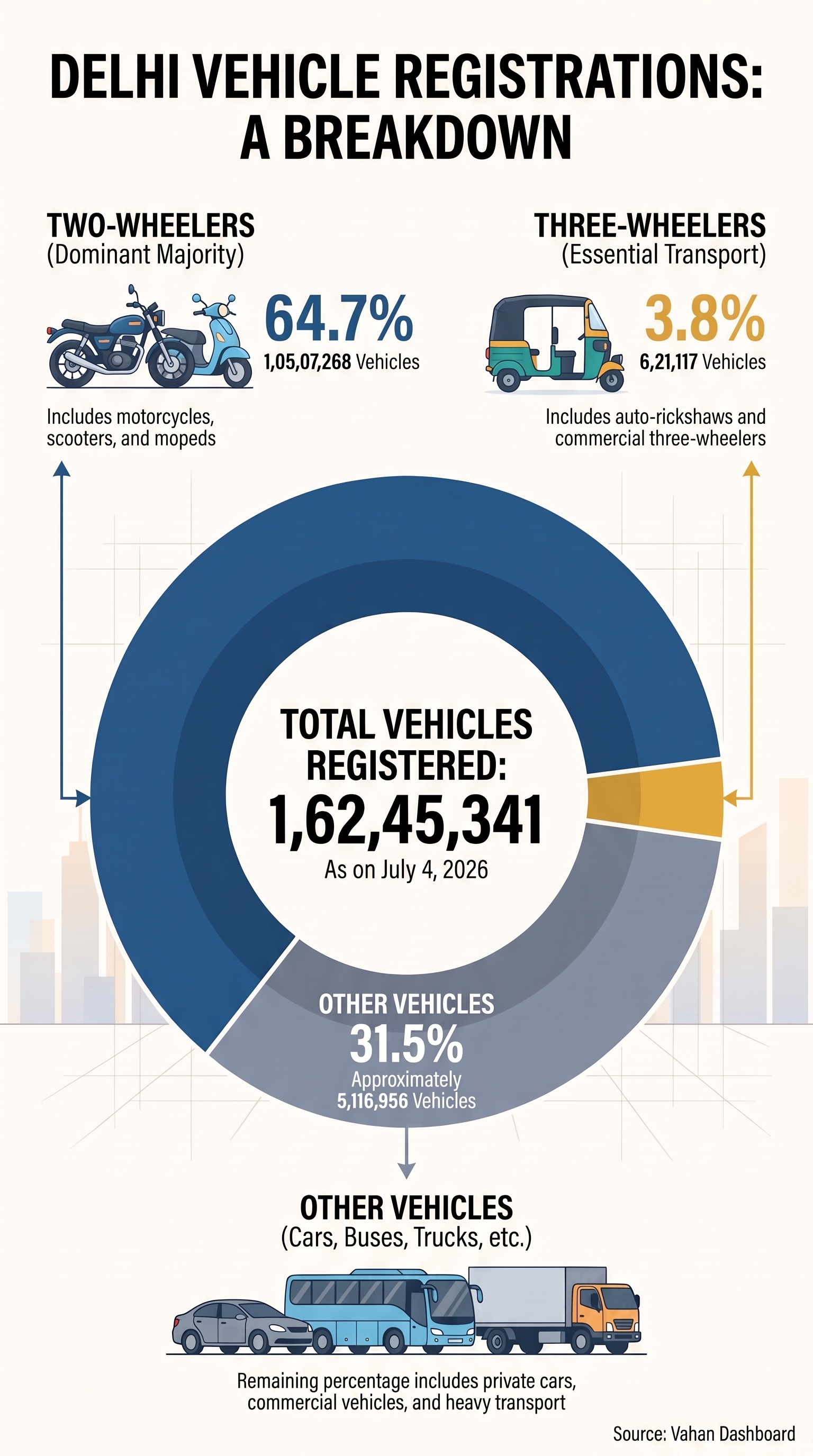
Of the 1.6 crore vehicles in Delhi, over 1.2 crore (1,28,32,710) are petrol-powered while only a per cent of it, that is 1,28,413 are pure EV vehicles, as per the VAHAN portal. Over eight lakh (8,51,603) are diesel-powered vehicles, and less than half that number (4,11,743) are CNG vehicles.
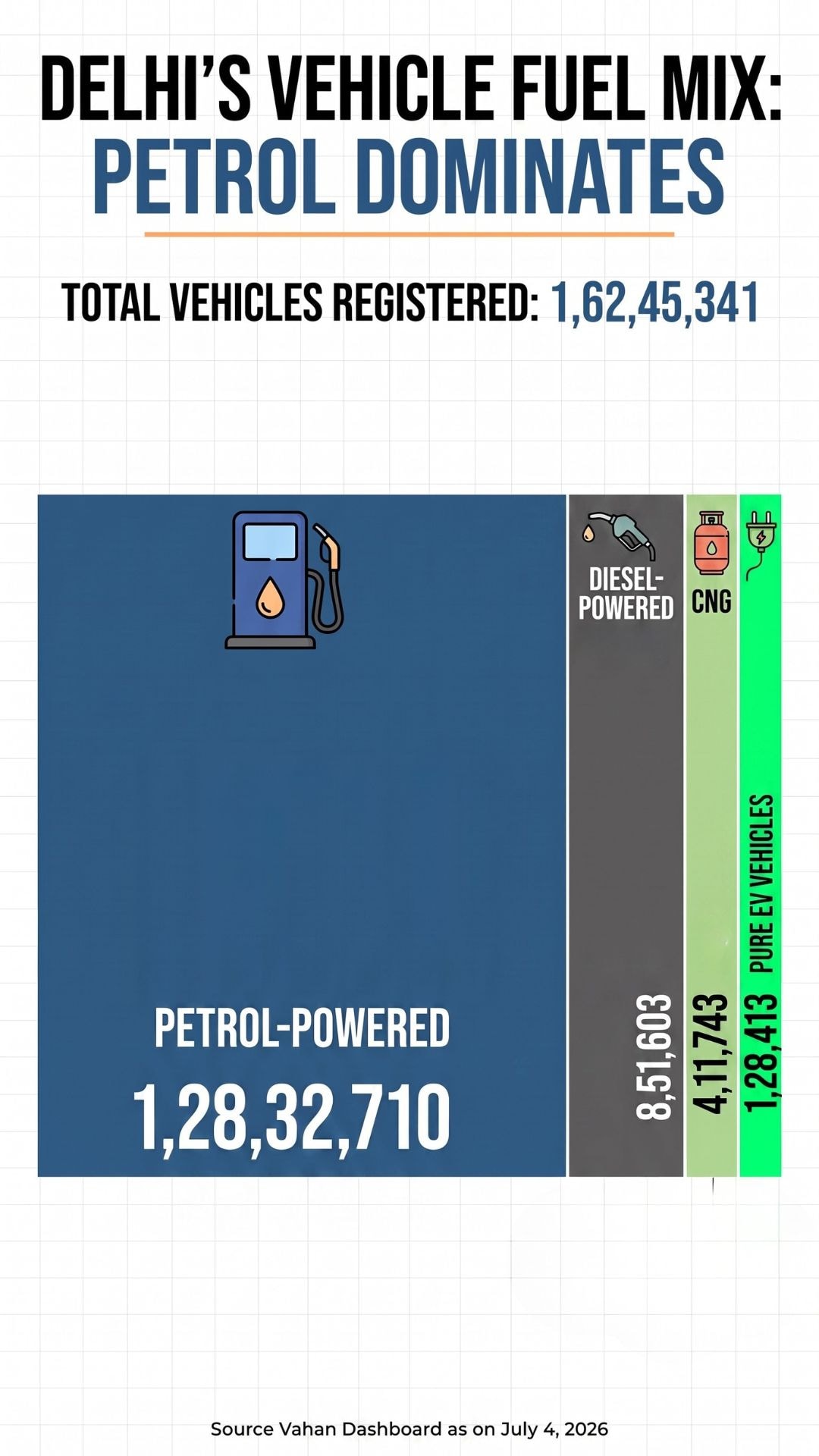
The numbers speak for themselves. Two and three-wheelers make up about two-thirds of the vehicular population in the city. Transitioning them to EVs means eliminating internal combustion engines from these two segments, says Anumita Roychowdhury, Executive Director of Research and Advocacy at the Centre for Science and Environment (CSE), a New Delhi-based think tank.
However, the government’s crackdown on petrol- and diesel-powered vehicles could have been harder, believes Amit Bhatt, Managing Director for India, at the International Council on Clean Transportation (ICCT).
“The government will stop registering new petrol or diesel three-wheelers from 1 January, 2027 and two-wheelers from 1 April, 2028, but existing petrol and diesel vehicles can still run. This means, if you buy a petrol-powered scooter on 31 March, 2028, you can still use it till 2043. The emissions will continue. In that perspective, the government has taken an easy and slightly relaxed approach. Having said that, I think what it does well is that it tries to solve the problem at the source by not creating a problem in the first place. If you stop registering new vehicles, then over the passage of time, the vehicles will get clean and it will form a zero-emission fleet. But it will take another 10-15 years for that to happen,” he explained.
Delhi EV Policy 2026 also extends to four-wheelers. To encourage electric car adoption, the government has announced a 100 per cent exemption on road tax and registration fees for electric cars with an ex-showroom price of up to Rs 30 lakh registered in Delhi.
The government has also introduced a Rs 1 lakh scrapping incentive for buyers purchasing a new electric car after scrapping a Delhi-registered BS-IV or older vehicle. There are also benefits for trucks and Gramin Sewa vehicles.
“In Delhi EV policy 1.0, we never had any incentive for the personal vehicle segment. Yet, the electric car market today is more than 10 per cent in Delhi. If this dormant demand can be stimulated with focused incentives and infrastructure development, then that is really going to take us forward,” adds Roychowdhury.
EVs On, Pollution Gone?
If all vehicles were to transition to EVs, will Delhi breathe clean? Not entirely. While transport is a major contributor, other sources would continue to pollute. However, pollution levels would fall significantly over time.
“If transport contributes to 50 per cent of PM 2.5 emissions, and let’s say, tomorrow all the vehicles become electric, then in your city, the PM 2.5 will go down by half. As simple as that. Now, the only problem here is that we are currently looking at new registrations, which is important. Against a national average of six and a half per cent growth in vehicle sales, Delhi has about seven and a half per cent year-on-year growth. The new registrations will only have an impact on pollution when there is a large fleet turnover,” explains Bhatt.
A transition to EV not just addresses tailpipe emissions but also dust on the road. Further elaborating on this, Bhatt said, “NOx (nitrogen oxides) emissions from vehicles form secondary particulate matter, which eventually results in dust. In other words, vehicle emissions also contribute to dust formation.”
Heavy-duty vehicles and trucks are major polluters too. So why focus on private vehicles? “Exposure to pollutants from private vehicles is relatively higher since they run through the day, when people are out on the streets,” explains Sunil Dahiya, Founder and Lead Analyst at Envirocatalysts. “As EVs replace polluting ones, we should also ensure that we shift from private individual vehicle ownership and usage to public transportation systems.”
Petrol To Coal, Are We Switching Source Of Air Pollution?
India’s total power generation during 2025-26 (up to March 2026) reached 1,845.921 billion units. Of this, 29.2 per cent (538.97 BU) was generated through non-fossil fuels, according to the Ministry of New and Renewable Energy.
In June 2025, India hit a milestone with 50 per cent of its installed electricity capacity coming from non-fossil fuel sources, five years ahead of the 2030 target set under its Nationally Determined Contribution (NDC) to the Paris Agreement.
In a world seeking climate solutions, India is showing the way.
Achieving 50% non-fossil fuel capacity five years ahead of the 2030 target is a proud moment for every Indian.
Hon’ble PM Shri @narendramodi ji’s leadership continues to drive Bharat’s green transformation — paving… pic.twitter.com/ydzWErWQNC
— Pralhad Joshi (@JoshiPralhad) July 14, 2025
However, coal remains a major source of electricity. Does switching to EVs mean changing the source of air pollution from roads to power plants? Roychowdhury rejects that argument.
“If you are really accounting for emissions from the source of the fuel, in this case electricity, then you need to compare it with the source of the oil that you’re using to run your internal combustion engine. When you talk about petrol and diesel vehicles, you are only looking at the tailpipe emissions. You don’t account for how much you are emitting because of the drilling and refining of that fuel,” she says.
To cut down on emissions from internal combustion engine vehicles, several efforts have been made, such as the transition to CNG, the implementation of BS-VI emission standards, and phasing out old vehicles. But tailpipe emissions cannot be fully eliminated.
“EVs eliminate exhaust emissions altogether. Several studies in India have compared life cycle emissions of vehicles across technologies and fuels and found that EVs are still cleaner than the petrol and diesel vehicles, even after accounting for the power plant emissions,” adds Roychowdhury.
To maximise the environmental benefits of EVs, Dahiya argues that charging must align with renewable energy generation. “EVs are charged during non-solar hours, at night, when we are dependent on coal for electricity. We need to create a time-of-day tariff structure, meaning charging electric vehicles should be cheaper and more lucrative for operators during solar hours when the electricity is cheap and comes from renewable energy sources.”
He also stresses working across sectors and addressing other sources of air pollution, including industries, and biomass burning in the capital, to completely move past the problem.
“The decision on whether we will be able to breathe clean air in future will depend on how we implement the policies available on paper and how well we coordinate across sectors, governance structures and regulatory bodies,” concludes Dahiya.