

Published On 7/6/2026
|
Last update: 12:43 (Mecca time)
In a new scene that reflects the increasing arms race in the Indian and Pacific Oceans, North Korea continued to test its nuclear missiles to enhance its military presence, in the wake of escalating geopolitical tensions.
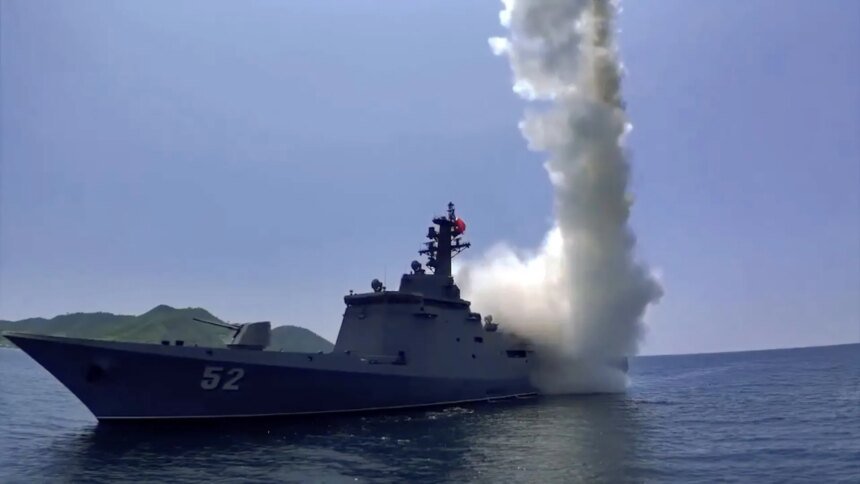
In the presence of its leader Kim Jong Un, Pyongyang conducted experiments on a weapon system for the destroyer “Kang Kun”, which weighs 5,000 tons, which included launching cruise missiles and using electronic warfare means.
Read also
list of 2 itemsend of list
The North Korean leader has previously pledged to provide his naval forces with nuclear weapons and develop new warships weighing 10,000 tons, in a move that reflects Pyongyang’s desire to expand its maritime defense capabilities, according to what Amr Al-Najjar said in his report on Al Jazeera.
While the two Koreas have been officially at war for more than seven decades, the pace of security and military rapprochement between South Korea and Japan and the expansion of their defense partnership is accelerating.

Indo-Japanese cooperation
As for India and Japan, they announced their commitment to promoting the concept of a free and open Indo-Pacific and agreed to expand defense and security cooperation, including plans to conduct joint exercises between the Japanese Self-Defense Forces and the Indian Navy.
In a press conference during her visit to New Delhi, Japanese Prime Minister Sanae Yakaichi said that expanding cooperation in the maritime field is important for regional security and peace.
Chinese-Russian maneuvers
Russia and China were not far from the deterrence race taking place in the region, as the Russian and Chinese naval and air forces began joint exercises on Monday in the waters and airspace adjacent to the Chinese city of Qingdao in the Pacific Ocean.
These maneuvers come within the framework of the growing military partnership between Beijing and Moscow, and the strengthening of military and security coordination to confront what they describe as increasing security challenges. These experiences, maneuvers, and military rapprochement reveal the transformation of the Pacific and Indian Oceans into an arena for strategic competition between powers.
In September 2025, China unveiled the Golang-3 (Ocean Wave-3) ballistic missile, designed for launch from nuclear submarines, which gives it the ability to carry out stealth strikes from the depths of the sea. This missile adds the element of surprise to China’s nuclear strategy, enhances deterrence, and ensures Beijing’s ability to respond if it is exposed to a sudden attack.
China also revealed – during a military parade described as the largest in the country’s modern history – an advanced arsenal of hypersonic anti-ship missiles, including the new “Ying Jie-15” (Eagle Strike-15) missile for the first time. It displayed other “Ying Jie” classes that had previously been tested against models of American aircraft carrier hulls.

A worrying radical transformation
This race represents part of the radical and disturbing transformation witnessed this year in international relations, which entered a new phase of strategic instability, with the decline in international transparency, and the collapse of historical arms control frameworks such as the “New START” treaty.
A report prepared by the Stockholm International Peace Research Institute (SIPRI) revealed that more than two thousand warheads are on maximum operational alert, mostly for Russia and America, and to a lesser extent France and Britain, with the possibility of temporary deployment from China and India.
After the dismantling of nuclear weapons was faster than the deployment of new ones since the end of the Cold War, the deployment of weapons rather than their dismantling has become more likely and rapid in the coming years.
The sky of the Pacific Ocean and its sea lanes are no longer a neutral space as it was after it turned into a stage for repeated power displays from rising powers or those trying to maintain their traditional military superiority.
As military movements around Taiwan intensify and US-Japanese alliances expand, Beijing and Moscow are building a joint deterrence theater over the same seas that the US Navy has occupied for decades.
Preparing for potential conflict
The Russian-Chinese maneuvers that began today near Japan and Taiwan are neither a passing nor a routine event, but rather a new episode of a profound shift in the balance of maritime power between Beijing and Washington, and an advanced step in building a joint deterrence system, carrying direct messages to Japan and its allies, and indirect messages to the United States about the balance of power in the Western Pacific.
The joint strategic air patrols between China and Russia this year reached their 11th sortie since 2019, according to the Chinese newspaper Global Times, which said that these patrols took place on a path extending over the Sea of Japan, the East China Sea, and the western Pacific Ocean.
At the same time, both Japan and South Korea quickly moved their fighters in response to these patrols, while Tokyo confirmed that it tracked Chinese H-6 and Russian Tu-95 bombers and their accompanying fighters, some of which crossed the Miyako Corridor, the vital port to the western Pacific Ocean from the East China Sea.
In a further context, a report on the Asia Times website revealed a strategic dimension that may be the most important in the deterrence equation, which is called the “repair gap” in the US Navy after a study warned that the ability to repair damaged “Arleigh Burke” destroyers in the Indian and Pacific theater is much less than what would be required for a major war with China.
The Asia Times quoted a report on the “The War Zone” website, saying that a leaked intelligence chip from the US Navy revealed that China possesses a shipbuilding capacity 232 times greater than that of the United States, at a time when Washington only has 8 large military yards.
Therefore, the coordinated repetition of exercises between China and Russia appears to be an attempt to build a higher level of communication aimed at mentally preparing adversaries to accept a higher level of risk around the front lines, and even represents an exercise in the integration of forces in a potential conflict, says Asia Times.
The US fleet repair crisis also reveals the difficulty of returning damaged ships to service in a long war scenario, which gives the Chinese-Russian maneuvers an additional deterrent dimension based on structural superiority in the ability to withstand losses and regenerate force.
Simultaneously, these transformations remind the United States and its allies that the balance of deterrence in the Western Pacific is not reshaped by the number of missiles and aircraft, but rather by who has the manufacturing and organizational capacity to keep its fleet at sea and in the sky for the longest possible period.