

Published On 5/7/2026
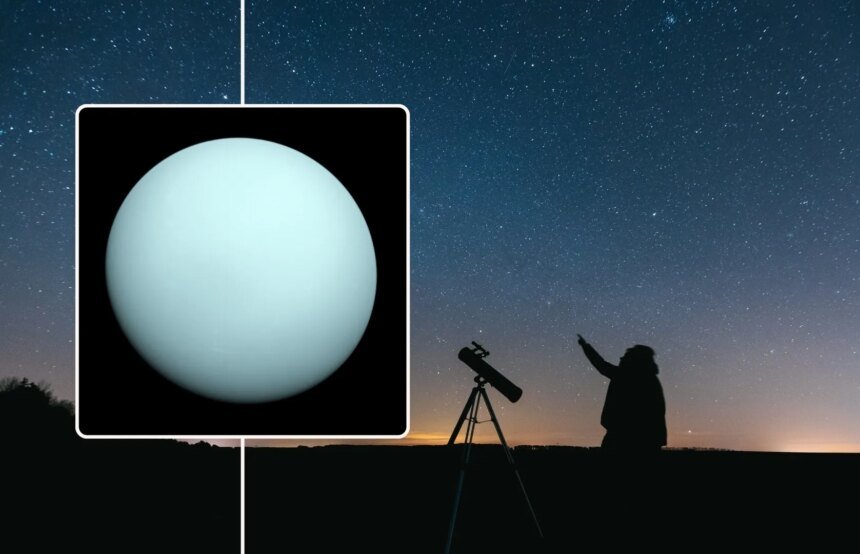
Since its discovery by the British astronomer William Herschel in 1781, the planet Uranus has remained one of the most difficult planets for amateurs to distinguish in the sky.
Uranus is the first planet discovered with a telescope, and not with the naked eye, as is the case with the six planets known since the dawn of history. It is located at a huge distance from the sun, so it appears very faint even in the best observing conditions.

But the sky gives astronomers a special opportunity this week, as the planet Mars approaches Uranus in a rare apparent approach, playing the role of a “celestial guide” that leads observers directly to the seventh planet without the need to move between faint stars or use complex maps.
Read also
list of 2 itemsend of list
Mars is the key… and the Pleiades and Aldebaran are the evidence
The ease of monitoring this time lies in the presence of three celestial landmarks that most amateurs know. In the dawn hours, the star Aldebaran, the brightest star in the constellation Taurus, appears in its reddish-orange color, while the famous Pleiades star cluster shines directly above it in the form of a small star cluster resembling a jewel in the sky.
Directly below the Pleiades, Mars appears as a clear red dot that is easy to distinguish even with the naked eye.
Here begins the final step; It is sufficient to direct the gaze slightly directly above Mars to find Uranus, which appears as a faint dot tending to a blue-green color without any luminescence. The observer does not need a large telescope. Once the location of Mars is determined, a small field telescope such as a 10 x 50 or a small telescope can be used to show Uranus more clearly.

If the observer follows with his naked eye in a real dark sky, he will glimpse the planet, as it shines with a magnitude of 5.8, which is at the limits of the visual ability of the human eye. Seeing Uranus with the naked eye is a challenge for astronomers.
Why is this method exceptional?
Finding Uranus is usually one of the most difficult tasks for amateur astronomers, because it does not differ much from the faint stars surrounding it, and the observer is forced to jump between similar star fields in order to reach it.
But during this conjunction, Mars will perform this task instead of the observer, as the two planets are located very close to each other in the sky, with an apparent separation that does not exceed about one degree (equivalent to the thickness of a little finger), a closeness that allows them to be seen together within the field of view of most binoculars.
This is why experts advise searching for Mars first, then looking up slightly to find Uranus, which is a much easier method than the traditional search that relies on astronomical maps.
An educational opportunity for astronomy enthusiasts
Observational experts believe that such conjunctions are the best way to teach amateurs to identify the sky practically, because using a bright body like Mars to discover a faint body like Uranus greatly reduces the difficulty of interstellar navigation.
These phenomena also provide an opportunity to understand the true movement of the planets, as Mars moves very quickly in its orbit compared to Uranus, and therefore their conjunction is repeated approximately every two years.

Specialists confirm that success in observing Uranus gives the amateur greater confidence in exploring the rest of the faint celestial bodies, and constitutes an advanced step in learning astronomical observation.
In a world full of screens and digital maps, the sky still gives people the pleasure of discovering itself. Every crime we find with our eyes carries a feeling that neither ready-made images nor smart applications can give.
Perhaps the journey to search for Uranus is a simple lesson in that the most beautiful discoveries begin with a step, a star, or a planet that leads us to a world far beyond what we could have imagined.