

Published On 7/3/2026
With the outbreak of the Ebola epidemic in the Democratic Republic of the Congo, population density and movement in the capital, Kinshasa, have become a challenge that places one of Africa’s most populous cities at the head of the health response and prevention plan, in an attempt to prevent the disease from reaching it.
Because it is the first to receive those suspected of being infected with the disease, Kinshasa is preparing its hospitals to protect health staff, patients and visitors, and is making efforts to prevent the spread of viruses in general, including Ebola, according to what was said by the Deputy Head of the Infection Control Department at Galbilo Hospital, Lisette Mabanida.
Read also
list of 2 itemsend of list
In a report prepared by Fadel Abdel Razzaq for Al Jazeera, Mapnida said that means for washing hands have been provided inside the hospital corridors and disinfectant materials at the entrance to each ward, and everyone is required to disinfect their hands.
For more than half a century, the Democratic Republic of Congo has faced Ebola since the announcement of the discovery of the first infection in the country in 1976, and it celebrated the end of the pandemic 16 times.
Currently, the Congolese government is dealing with the 17th strain, which bears the name Yuendeogu, after the largest city in western Uganda neighboring the Congo, where the first infection was recorded. It pledged to eliminate the new dynasty as it had eliminated previous dynasties.
At the same time, the Africa English organization is sounding the alarm about the spread of the disease and its health repercussions, and is using social networking sites to publish awareness materials calling for avoiding touching animals from which the infection can be transmitted to humans, and staying away from those infected and suspected of being infected.

Educating citizens
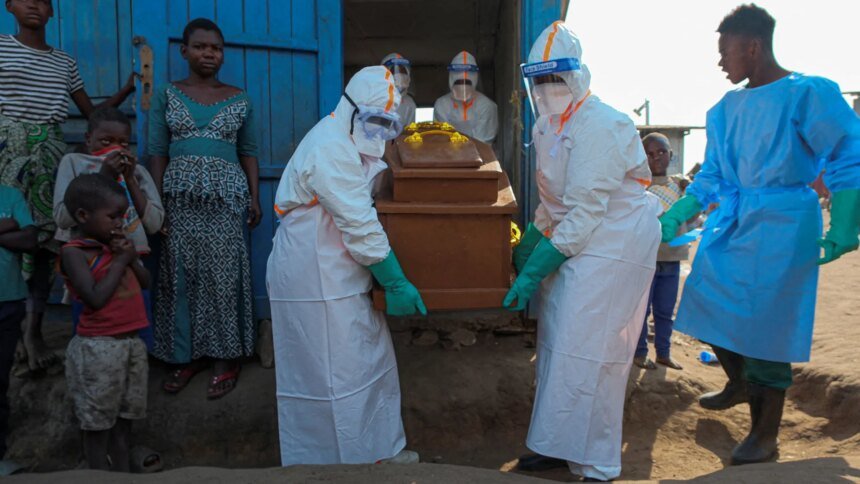
Africa Angelzone aims to warn people that the danger still exists and people must protect themselves, urging them to transfer suspects to treatment centers, and bury those killed by the disease, according to what its executive director, Frederic Bicombe, said.
With the outbreak of the epidemic, the government’s efforts are accelerating to stop the transmission of infection to the capital, Kinshasa, which requires adherence to precautionary measures and educating citizens about the dangers of this deadly disease.
A recent report by the United Nations Development Program revealed serious economic impacts as a result of the outbreak of the Ebola virus in some African countries. The report confirmed that the African continent may face major economic losses that exceed its capacity.
The Democratic Republic of Congo is the most affected country, as it alone faces the risk of losing more than a billion dollars of its gross domestic product, in addition to the loss of about 55,000 jobs.
Last month, the International Red Cross warned that the Ebola outbreak in Congo had not yet reached its peak, and the crisis was likely to continue for a full year before it was contained.
The New York Times reported that scientists are continuing their efforts to develop treatments to limit the spread of Ebola, which is witnessing an outbreak in both the Democratic Republic of the Congo and Uganda. The newspaper pointed out that two major non-profit organizations working in the field of vaccines announced the allocation of tens of millions of dollars in funding to support the development of new vaccines.
The newspaper quoted researchers as saying that evaluating the effectiveness of these measures will take months, suggesting that new treatments will gain great importance in the future, at a time when the disease may continue to spread during the coming period.

Dangerous epidemic
Ebola is considered a highly dangerous virus that infects humans, and the average death rate resulting from it is about 50%. The majority of recorded cases and outbreaks occurred in sub-Saharan African countries, so types of this virus were named by their names.
Ebola viruses are transmitted through contact between various bodily fluids, such as blood and saliva, or contact with contaminated surfaces and tools. It is not transmitted through the air like the influenza virus, and the infected person is not contagious until symptoms appear. Its symptoms begin in the form of fever and severe fatigue, and in its advanced stages, it may lead to deterioration of liver and kidney functions.
An outbreak of the disease was reported in the Democratic Republic of the Congo and Uganda in 2026, prompting international health authorities to declare a public health emergency.