


Published On 5/7/2026
In a study entitled “Paths of Controlling Arms in Iraq: Challenges and Possible Expectations,” researcher Raed Al-Hamid, issued by Al Jazeera Center for Studies, discusses the future of the Iraqi government’s efforts to control arms in the hands of the state, the internal, regional and international challenges surrounding this file, and possible scenarios for its outcome.
The study believes that the file of confiscating weapons in the hands of the state today represents one of the most complex files in Iraq, because it goes beyond the security dimension to the nature of the state itself, its ability to monopolize the use of force, consolidate the rule of law, and reorganize the relationship between official institutions and the armed factions whose influence has expanded since 2003, and then became more entrenched after the war against ISIS in 2014.
Read also
list of 2 itemsend of list
It explains that the continued presence of armed formations with independent decision making makes the state unable to fully impose its will, and makes political and security decisions hostage to the balance of power on the ground, which is reflected in investment, development, foreign relations, and the stability of the entire political system.
The study also confirms that the success of the “Development Road” project, attracting capital, and enhancing cooperation with the United States have become linked to resolving this file, in addition to the Ali al-Zaidi government’s implementation of its pledges related to arms control and unification of security decisions.
The study shows that armed factions are no longer merely combat formations, but have transformed into entities possessing a diverse arsenal that includes missiles, drones, and monitoring systems, as well as vast financial capabilities and influence within state institutions, including the judiciary.
She believes that the main problem lies in the overlap between the Popular Mobilization Forces, as an official institution funded by the state, and the factions that maintain their organizational independence and ideological and political affiliations, which makes some members combine belonging to the official institution with loyalty to their faction leaders, which puts the government before the dilemma of separating state resources and activities that are not subject to its direct authority.
The study also indicates that the Al-Zaidi government placed in its ministerial program an explicit pledge to restrict weapons to the state, unify security decisions, and link all military capabilities to official institutions.

The government approach and the position of the factions
The study shows that the new government abandoned the policy of direct confrontation and adopted a policy of gradual containment, out of awareness of the sensitivity of the issue and its internal and external entanglements. It believes that the selection of Ali al-Zaidi to head the government came within the framework of an attempt to avoid a clash with the United States, while at the same time seeking to preserve the cohesion of the coordination framework and the Shiite forces.
The study indicates that the government has set a time limit for ending the weapons file at the end of September 2026, coinciding with the end of the international coalition’s mission in Iraq.
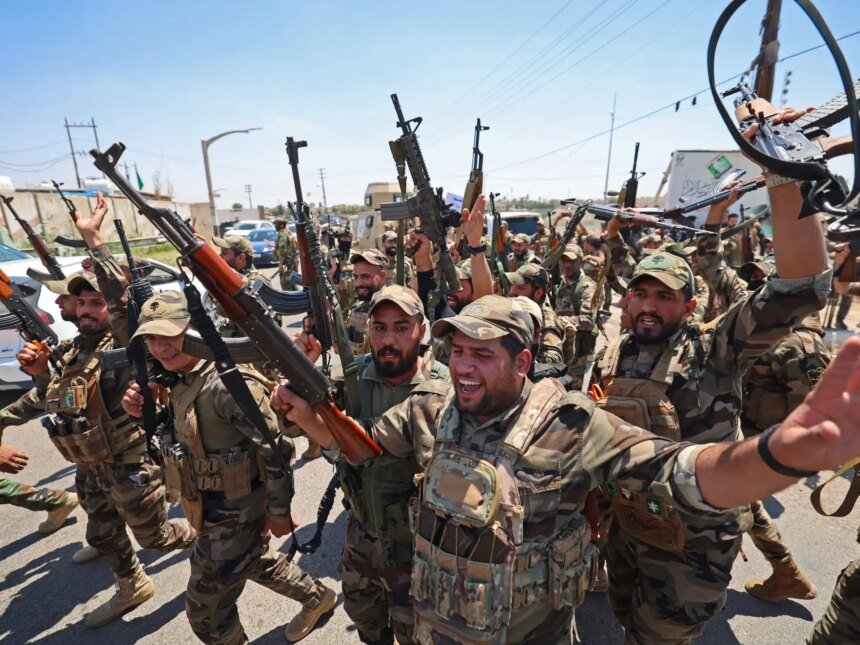
In this context, factions such as Saraya al-Salam, Asaib Ahl al-Haq, and the Imam Ali Brigades announced the start of procedures for separating from the Popular Mobilization Forces and preparing to integrate into state institutions, while other factions, most notably the Hezbollah Brigades, the Nujaba Movement, and the Sayyid al-Shuhada Brigades, maintained their refusal to hand over weapons, considering it part of the “resistance” project and not subject to government decisions.
The study believes that this internal division represents the most prominent features of the current stage, and makes the government’s success dependent on its ability to manage these disparities without sliding into open confrontation.
The study classifies the factions’ positions into three main tracks. The first includes the factions that accepted the merger, led by the Atabat Mobilization Forces, the Imam Ali Brigades, and Asaib Ahl al-Haq, which announced their support for imposing state sovereignty and restricting weapons, out of awareness of the importance of preserving their political and economic gains within the regime.
As for the second path, it is represented by the factions that practice a policy of maneuver, led by the Sayyid al-Shuhada Brigades, which show flexibility in their political discourse, but at the same time maintain an mobilizing discourse that confirms the continuation of the resistance approach. The third track includes categorically rejecting factions, such as Kataib Hezbollah and Harakat al-Nujaba, which consider their weapons a “red line,” refuse to submit them to government authority, and believe that the presence of foreign forces justifies their continued retention of their military arsenal.
The study indicates that this discrepancy is not limited to armed factions, but extends to political forces. The Sunni and Kurdish forces, along with large sectors of the civilian forces, support ending armed manifestations as a condition for stability and development, while the government still avoids announcing clear executive steps to collect weapons, despite the approaching date it set for completing the mission.

Regional and international position
The study believes that the future of arms control cannot be understood apart from the American-Iranian competition. The United States makes the dismantling of non-state armed systems a condition for developing its relations with Baghdad, and uses multiple tools, including economic support, security cooperation, and energy exemptions, to pressure the government to implement this path.
On the other hand, Iran declares that the issue is an internal Iraqi matter, but it maintains its close relations with a number of factions, and considers them part of the axis of resistance, while the data of the study indicate that the Revolutionary Guard continues to seek to preserve the capabilities of these factions, and even work to establish new networks that guarantee the continuation of Iranian influence in Iraq.
The study believes that this overlap forces the government to achieve a very sensitive balance between American pressures and Iranian considerations, in order to prevent the explosion of the internal scene.
Available options and conclusions
The study shows that Baghdad has two main options. The first is to resort to force, which is an option that it sees as extremely dangerous, because any confrontation within cities with factions that have significant combat experience may lead to a widespread security collapse and the disintegration of some state institutions.
The second option, which is suggested by the study, is based on gradual dismantling, by drying up funding sources, tightening control over outlets, and integrating individual fighters into state institutions, while gradually weakening the opposition factions, instead of direct military confrontation with them.
The study concludes that the most likely scenario is a gradual continuation of the path of containment and integration, rather than a quick resolution or open confrontation.
The government, in its estimation, will continue to reduce the influence of the rejectionist factions, in parallel with accommodating the factions wishing to shift to institutional work, while limited groups will remain able to carry out destabilizing operations, but they will not have the ability to topple the regime or drag the country into a civil war.
The study believes that American pressure, and the desire of most factions to maintain their political and economic influence within the country, will gradually push Iraq towards reducing the phenomenon of parallel weapons, even if the goal of collecting all weapons is not achieved in the foreseeable future.
Full study (here)