


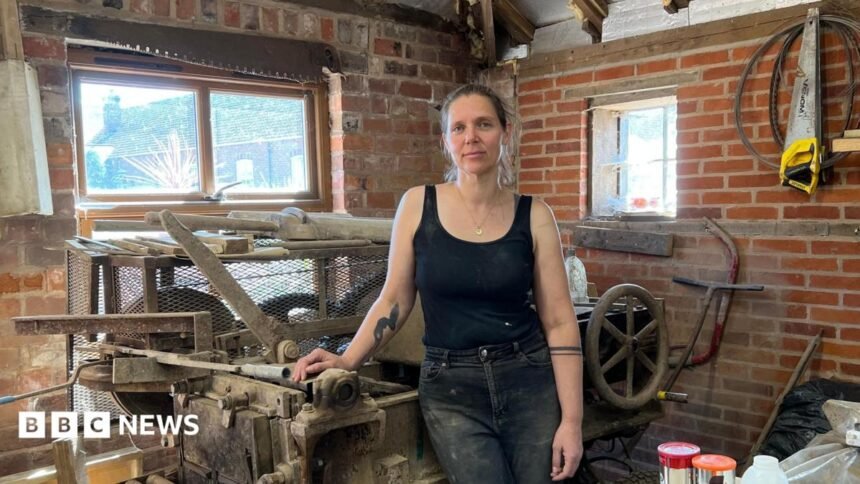

Tessa Oldroyd says she is “making history” at a 186-year-old tile-making site in North Lincolnshire
Tessa Oldroyd says she is “making history” at a 186-year-old tile-making site in North Lincolnshire
Standing beside a machine older than her grandfather, Tessa Oldroyd feeds clay through a clanky mechanism driven by iron cogs that have been turning for more than a century. In her hands, Britain’s tile-making past is very much alive. But a dozen miles away, its future is being reshaped.
The clay, most of which is dug from the Humber Estuary, arrives in heavy blocks and is stacked on pallets in the yard at William Blyth, in Barton-upon-Humber, North Lincolnshire.
Oldroyd – the only woman in a male-dominated workplace of 24 workers – explains how one block is placed into the machine, affectionately nicknamed “the stupid”, before the cogs turn and “squeeze the clay through a plate, extruding it into tiles”, which are then baked in its coal-fired kiln.
This is how roof pantiles have been made for generations at the site.
The small firm is one of about a dozen traditional companies surviving at a time when others in the industry are looking to modernise production in the face of significant economic pressures.

The William Blyth site in Barton dates back to the 1840s
The William Blyth site in Barton dates back to the 1840s
Pantiles, seen on rooftops across Britain, have a distinctive curved shape.
The machine Oldroyd is using dates back to the 1920s. Some equipment on site is much older and the work is far from easy.
“The most challenging thing for me probably would be lifting the clay,” she says.
But she wouldn’t trade her job.
“I’m glad to be actually making history.
“When I think about this site and how old it is and we’re still carrying on this tradition and the fact that lots of the tiles, if not all of them, will be here for hundreds of years to come.”
The work Oldroyd and her co-workers do today is part of a tradition stretching back centuries.
Though clay roof tiles were introduced by the Romans, the English industry grew up in the eastern part of the country during the 12th century.
By the early 1700s, pantiles were being made, with East Yorkshire and Lincolnshire becoming major centres of production.
Today about a dozen old school firms survive across the UK, according to the Roof Tile Association. William Blyth, founded in 1840, is among them.

Some of the machinery used by William Blyth dates from the 1800s
Some of the machinery used by William Blyth dates from the 1800s
In recent years, traditional manufacturers in the British ceramics sector have faced pressures including rising energy prices, higher labour costs and competition from cheaper imports.
The 200-year-old Denby Pottery fired its final pieces earlier this month before permanently blowing out its kilns. It prompted the chancellor to announce a £120m support package to help the sector.
“It’s an incredibly difficult situation at the moment,” says Noble Francis, economics director at the Construction Products Association.
Energy alone can account for up to a third of costs in ceramics manufacturing, he explains.
“I think unfortunately, these pressures are only increasing, especially in light of the Middle Eastern conflict.
“We’ve seen increases in industrial energy prices and that’s only going to make it more difficult over the next six to 12 months for ceramics manufacturers.”

Gabriel Nichols says William Blyth offers “a very niche product”
Gabriel Nichols says William Blyth offers “a very niche product”
According to data compiled by the Roof Tile Association (RTA), production in the UK clay roof tile industry fell from about 4.5 million sq m of tiles in 2021, to just over 3 million in 2025.
However, production was up by 5.3% between 2024 and 2025.
Ceramics UK said businesses had “experienced many of the same challenges as the wider construction products and ceramics industries”.
Francis says there are steps businesses can take to improve their long-term prospects, including understanding customers, focusing on a specialised market and diversifying their core offering.
William Blyth has done exactly that, with a garden centre and cafe on site.
“We are a very niche business and we make a very niche product,” says Gabriel Nichols, the firm’s specialist manager. “We are the last makers of handmade pantiles pretty much in Europe now, a lot of the factories have closed.
“You’re not going to put our tiles on a new-build house made of machine-made bricks. They’re going to go on a new-built house that’s made of handmade bricks or a restoration project.”

William Blyth stands in the shadow of the Humber Bridge
William Blyth stands in the shadow of the Humber Bridge
While the Barton team work clay through century-old machinery, a different version of the industry is taking shape north of the Humber.
At Wienerberger’s factory in Broomfleet, East Yorkshire, construction is under way on what the company describes as “the world’s first fully electric tunnel kiln” for clay roof tiles.
The project, part of a £37m investment, which includes £4.3m in government funding, aims to transform production in the UK with upgraded facilities and retrained staff for a more modern industry.
Where traditional kilns rely on gas or coal, Wienerberger’s system will use a fully electric process, with part of the electricity generated on site using the firm’s solar farm. The Austrian company says it is designed to cut 4,700 tonnes of carbon dioxide per year.
“This is quite of a big step for the Wienerberger Group because it’s the first time that we’re going to have a clay roof tile in the world that will be fired on electric,” senior engineer Emilande Renard says.

Wienerberger is building what it describes as “the world’s first fully electric tunnel kiln”
Wienerberger is building what it describes as “the world’s first fully electric tunnel kiln”
Wienerberger, which is also building a hydrogen kiln at its brickworks in Denton, near Manchester, says it sees modernisation and the use of new technologies as a long-term strategic move, designed to reduce carbon exposure and meet changing regulation and customer expectations.
But that transition is not cheap when electricity remains more expensive than gas.
The 207-year-old company, which has had a UK presence for 25 years with 14 factories in England, says the decision is not about short-term savings, but long-term resilience.
Investing in an electric kiln means the firm is “strengthening the long-term viability of UK brick and roof tile manufacturing”, says Renard.
Francis says innovation is “absolutely critical” in energy-intensive manufacturing.
At William Blyth, however, Nichols believes modernisation could undermine what makes their tiles valuable: their variation, texture and character.
Instead, the business relies on something less tangible: heritage.
As Oldroyd puts it: “There will always be customers that want something handmade and something that has history.”
Listen to highlights from Hull and East Yorkshire or Lincolnshire on BBC Sounds, watch the latest episode of Look North.
Get in touch
Your Voice
Download the BBC News app from the App Store, external for iPhone and iPad or Google Play, external for Android devices
Related topics
UK cement production drops to lowest levels since 1950s
‘People don’t expect to see a female lorry driver’
Planning bids for new homes rise in England but building remains low, data suggests
View Roman toddler’s footprint at pop-up museum
Related internet links
Construction Products Association
Wienerberger
William Blyth