


Logging with a twig should attract people to return to Taliban rule – the government is the hidden sender
Published 09.47

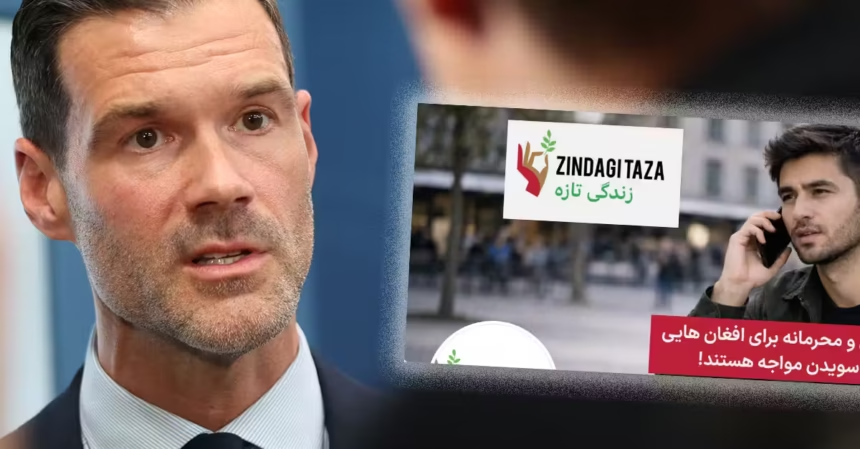
A hand holding green leaves and the text “new start” in Persian – the campaign that will get hundreds of Afghans in Sweden to return voluntarily.
But the fact that the Swedish government is behind it must be completely hidden, according to a report.
– I will ask responsible officials at the Ministry of Justice to follow up on this, says Migration Minister Johan Forssell.
Last year, the government spent just over eight million kroner on the campaign, which targets Afghans who have received deportation orders, but who for various reasons have not left Sweden. Currently, most countries in the EU, including Sweden, do not forcibly deport people to the Taliban regime Afghanistanas there is no organized reception. Afghanistan ranks at the bottom globally when it comes to human rights, democracy and equality.
One of the goals of the campaign is therefore to encourage at least 200 Afghans in Sweden to get on the plane to Kabul voluntarily.
But the fact that the Ministry of Justice is the sender behind the campaign must be hidden in every way, according to the report from the international organization Seefar, which received the assignment.
“For ethical and strategic reasons” the project will not in any way refer to or mention the Swedish government, they write there.
Instead, they have developed a new brand, “Zindagi Taza”. It means “fresh start” or “new life” in Persian.

According to the report, the reason why the sender is deliberately hidden is that many in the Afghan group are traumatized by meetings with Swedish authorities. Therefore, the word “return” should also be avoided – it can raise suspicions for many who are afraid to go back, the report states.
The project’s “visual identity” has been developed by a graphic designer, who worked on the logo for two months. It represents a hand holding a green sprig, and should bring to mind “hope, renewal and a new beginning” in of the Taliban Afghanistan. Nowhere is the Swedish government’s role or funding stated.
Nor is the sender mentioned on the campaign’s YouTube channel or Facebook page. On the contrary, it says on Facebook that they offer free counseling for Afghans in Sweden, and that “the service is independent of government authorities”, even though the Ministry of Justice is the client.

To be distributed discreetly – with selected advisers
Seefar’s report emphasizes how important it is that the campaign goes under the radar. It must be distributed discreetly, with the help of specially selected “advisors”.
These people are to be recruited from Swedish and Afghan voluntary organisations, mosques, cultural associations and from among Swedish-Afghans in whom many in the group have great confidence. The counselors must be paid for the work of getting people to return voluntarily.

Their role is to contact potential returnees and highlight positive aspects of starting over in Afghanistan – despite the fact that the Swedish Foreign Ministry has been advising against travel to the country for several years due to the difficult security situation.
The campaign’s pilot project tried to use chats in the online computer game PUBG, Player Unknown’s Battlegrounds, popular among young men, to seek out potential returnees. However, after tests with PUBG in the Afghan group, they chose to focus on information materials and phone calls instead, according to Seefar.
Aftonbladet has spoken to several people in Swedish-Afghan association life, who were contacted by the campaign. They are skeptical that hundreds of people will heed the message to go back and believe that the situation in their home country is catastrophically bad right now.

The government has received criticism for participating in the EU talks with the Taliban regime. According to Migration Minister Johan Forssell, the Taliban meeting is intended to get Afghanistan to accept convicted criminals who are deported from Sweden. The focus of the Seefar campaign, however, should not be criminals, but people who have received deportation orders and who it is hoped will return to Afghanistan on their own.
Voluntary returns are also more cost-effective than expensive forced deportations, Seefar themselves have found.
The Zindagi Taza campaign, which will get at least 200 Afghans to go back to Afghanistan on their own initiative, will last until August this year.

“Deeply unethical”
Torun Elsrud, associate professor of sociology and teacher of social work at Linnaeus University, who researches among other things asylum seekers in Sweden, thinks that the return project is problematic in several ways.
– It must be remembered that the Afghans who are here fled from terrible circumstances in one of the world’s most dangerous countries. Trying to get them to return to Taliban rule – and also to hide who is financing this – is deeply unethical, says Torun Elsrud.
However, she is not surprised that they are trying to hide the sender and believes that many Afghans have very little trust in the Swedish authorities, among other things because of long asylum processes and that they have had to endure a lot of mistrust.
– But even if the sender is hidden, I have a hard time seeing how to get even 200 people to return. Some Afghans I have spoken to would rather die than return. Many flee on to other European countries where they are often granted the refugee status they were denied in Sweden. It is also a big loss both financially and from an asylum legal perspective.

“Participants receive clear information”
Seefar’s CEO Paul Clewett answers Aftonbladet’s questions by email and believes that even though the project is financed by the Swedish government, it is conducted completely independently.
“The financing is not hidden and it is public knowledge that Seefar has been contracted by the Swedish government,” writes Clewett.
He believes that they do not try to persuade people to return to Afghanistan, but only work with people who themselves are thinking about or considering returning and want advice and support about how it can be done.
“Participants are given clear information about what the project offers, they agree to proceed and participation is completely voluntary at every stage of the process,” writes Paul Clewett.
Do you see any ethical problems with trying to convince Afghans to return to a country that is today ruled by the Taliban, where there is a lack of democracy and respect for human rights?
“No, because that’s not what we do. We only provide independent support to people who have already decided to return or who want advice on how a return can go about. Seefar does not design or decide on migration policy. That is the responsibility of national governments.”
Forssell: “Not aware”
Migration Minister Johan Forssell claims that he did not know that the sender behind the campaign was hidden – even though this is explicitly stated in the report that Seefar submitted to the Ministry of Justice.
– The Ministry of Justice has not been aware that Seefar has hidden senders or financiers, he writes in an email to Aftonbladet.
– It is important that the projects and organizations we support are well-functioning and efficient. It is also a matter of course that it should take place in a way that is as neat and transparent as possible. I will therefore ask responsible officials at the Ministry of Justice to follow up on this. If there is reason to clarify routines and our expectations towards Seefar, it will happen, with the expectation that measures will also be taken, he writes further.
Johan Forssell does not answer the question of whether there are ethical problems with encouraging people to return to the Afghanistan of the Taliban regime, but writes in the email:
– A cornerstone of regulated immigration means that people who have their asylum application rejected in a legally secure process, and thus lack grounds for asylum and a legal right to be in Sweden, must return to their home countries. All parties in the Riksdag agree on this.