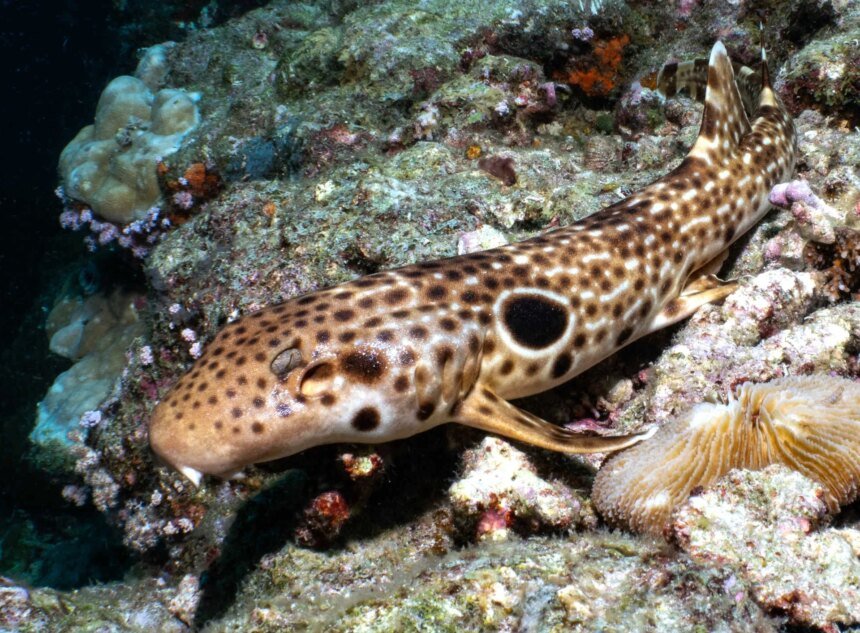
Residents of southeastern Papua New Guinea have long known a strange fish capable of “walking” on shallow coral flats during low tide, while most of its body remains outside the water for sometimes up to two full hours as it moves between coastal pools, an extremely rare ability among sharks.
Locals call it “Kaddikidiwa,” a name that can roughly be translated as “dog shark” or “lazy shark,” in reference to its slow, swaying style of movement in shallow waters.
Now, scientists have been able to identify this creature as a new species that had not been scientifically described before. They gave it the scientific name “Hemiscelium dodjonae” or “Dodgeon’s Walking Shark,” in honor of the ecologist at the University of the Sunshine Coast in the Australian state of Queensland, Christine Dodjohn, who was part of the scientific team that officially described the species.
The researchers described the new species – the first to be added to the genus Hemiscelium, also known as epaulette sharks, since 2013 – in a study recently published in the Journal of the Ocean Science Foundation.

An unexpected encounter in shallow water
Christine spotted this shark for the first time after midnight one day in March 2025, while diving in shallow water no more than one meter deep above a seagrass meadow in Milne Bay, located off the southeastern coast of Papua New Guinea and open to the Solomon Sea.
Christine, who has devoted more than 20 years to studying this genus of sharks, was swimming in search of another type of walking shark, known scientifically as the Hemiscelium michaelii, or the Spotted Eibolite Shark, or the Eibolit Michael Shark, which is distinguished by its tiger-skin-like patterns, when she came across a creature approximately one meter long, quietly gliding along the sea floor.
When she directed the light of her flashlight in front of him, he froze in a defensive reaction. She approached him, held him gently, then turned him onto his back and pinned his tail under her armpit, a method called “flip and hold,” which is used to temporarily silence some sharks to make them easier to handle.

A clear difference from known species
After securing the shark, Dudgeon handed it to fellow study principal investigator Jess Blakeway, also a marine biologist and PhD student at the University of the Sunshine Coast, who was waiting on a boat slowly drifting nearby.
From the first moment, Jess realized that the shark’s color pattern and skin markings did not match other previously known species of sharks, which are very similar in size and general body shape. They all feed on small invertebrates that live at the bottom of the sea, and do not pose a danger to humans. Therefore, scientists rely mainly on skin patterns, colors, and geographical distribution to distinguish between them.
Speaking to Al Jazeera Net, Jess says, “This species is characterized by a unique pattern of short white lines and brown spots that reminded me of Braille or Morse code, and it is a pattern that clearly differs from the rest of the species that we work on and know within this genus.”
This species belongs to a unique group of walking sharks that have developed a special ability to use their four pectoral fins as limbs for movement on the sea floor, allowing them to spend most of their time in shallow waters, where they swim between seaweed fields and coral clusters scattered in Australia and the island of New Guinea.
“This trait is very useful in shallow coral environments, especially during low tide,” Jess explains. “By moving between secluded tidal pools at low tide, these sharks can access prey that many other predators cannot.”

Genetic analysis reveals identity
During the following days, the team continued to search for other individuals of this shark, and were able to catch 11 additional individuals with the same color pattern, which strengthened their confidence that they were facing a new type of shark that was not known to science before.
But proving that it was a new species was not possible based on external appearance alone. To confirm this, the researchers collected biological samples from 9 individuals before releasing them again into their natural environment, while they kept three other individuals for detailed studies.
The researcher says, “Upon returning to the laboratory in Australia, we conducted DNA analyzes that showed that these sharks differ genetically from all previously described species within the Hemiscelium genus.”
She added, “Genetic analyzes confirmed that the walking shark represents an independent subspecies within the genus of walking sharks, and not just a color or morphological difference to one of the previously known species, which confirmed its status as a new, scientifically independent species.”
Limited scope of spread
Scientists are still in the early stages of studying this species, but they believe that it has the smallest known geographic range of all the shark species discovered so far, and that it generally has limited ranges, which makes it more sensitive to local threats.
Jess points out that Papua New Guinea is one of the world’s richest regions in biodiversity, but access to many of its areas represents a major logistical challenge. As a result, large areas of it are still not sufficiently scientifically explored, and have not been subject to regular field surveys.
The samples were collected between the Amphlett Islands and the Trobriand Islands, located north of Milne Bay. However, researchers expect that the species is widespread throughout the D’Antrecasteau archipelago and the Trobriand Islands, and its presence may extend to Moiwa Island, located about 274 kilometers northeast of Milne Bay.
“Our current knowledge of the geographic distribution of Hemiscelium dodjonae is based on field surveys carried out in Milne Bay and Oro counties, as well as available historical observations and photographic records. However, further studies are still needed to accurately determine its full range,” says Jess.
She adds, “Although this discovery adds a new species to the exceptional biodiversity that Papua New Guinea enjoys, especially in the Milne Bay region, it also highlights how much we still do not know about biodiversity in this region. More importantly, it raises new scientific questions about the mechanisms that led to the emergence and differentiation of new species in this biologically rich region.”
She continues, “One of our main priorities is to determine the full geographical range of the species more precisely, and to understand the nature of the threats it faces. We also seek to study the effectiveness of existing local management systems, such as locally managed marine areas, and understand the extent of their contribution to protecting and preserving this species.”

Fears of extinction risk
Although scientists have only recently identified this unique type of shark, the discovery from the first moment raised serious concerns about the fragility of the status of this new species and its ability to survive, as they believe that it may face local extinction unless urgent and effective protection measures are taken to ensure its survival.
This species faces a range of environmental threats, including the degradation of natural habitats due to urban expansion and coastal development, the bleaching of coral reefs linked to climate change, as well as the pressures of local fishing activities, the expansion of oil palm plantations and the accompanying environmental pressures.
Given its limited range compared to other shark species, this species is likely to be the most endangered of all known species in this group.
The study indicates the possibility that the new species has already disappeared from some of the locations where it previously lived, which is known scientifically as “local extinction,” meaning the disappearance of the species from a specific area while remaining in other areas.
The researcher points out that “local residents in a number of areas reported that sharks have become rarer and more difficult to monitor than they were before, which has raised concerns about the possibility of local extinction in some locations or a decline in the population numbers of the species.”
Before this discovery, scientists recognized the existence of only 9 species of walking sharks. The International Union for Conservation of Nature classifies two species as “vulnerable,” including the spotted epaulette shark, which the team was originally searching for when it found the new species.
Jess and her team hope to return to the area later this year to continue studying Hemicellium dodjonae. This will require – according to her – continuing field surveys and working closely with local communities to document the whereabouts of the species and the impact of environmental pressures and human activities on it.
The new data may contribute to supporting the future classification of this species as an endangered species when it is officially evaluated.
Based on current data, GISS believes that the species meets the requirements of Standard B approved by the International Union for Conservation of Nature, which is the standard related to the narrow geographical range of the species. It may therefore qualify for classification as ‘vulnerable’ or ‘endangered’. However, it suggests that more data are needed to support any formal assessment.