

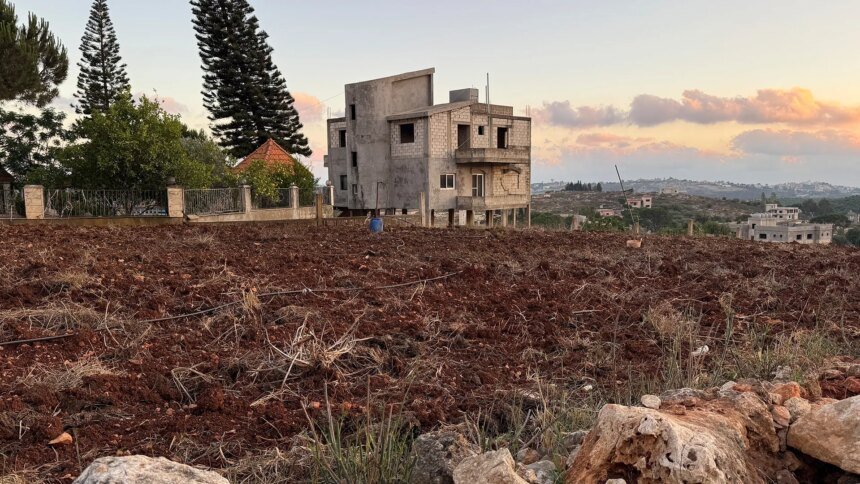
South Lebanon- Between the intertwined irrigation lines in one of the fields of the town of Houmin al-Fawqa, water slowly seeps into the roots, while Muhammad Shuraim bends down to make sure that the land has received its share. He removes dry weeds from the trunk of an olive tree with his hand, then continues walking among the trees that he knows tree by tree, as if each of them had a name and a memory.
He raises his head towards the sky bFrom time to time, he habitually waited for the direction of drones, before returning to his work in silence, as if nothing had happened.
The road leading to the fields still bears traces of the raids: deep holes in the asphalt, piles of scattered stones, and walls pierced with shrapnel, but the trees that survived the bombing remained standing, waiting for someone to water them after their owners were forcibly absent under the weight of war and displacement.
Shraim chose to stay. He did not leave his land or his home, and he stuck to his agricultural season despite the bombing and the decline in movement in the villages. He grows potatoes, onions, tomatoes and cucumbers, during a season that he says was a direct target of the deprivation and paralysis that struck southern Lebanon at the hands of Israel.
His work was not limited to producing crops, but extended to an attempt to keep life possible within the town. With the closure of stores and the difficulty of accessing the fields, he found himself securing whatever food he could for those who remained, in an environment where the details of daily life were eroding.
For him, land is not just agricultural property, it is an inheritance extending across generations. He inherited it from his father, just as his father inherited it from his grandfather, and he wants to hand it over to his son as he received it, so he talks about it as a mutual relationship in which memory is inseparable from soil, and dignity from agriculture.

Link
As the waves of displacement expanded, Muhammad’s phone became the only link between landowners and their fields. Calls came from nearby villages, from distant Lebanese cities, and sometimes from outside the country. The questions did not begin with homes, but rather with trees: an olive tree that needs water, a lemon tree that is beginning to wither, a tank that must be opened, another closed, and an irrigation network that needs someone to ensure its continued operation.
He knew that those small details were not just cultivation, but an entire life that spanned decades. The tree, which he has been taking care of for 20 years, is not treated as an inanimate object, but rather as part of the memory of its owners.
Therefore, whenever the bombing is relatively light, he carries water hoses or tank keys, and takes roads that may turn into a dangerous path at any moment due to drones. Despite repeated warnings from landowners not to risk it, leaving the trees thirsty was considered not an option.

The fields were not adjacent to each other, but were distributed on the outskirts of the town, some of them in open areas that were difficult to reach. He moved among them, checking the irrigation networks, ensuring that the water reached the roots, and then quickly leaving before the sky changed calm.
His responsibility was not limited to crops only. With the displacement of people, livestock and poultry were left behind, while feed prices rose and they sometimes disappeared from the markets. Between water and food, his days turned into a continuous attempt to prevent the collapse of what remained of the town’s life cycle.

The land that did not disappear
After months of absence, some landowners returned. The first surprise was that the trees were still standing.
Before leaving the field at the end of his day, Muhammad closes the last water valve, then pats the trunk of a perennial olive with his palm. He slowly bent down, picked up a handful of dirt, and brought it closer to his face as if recalling a scent he had known since childhood. The grains leak between his fingers, while his eyes remain fixed on the ground that has never left him.

Abu Hassan says to Al Jazeera Net, as he inspects his orchard after his return: “I thought I would find the trees withered, but Muhammad not only preserved the land, but also preserved the toil of an entire lifetime. If it were not for him, we would have lost years in one season.”
As for Umm Ali, who was displaced under the bombing, she told Al Jazeera Net that what hurt her most was thinking about the lemon and rose trees she left behind around her house, adding that knowing that someone was checking on her gave her some reassurance, “as if part of our lives remained here waiting for us.”
Shreim’s story summarizes a broader picture of what happened to agriculture in southern Lebanon during the war. The bombing, the difficulty of accessing the fields, and the delay in irrigation and harvesting crops did not only harm the seasons of individuals, but also extended to affect the agricultural sector in large areas.

Estimates of the Lebanese Ministry of Agriculture, in cooperation with the National Council for Scientific Research, indicate that the value of direct damages amounted to about 41.2 million dollars, which included damage to about 1,380 hectares of agricultural land and orchards, and the need to rehabilitate them, in addition to the destruction of basic agricultural facilities and equipment.
Estimates also reveal that the losses did not stop at the agricultural structure, as they affected production itself, with activity declining or stopping in large areas, which led to about 56,320 hectares being affected.
The economic value of production losses was estimated at approximately $530.5 million, as a result of decreased productivity, disruption of agricultural operations, high production costs, and difficulty in accessing markets.