

Published On 4/7/2026
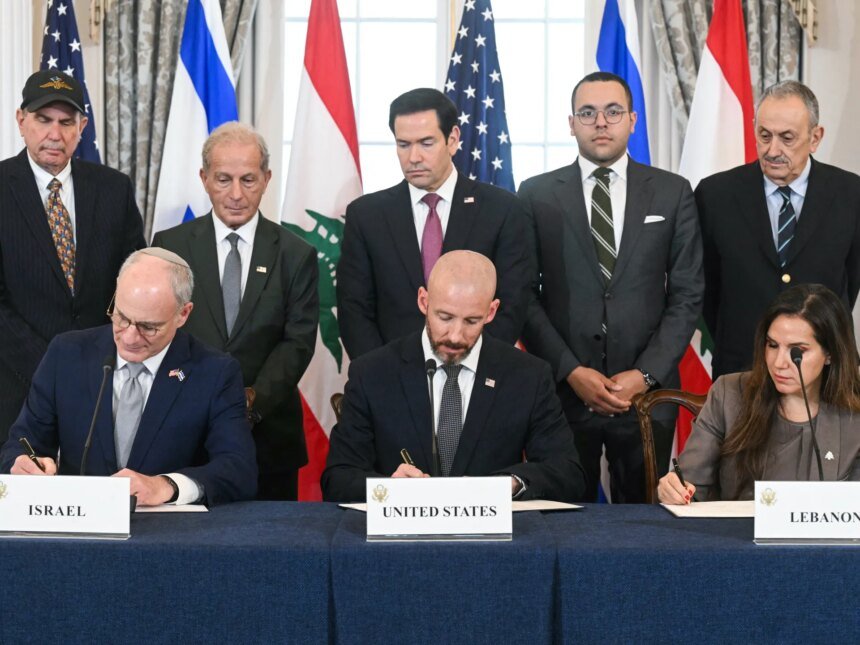
The Lebanese and politicians in Israel and the countries of the region are monitoring the extent of compliance with the terms of the framework agreement signed a week ago between Beirut and Tel Aviv under the auspices of the United States, after 5 rounds of negotiations between the two countries, which do not maintain diplomatic relations.
So far, the agreement indicates a state of internal division in Lebanon, with Israel insisting on linking the gradual withdrawal of its army from the south to the disarmament of Hezbollah, a condition that has hindered the full return of displaced Lebanese to their homes despite the decline in the pace of Israeli attacks and its violations of the ceasefire.
With the paths linked together in implementing the terms of the framework agreement, the horizon does not seem clear for the next stage of negotiations for a final agreement.
Return of displaced people
The agreement signed by Tehran and Washington last month to end the war between them established a ceasefire in Lebanon starting on June 21.
As a result, hundreds of thousands have since returned to their homes in southern Lebanon and the southern suburbs of Beirut. The authorities worked to remove random tents in Beirut and its surroundings, coinciding with the decrease in the number of official shelter centers, according to the Lebanese authorities.
However, the return to dozens of towns and villages, especially those near the border, which were subjected to massive destruction, is still pending, with Israel announcing through its officials that it will keep its forces in a “security zone” up to 10 kilometers deep from its borders, and continuing to launch strikes from time to time despite the ceasefire being in effect.
While the agreement stipulates in particular the disarmament of Hezbollah, a gradual withdrawal of Israel from the lands it has penetrated into southern Lebanon, and the deployment of the Lebanese army starting from two “experimental” areas, it does not specify a timetable for Israeli withdrawal.
On the other hand, it links the fulfillment of these terms, including the return of residents to the areas occupied by Israel, to the completion of the party’s disarmament, a task that analysts doubt the ability of the Lebanese state to accomplish.
Hezbollah weapons
Hezbollah’s weapons are putting pressure on the Lebanese presidency and government as it is a pivotal point in the agreement, amid strong doubts about making any progress on this item, due to the party’s positions that reject any giving up its weapons.
While Lebanese officials believe that the agreement represents a “first step” on the path to restoring the state’s sovereignty over its entire territory and the return of the displaced to their towns, Hezbollah says that the agreement is “non-existent” and “humiliating.”

The party considered that linking the Israeli withdrawal to its disarmament “crossing red lines,” while its supporters protested in Beirut and blocked roads.
Hezbollah’s criticism so far has focused on the following two points:
- The terms of the agreement open the door for the Israeli army to remain in the south for an unknown period
- Adhering to disarming the party means inciting division and internal strife
Criticism does not come only from Hezbollah. Amnesty International, five human rights organizations, and organizations concerned with freedom of the press have warned that the framework agreement “threatens to fail the victims of war crimes in Lebanon,” claiming that “parts of the text of the agreement aim to prevent victims of serious crimes covered by international law from seeking justice before international forums.”
She said that other parts appear to be “tacit acceptance of the continuation of the prolonged and open-ended forced displacement of tens of thousands of residents from vast areas in southern Lebanon occupied by Israeli forces.”
The organization referred in particular to Article 13 of the agreement, which stated, according to the text published by the US State Department, “Israel and Lebanon are committed to taking measures in good faith that demonstrate positive intentions, including stopping all hostile or negative measures in international political or legal forums.”
Sovereignty and independent path
Despite this, the presidency in Lebanon hopes to move forward with the framework agreement as “the best possible” and a step towards strengthening the sovereign decision in isolation from the Iranian umbrella. However, President Joseph Aoun, in response to the criticism, stressed that the “framework formula” does not legitimize the continuation of the Israeli occupation in Lebanon and that the goal is complete withdrawal, expressing his objection to the military option, which did not succeed in his opinion.
Aoun is pushing to separate the negotiations with Israel from the Iranian-American track, an approach that does not find explicit acceptance by Hezbollah and its allies in Parliament, which makes the framework agreement in place until today.
The Speaker of Parliament and the Amal Movement, Nabih Berri, believes that any attempt to separate Lebanon from the “American-Iranian negotiating track” will only lead to prolonging the Israeli occupation.
Although Aoun stressed the role of the Lebanese army in assuming its responsibility in achieving security and stability in the south after the withdrawal of Israeli forces from the occupied Lebanese villages and towns, it is not clear whether the army is ready for this mission and whether it is able to confiscate Hezbollah’s weapons.
Danny Citrinovic, a regional affairs analyst and former Israeli military intelligence officer, said that the dismantling of Hezbollah “will never happen,” adding that the agreement actually legitimizes an open-term Israeli military presence, from which it is difficult to withdraw and dismantle Hezbollah.
Continuous violations
Meanwhile, Israel’s violations on the ground continue with its attacks in southern Lebanon, albeit at a limited pace, despite the signed framework agreement.
The Lebanese Ministry of Health said, in a statement on Friday, that it counted 3 dead and 3 wounded during the last 24 hours, raising the total toll of the Israeli aggression to 4,301 dead and 12,199 wounded since last March 2.
Israel continues to occupy areas in southern Lebanon, some for decades, and others it controlled during the war between 2023 and 2024.
During its current aggression, Israel has also expanded the scope of its incursion to more than 10 kilometers into Lebanese territory, in its deepest advance since its withdrawal from Lebanon in 2000. The government does not show any intention of withdrawing under the pretext of securing northern Israel from any possible attacks.
Lebanon entered the war on March 2, after Hezbollah fired missiles at Israel, which it said were a response to the killing of Supreme Leader Ali Khamenei in the first American and Israeli strikes on Iran on February 28.