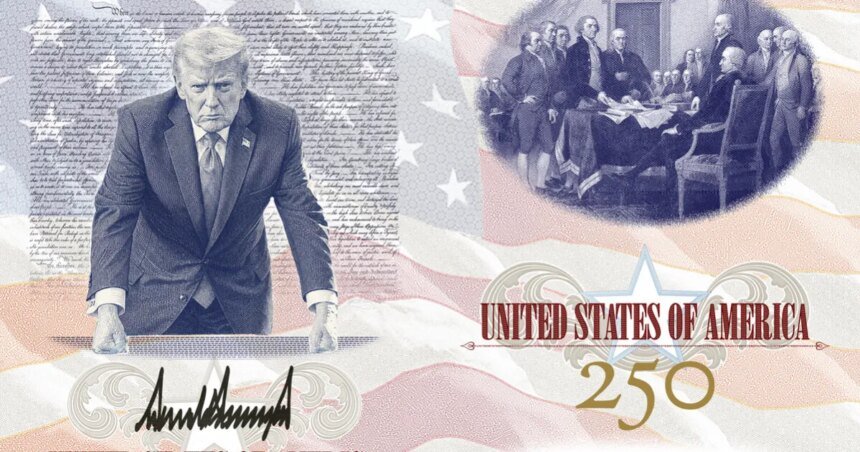
When the Founding Fathers met in Philadelphia in 1787 to draft the Constitution, they had one very clear concern: that true freedom can only be preserved when power is distributed, not concentrated, restricted, not absolute, and subject to the control of the law, not the will of man.
After 250 years, the question still remains: Did the Founding Fathers succeed in building an American system of government that would protect itself from the control of absolute individualism, or did they succeed in building a wall that was solid on the outside and could be hollowed out on the inside without falling?
The current scene holds a sharp irony; While official celebrations are held under the banner of “Freedom 250” launched by the White House, and President Donald Trump’s image is printed on commemorative passports and gold coins, and the South Lawn of the White House is transformed into a martial arts arena on his birthday, millions of Americans feel that they are not celebrating the founding of a republic, but rather the coronation of a man.
A poll conducted by Reuters and Ipsos showed that one in 5 Americans will not participate in Independence Day celebrations this year, while two in 5 believe that the country will not last an additional 250 years.
According to analysts’ statements to Al Jazeera Net, what is happening today in the United States is not an accidental slide or a mere difference in policies, but rather represents a shake in the foundations and intersects with 3 major transformations that are reshaping the features of the republic from within:
- Concentration of power in the hands of the president at the expense of the principle of separation of powers.
- The transformation of national identity from an open civilizational project into a closed ethnic and cultural reserve.
- Redefining the American role in the world from multi-instrumental leadership to structured trade-offs under the slogan “America First.”

A crack in the structure of democracy
When the founders of America met to draft the Constitution, they were establishing a system based at its core on the idea of balance between the powers (executive, legislative, and judicial), each of which monitors and restricts the other, making them all act as guardians over each other and evaluators at the same time.
This is the meaning of the writer and political researcher based in Washington, Dr. Osama Abu Irshaid, who believes that the founding fathers built their system on a specific concern: that the system would never turn into a property reduced to a person.
Abu Irshid added – in his statements to Al Jazeera Net – that the founders did not imagine that the political system would turn into a hostage of two parties, nor that one of these two parties would in turn become a hostage of one person. The Republican Party today has been reduced to Donald Trump in an unprecedented way in American political history, as his mantle has come to encompass the entire party in the House of Representatives and the Senate.
According to the same researcher, this reduction produced a dangerous equation: a president who has executive power, a party that controls legislative power, and 3 Supreme Court judges appointed by him. Therefore, Trump was able, in his first term, to redraw the ideological balance in the highest judicial authority in the country, so that his influence extended throughout the three institutions at the same time. This is what he sees as an actual undermining of the constitutional philosophy on which the republic was founded: “distributing power, not centralizing it.”
Scott Lucas, professor of international politics at the University of Birmingham, goes further in his diagnosis, as he believes that the issue is not related to reforming the American bureaucracy or reducing it, but rather “to completely distort it and subjugate it to serve Trump’s inner circle.”
Lucas explains his vision that “Project 2025,” which drew the road map before Trump came to power, and through the appointment of Elon Musk to head what was called the “Ministry of Government Efficiency,” there was a systematic purging of thousands of government employees, and others were planted in all federal agencies, including the intelligence services, whose work was hampered and their ability to perform their original functions was paralyzed.
In his statements to Al Jazeera Net, the professor of international politics concludes that the current scene in the United States is no longer related to party loyalty, but rather to personal loyalty to Trump alone.
However, there is a different voice than before in the diagnosis. Former Pentagon official David De Roche believes that what is happening does not necessarily deviate from the American historical context. He explained that after every long period of one party controlling power, there comes a counter-reaction wave that reshapes the bureaucracy. This is a pattern that has been repeated since the administration of former President Dwight Eisenhower, which carried out a systematic purge to remove communist influence from the government, all the way to the administration of former President Bill Clinton, which dismissed more than 300,000 civil servants under the name of “reinventing the government.”
In his statements to Al Jazeera Net, Des Roches says that “the goals of the civil service are always present, and the constant fear of them keeps them alive,” adding that the current changes remain “repairable” whenever a future president comes in who is more committed to the constitution.

The crisis of nationality and identity in America
There is a parallel battle that is no less important than the previous one, which is the issue of identity and belonging, which is a battle that touches on the heart of what it means to be an American. Since former US President Thomas Jefferson wrote that “all human beings are created equal,” America has been living in tension between the raised slogan and the racist reality that contradicts it. The irony is that this tension has not been resolved in 250 years, and may even reach its peak at the present time.
Dr. Abu Irshid analyzes this issue from its roots, and sees that Trump does not represent an isolated phenomenon, but rather interacts with a wide segment of white Americans who feel that their identity is fading in the face of successive waves of immigration from Asia and Latin America. This has its roots in accumulated historical fears towards the Irish, Germans, Chinese, and Catholics in previous eras, but today it has become more severe with any shift in the demographic composition of America towards a multi-ethnic, colored majority.
In this general context, the battle of “birth nationality” emerges as more than just a legal dispute; The 14th Amendment to the Constitution, which came in 1868 to guarantee citizenship to the children of freed slaves, is today facing an unprecedented constitutional challenge, even though the Supreme Court rejected Trump’s attempt to cancel it.
The former Pentagon official offers a different reading of the previous scene, as he believes that Trump is not trying to change norms that have existed for 250 years, but rather seeks to restore what he considers the “original goal” of the 14th Amendment to the Constitution, which he believes existed in a historical context that is completely different from the reality of mass immigration in our time.
Des Roches adds that the real tension arose from a new phenomenon that was not known at the time the amendment was drafted, namely mass irregular migration. As for these attempts to redefine, in his view, they represent a legitimate discussion about how to apply old constitutional texts to a changing reality.
However, Dr. Abu Irshid responds to this by saying that these attempts are a real danger to the entire constitutional system. The Supreme Court, with its conservative composition, is able to redefine many fundamental concepts, which establishes legal precedents that will serve as binding laws in the absence of Congress from its legislative role.
America and Trump… who sets policies?
Reading the internal scene in the United States in isolation from its role outside the borders is not really correct, as shifts in foreign policy reveal a coherent strategic structure that goes beyond mere circumstantial changes. Starting from Trump’s demand to annex Greenland, to the use of military force in Venezuela, to the quest to control shipping lanes, rare mineral resources, and war in the Middle East; It turns out that there is an expansionist logic to all of this.
Scott Lucas describes this approach as “expansionist narcissism,” and distinguishes it from traditional American expansionism. The United States witnessed several expansionist stages in its history, such as the imperialist orientation in the late 19th century, international hegemony during the Cold War, and then the attempt to consolidate unipolarity after the events of September 11, 2001.
What distinguishes the current stage – in his opinion – is that everything revolves around Trump’s person and not around strategic American interests, which turns the slogan “America First” into a mere façade for the “Trump First” agenda.
On the other hand, David De Roche suggests a more careful and less severe reading. He believes that Trump’s ambition towards Greenland – for example – essentially expresses a real concern about Russian or Chinese penetration of areas vital to American security, and not a purely expansionist desire. America did not need to declare control over Greenland because it actually controls it through its military bases and protection of the region.
The same applies to Venezuela, as the former American official believes that the fundamental American concern continues through successive government administrations, whether Republican or Democratic, and what has changed under the current administration headed by Trump is only the method of expression and the tools used.
As for the political researcher based in Washington, Osama Abu Irshaid, he agrees with De Roche on a fundamental point: The difference between Trump and his predecessors is not in the imperialist essence of American policy, “but in the crudeness of the method and the frankness of blackmail.”
According to Abu Irshid, Trump demands everything in exchange for everything: rare minerals in exchange for military support for Ukraine, and economic deals in exchange for security protection for Europe. These trade-offs are what characterize Trump’s decisions, not the imperialist essence that he shares with previous administrations.
Will American institutions survive?
The issue of the steadfastness of American institutions in the face of these pressures remains the most pressing focus of analysts’ discussion, and it can be said that opinion here is divided between those who see the institutions as historically well-established and able to withstand, and those who see that what is happening exceeds the threshold of previous tests.
David De Roches brings to mind a broader historical context; The American bureaucracy has witnessed similar tensions at every stage in which the government succeeds after a long period in which one party continues. He believes that constitutional institutions still exist and their goals are still present, and that fear for them is keeping them alive until now.
Lucas directly poses the fundamental question: Can the American system, which has developed over 250 years and proven its resilience, withstand this pursuit of authoritarian power by Trump’s inner circle? He leaves the answer pending, noting that this is the decisive “historical challenge.”
As for Dr. Abu Irshaid, he points to what he sees as a dangerous precedent, as Trump, in his second term, has become more experienced in dealing with government agencies, and has surrounded himself with people who are more loyal and more capable of implementing his agenda. What is more dangerous in his view is that the Supreme Court, in its current formation, is redefining fundamental legal concepts and establishing judicial precedents that may change the face of the republic for decades to come.
And the bottom line.. What the 250th anniversary of its founding reveals is not that the American Republic is on the verge of collapse, but rather that it is fighting a more dangerous battle. The institutions established by the Founding Fathers still exist in structure, but their founding spirit is eroding from within, according to analysts.