Published On 1/7/2026
The Israeli newspaper “Maariv”, quoting a source close to Israeli Prime Minister Benjamin Netanyahu, revealed that there is a division in views within the American administration regarding the negotiations in the files of Iran and Lebanon.
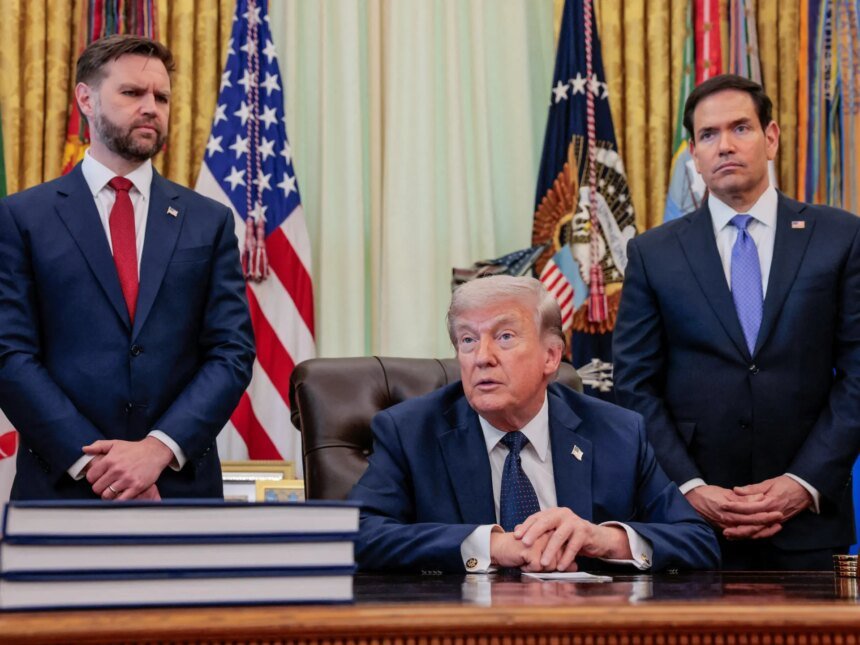
This division is represented by two competing camps, the first led by Vice President J.D. Vance, and including envoys of US President Steve Witkoff and Jared Kushner. As for the second camp, it is led by Foreign Minister Marco Rubio.
According to Maariv, the US Secretary of State worked closely with Ron Dermer, the Israeli politician who held prominent positions and who Netanyahu recently returned to the forefront of negotiations with Lebanon in their crucial stages.
According to the newspaper, Vance’s team succeeded in achieving a partial agreement with Iran and before that in reaching a ceasefire agreement in Gaza, while the Rubio camp was able to exert pressure in coordination with Israel to sign an agreement with Lebanon.
According to what the Israeli newspaper “Maariv” reported, the Rubio camp, in coordination with Israeli Prime Minister Ron Dermer’s envoy, succeeded in signing an agreement with Lebanon that is consistent with vital interests and Israeli security requirements.
Despite the difference in visions between Vance and Rubio, who are potential candidates for the next presidential elections in the United States in 2028, the American website Axios quoted an official as saying that Vance and Rubio serve Trump’s interests.
Speaking about Rubio and Vance, one of the White House advisors said, “Do not look at them as two sides of the same coin, but rather as two different tools in a multi-purpose Swiss Army knife,” adding that Trump is the one who determines how to use these tools.

Israeli warnings
On the other hand, Maariv newspaper revealed a division within Israeli circles regarding the agreement with Lebanon. While security officials describe it as a historic achievement, others believe that it entails serious dangers to Israeli security.
The agreement, which was signed last Friday evening, in Washington, stipulates a gradual Israeli withdrawal from Lebanese territory, in exchange for the Lebanese government’s commitment to disarming Hezbollah, which categorically rejected this agreement.
Israeli officials believe that the agreement allows Israel to maintain a military presence in southern Lebanon, but gives Hezbollah enough time to reorganize its ranks and restore its capabilities even though it was, according to their assessment, “on the verge of collapse.”
Netanyahu praised the agreement, describing it as a “historic achievement,” noting that it allows the Israeli army to continue its presence in southern Lebanon to confront Hezbollah threats. Netanyahu also presented the agreement as a victory over Iran.
On the other hand, Maariv newspaper quoted a senior Israeli security source, in a statement to Al-Monitor, warning of the repercussions of the agreement, saying: “We are not complacent. Hezbollah was on the verge of collapse, and now we are giving it time to regain its strength.”