Published on 6/30/2026
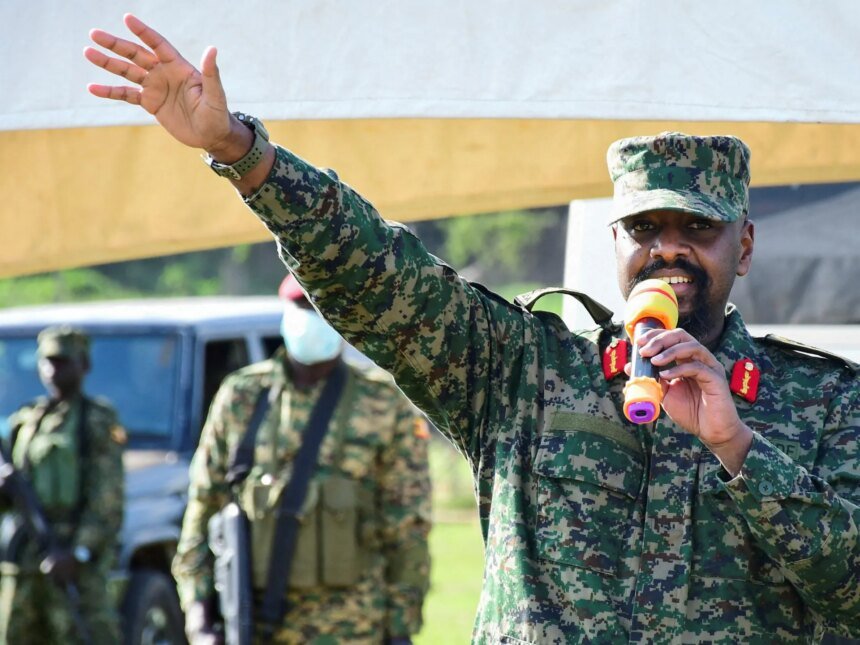
Uganda Defense Forces Commander General Muhoozi Kainerugaba, son of President Yoweri Museveni, announced the closure of two of the country’s largest media outlets: the Daily Monitor, the largest independent daily newspaper, and NTV Uganda, one of the largest private broadcasters.
Kainerugaba said the two institutions were closed and would not be reopened without his permission. “In Uganda, I do not believe in freedom of the press!” he wrote on the
The Daily Monitor newspaper announced the deployment of armed security personnel outside the headquarters of the National Media Group (NMG) in the Namungo area of Kampala and at its location in the Serena Hotel, preventing anyone from entering or leaving. NTV Uganda, Spark TV and other television and radio stations owned by the group also stopped broadcasting on Sunday.
According to the newspaper “Monitor”, the “National Media Group” issued a statement in which it said that its headquarters had become inaccessible following a “night military raid”, which led to a power cut and disrupted its work on its television, radio and newspaper platforms, adding that it would continue to interact with its audience through its digital platforms. The newspaper explained that NTV Uganda remained on the air for several hours before it and Spark TV stopped at five in the morning.
General Kainerugaba said that he has had the authority to close any media outlet since 2017, when his father, President Yoweri Museveni, granted him this authority. Kainerugaba is seen as the most likely successor to his father, who has ruled Uganda since 1986.

Fears and condemnations
The Association of National Broadcasters in Uganda confirmed that it is closely following the situation, and that it is “deeply concerned about this measure and its impact on the media system” and on the rights guaranteed by the constitution. She added that the Uganda People’s Defense Forces, Uganda Police Force and Uganda Communications Authority are yet to issue a statement on the operation.
According to the Monitor newspaper, the Uganda Communications Authority later acknowledged that the group’s outlets had stopped broadcasting, and said that it had begun consultations with relevant government agencies, calling on the public to remain calm. The newspaper quoted the East African Press Council calling on the governments of the region to reduce escalation with the media, considering that closing the group’s operations in Uganda “violates the state’s constitutional, regional and global obligations in the field of human rights.” It also reported the East African Journalists Union’s condemnation of the campaign.
The Monitor newspaper also reported that veteran journalist Andrew Mwenda, leader of the pro-government Uganda National League and a close ally of Kainerugaba, said that he had held talks with the general and it was agreed to reopen Daily Monitor and NTV soon, preceded by a discussion with the managements of the two institutions. Less than an hour later, Kainerugaba said on his official account that consultations were being held with “our allies abroad” regarding reopening the two institutions, and that their results would be submitted to his father to make the final decision. The newspaper added that the group did not immediately comment on the proposed talks.
History of confrontation
This action is reminiscent of previous confrontations between the Ugandan authorities and the media group. In February 2007, NTV Uganda was taken off the air two months after its launch in December 2006, following accusations that its coverage was negative. In 2013, the police closed the Daily Monitor, Dembe FM radio and the Red Paper newspaper for more than a week, following the publication of a message linked to what was known as the “Muhoozi Project”. Monitor reported that President Museveni had previously described Daily Monitor as an “enemy and evil newspaper” because of its critical coverage.