

To play this video you need to enable JavaScript in your browser.
This video can not be played
If you’re a lover of a takeaway donor kebab, you may not be after watching this
To play this video you need to enable JavaScript in your browser.
This video can not be played
If you’re a lover of a takeaway donor kebab, you may not be after watching this
Millions of people are likely to have eaten takeaway kebabs made with goat, skin and fat when they thought they were buying lamb meat, in a fraud that investigators have compared to the 2013 horsemeat lasagne scandal.
BBC News has been told the kebabs from Kismet Kebabs, which describes itself as one of the UK’s largest doner kebab makers, were sold to fast food outlets across the country for years.
The firm was fined £500,000 after pleading guilty in court to a fraud that dates back to 2021.
Kismet Kebabs, which is estimated to have made £6m from the fraud, said it related to “historical events that occurred over five years ago” and when they “operated under a different leadership structure”.

Kismet Kebabs was established in 2008 and produces more than 100 tonnes of kebab varieties every week
Kismet Kebabs was established in 2008 and produces more than 100 tonnes of kebab varieties every week
Kismet Kebabs advertised and labelled its lamb doner kebabs as being made with up to 87% lamb – depending on the kebab.
But concerns were raised when trading standards officers in Swansea began to randomly DNA test doner meat from takeaways in the city in 2020 and 2021.
Kebabs that were meant to be “70% lamb” came back as showing “less than 10% sheep”.
“I think some customers won’t be surprised there’s a lot of skin and fat in these products – but I don’t think many people will be expecting goat,” said Swansea trading standards officer Rhys Harries.

Kismet Kebabs Ltd directors Panayiotis Vasilis Michael, left, and Djemal Enver, right, admitted one count of fraud by false representation
Kismet Kebabs Ltd directors Panayiotis Vasilis Michael, left, and Djemal Enver, right, admitted one count of fraud by false representation
“A consumer buying a kebab knows it’s probably not the best quality ingredients, but it’s still got to be what it says it is,” said Harries.
“It’s almost the same as the horsemeat scandal, because of the volume of product that was going out of this factory.”
The 2013 horsemeat scandal is one of the most high-profile food fraud crises in recent history, when DNA testing revealed horsemeat in beef products and led to a range of processed foods being withdrawn from sale across Europe.
Investigators raided the Kismet factory in Essex in May 2021 to find out what was in the kebabs, as takeaways thought they were buying lamb as advertised on the package.
Harries said as soon as investigators visited their premises in Latchingdon, near Chelmsford, it became clear that no lamb was being delivered to the factory.

The kebabs from Kismet Kebabs were sold to “all corners” of the UK for years
The kebabs from Kismet Kebabs were sold to “all corners” of the UK for years
“We didn’t see any lamb apart from lamb fat,” said Harries.
“There were pallets of goat, pallets of trim, offcuts with high fat content, boxes of fat, boxes of skin, bits of mutton.
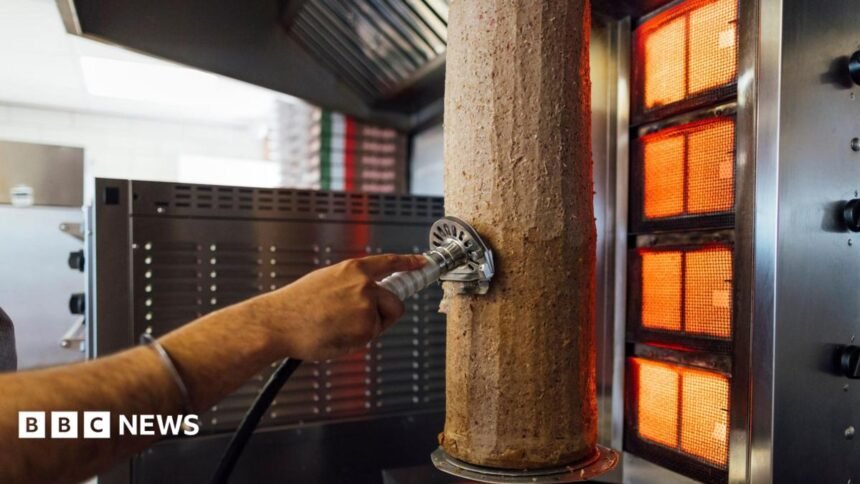
“It all goes into a massive mincer and comes out looking like Play-Doh.”
Those giant kebab sticks were then labelled to suggest they were made with between 50% to 90% lamb, depending on the recipe.
Chippies sell catfish as ‘traditional fish supper’
Mice, poo and contaminated food at city kebab shop
On one production line, investigators found the same large trays of doner meat being emptied into two different packets to go to shops – one labelled as “70% lamb” and one labelled as “50% lamb”.
“We were seeing labels that bore no resemblance to what they were actually putting in [to the kebabs],” said Harries.
“This is straightforward food fraud. They were charging wholesalers and consumers a premium price for something that’s full of rubbish.”

Trading standards officers say lamb was often listed as the main ingredient but kebabs often contained just small amounts of lamb fat
Trading standards officers say lamb was often listed as the main ingredient but kebabs often contained just small amounts of lamb fat
Last month, Swansea Crown Court heard councils around England had been writing to complain about issues with labelling and meat content at Kismet Kebabs, who had won best supplier of the year at the 2021 British Kebab Awards.
One lamb doner kebab that claimed to contain 87% lamb was found to be 40% animal fat.
Trading standards said Kismet Kebabs had sold so many kebabs over its years of offending that it took two officers 18 months to go through all their invoices and paperwork.

Kismet Kebab’s defence lawyer told the court the firm had made “little financial gain”
Kismet Kebab’s defence lawyer told the court the firm had made “little financial gain”
Among trading standards’ findings were “recipe cards” that contained the exact ingredients workers used to create the lamb kebabs, where they concluded that no lamb meat at all was being used in their production.
Instead, some lamb kebab recipes showed only goat, beef fat and chicken drumsticks.
“It was so wrong – it had to be fraudulent,” said Harries.

Trading standards officers found kebab-making machines which ground ingredients into a “Play-Doh”-like paste
Trading standards officers found kebab-making machines which ground ingredients into a “Play-Doh”-like paste
Kismet Kebabs were fined £500,000 in court and ordered to pay £259,298 costs, as Judge Huw Rees said the firm had engaged in “considerable dishonesty” over a prolonged period of time.
The Food Standards Agency (FSA) said the “sampling initiatives” like those used to investigate Kismet Kebabs were “targeted” and that overall food safety and standards in the UK remained high.
“Food must be safe and accurately labelled, wherever it’s sold, and we take food fraud and mislabelling seriously,” said Andrew Quinn, head of the FSA’s national food crime unit.
Stuart Jessop, who represented Kismet in court, said the company accepted it had “taken its eye off the ball” but had made significant changes since the raid – and had run successfully for many years without issue.
Kismet Kebabs remains one of the UK’s largest kebab meat suppliers.
In 2024, the company was accredited by BRCGS (Brand Reputation through Compliance Global Standards), a global food safety standard recognised in 130 countries.
Once BRCGS became aware of court proceedings against Kismet Kebabs, its accreditation was reviewed and last month the firm was found to still be compliant.
In a statement, Kismet Kebabs Ltd said the business was “significantly different” to how it was run five years ago.
“It is important to recognise that the matters in question relate to historical events and do not reflect the standards, systems, management structure, or operational controls that exist within the business today,” a spokesperson added.
Get in touch
Have you been affected by issues raised in this story?
Related topics
More top stories
Race Across the World winner’s car smashed into and laptop stolen before kids’ mental health talk
Teen dies on Duke of Edinburgh expedition
A trip to India left me with 38 parasites in my brain