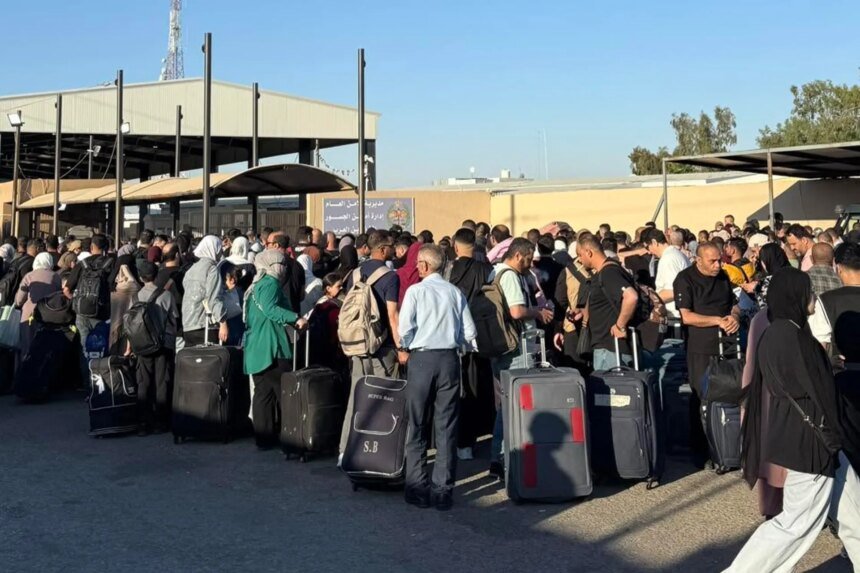
In a step described as the most decisive in managing the issue of transit through the King Hussein (Allenby) Bridge, the Jordanian Ministry of Interior took a package of regulatory measures and additional restrictions, aimed at controlling the movement of passengers and reducing the violations that caused repeated crowding and disruptions in the flow of work within one of the most important border crossings between Jordan and the West Bank.
The measures also come in the context of previous statements by Jordanian Interior Minister Mazen Al-Faraya, who described the reality of services on the bridge as “garbage,” which sparked widespread interaction and was considered an acknowledgment of the extent of the challenges that travelers face on a daily basis.
On Tuesday, the Ministry of Interior decided to prevent the entry and travel of 468 people across the King Hussein Bridge, after monitoring repeated patterns of travel back and forth for commercial purposes, especially taking advantage of price differences in the free market.
The Ministry confirmed that this measure aims to reset the operational priorities of the bridge to ensure that priority is given to travelers for humanitarian, medical and educational purposes, and not for purely commercial purposes.
Secret censorship
Al Jazeera Net learned from informed sources that audits on the bridge will continue throughout the summer, by sending virtual travelers by the Ministry of Interior, with the aim of determining the extent of compliance with the approved procedures and revealing any possible violations in their application.
The King Hussein Bridge (also known as the Allenby Crossing) is one of the most prominent crossing points between Jordan and the West Bank, and it acquires special political and humanitarian importance as the main outlet for Palestinians abroad through Jordanian territory.
The Jordanian Ministry of Interior, represented by the Department of Crossings and Borders, manages movement regulation operations in coordination with other parties, under operational restrictions affected by external factors linked to the Israeli side at the other end of the crossing.
For his part, the writer and political analyst, Maher Abu Tir, confirmed that the Jordanian authorities – according to data from the Ministry of Interior – placed 468 people on lists preventing entry into the country after it was proven that they made repeated reservations through the transportation company “Jet” platform, as the data showed that some of them traveled 5 or more times during short periods.
Abu Tir added – in his speech to Al Jazeera Net – that the Ministry of Interior will impose control on duplicate entry cases whose owners enter Jordan to the duty-free market and then return to the West Bank.
Abu Tair confirmed that the Jordanian security services were able to dismantle active networks selling travel tickets through the black market linked to the electronic platform designated for those heading to the West Bank.
He explained that thwarting these activities came after a secret security operation during which tickets were purchased from brokers at high prices, which allowed the documentation of relevant evidence, correspondence and communications, in preparation for taking legal measures against those involved and arresting them.

Regulatory procedures
The Ministry of Interior confirmed that these practices directly affected the opportunities of genuine travelers, especially patients, students, and those in humanitarian cases.
These measures came after an expanded security and administrative meeting held by the Ministry of Interior to discuss the escalating challenges in managing the bridge. It was agreed to implement a package of reforms that include strengthening electronic oversight, reorganizing reservation mechanisms, and improving queue management, in addition to restructuring some operational routes within the crossing.
It was also decided to create special arrangements for specific categories, such as VIPs, by allocating separate paths and waiting tents, in addition to reorganizing the file of humanitarian cases to ensure the acceleration of their procedures.
These decisions coincided with a broader government trend towards developing the infrastructure of the crossing, as the Ministry announced the start of implementing projects that include modernizing waiting halls, constructing modern canopies, expanding passport facilities, in addition to developing shipping and transportation facilities.

Facilitating the transit of passengers
Jordanian Interior Minister Mazen Al-Faraya had confirmed – in previous statements – that the Kingdom is committed to facilitating the crossing of the Palestinians across the bridge, as it is a vital humanitarian corridor.
He explained that regulatory measures such as advance reservation came to address limited capacity, and not to restrict freedom of movement, noting that the number of travelers is also subject to operational considerations from the other (Israeli) side.
On the humanitarian side, the crisis continues to cast a shadow on travelers, as many describe their experience at the bridge as stressful and complicated, with long waiting hours and multiple procedures.
Individual cases of accidents and injuries that occurred during severe crowding have been recorded, which has reopened the discussion about the need to improve waiting conditions and provide a safer environment for travelers.
The Jordanian government confirms that a large part of the challenges are related to operational restrictions beyond its control, in light of the limited working hours and sudden closures imposed by the circumstances surrounding the crossing. However, the Ministry of Interior stressed that work is continuing to develop procedures and improve the level of services.