Published on 6/30/2026
|
Last update: 7/1/2026 00:52 (Mecca time)
The victory of the Moroccan national team over its Dutch counterpart in the round of 32 of the 2026 World Cup did not remain a passing sporting event. After the “Atlas Lions” clinched the qualification ticket on penalties, the echoes of the match quickly moved from the stadium to the Dutch street, then to the arena of politics and social media platforms, where the celebrations of Moroccan fans turned into material for an old racist speech against the Moroccan community and the Dutch of Moroccan origins.
The scene began with widespread football joy, as Moroccan fans came out in several Dutch cities, raising Moroccan flags, honking car horns and firing fireworks to celebrate the qualification.
Read also
list of 2 itemsend of list
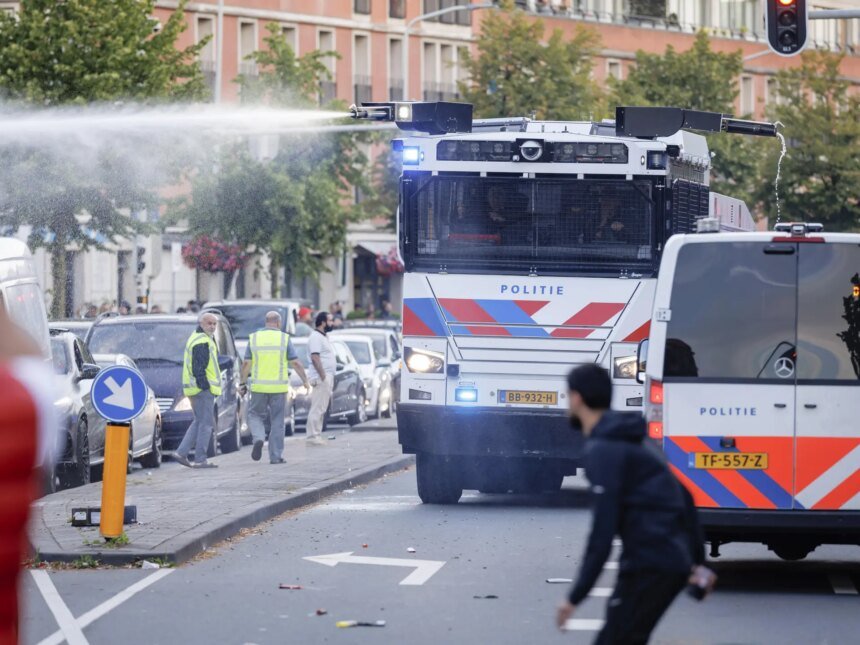
But this joy quickly took a more tense turn in some areas, especially in the Skelderswijk neighborhood in The Hague, where riot control units were deployed and police were deployed with water cannons to disperse the gatherings.
Joy started in the street
The first clips circulating on the “X” platform show scenes of loud celebration after the end of the match, as Moroccan fans gathered in the streets carrying flags, in an atmosphere that at first appeared closer to a public celebration of victory, before it later turned into a security clash.
In those first moments, the scene was not so much a scene of riots as it was a scene of widespread football joy; Crowded streets, Moroccan flags, car horns, and fireworks lighting up the place.
But these celebrations, which began as an expression of a historic victory over the Dutch national team, later took a more tense path as the police intervened and attempted to disperse the gatherings.
Later scenes showed the atmosphere gradually turning tense, with the police presence increasing around the gatherings and trying to push the revelers to leave some of the streets. Here the story began to change and it was no longer just celebrations after a match, but rather an intermittent confrontation between security forces and groups of young men.
As the police advanced toward the revelers and attempted to disperse the gatherings, the atmosphere of joy gradually turned into a moment of friction in the street, as fans continued to set off fireworks and raise Moroccan flags around the place, before these scenes were later taken out of their celebratory context and presented as “riots,” ignoring the difference between limited groups that entered into tension with the police and a large crowd that came out to express their joy at qualifying.
The spark of the racist campaign
The leader of the far-right Freedom Party, Geert Wilders, did not delay in exploiting these events. In a blog post on the “X” platform, he called for the deportation of those he described as “rioters” and their families to Morocco, saying: “Clean these streets, and deport the rioters and their families to Morocco. This is our country, leave.”
These positions were not isolated from the political context that Wilders has been adopting for years, as he had previously sparked widespread controversy due to his statements calling for “reducing the number of Moroccans” in the Netherlands, a speech that remained present in his party’s speech on immigration.
Go back to your country
After Wilders’ post, the wave of anti-Moroccan posts expanded on social media platforms, and Dutch accounts began circulating racist phrases in Dutch, including those meaning “Go back to your country” and “Send the Moroccans back to Morocco.” Thus, the discussion moved from a limited incident of tension following football celebrations to a collective discourse targeting Moroccans as a community, and turning the joy of qualifying into an excuse to revive calls for deportation.
In additional posts, the interaction did not stop at criticizing what happened in the street after the match, but rather tended to hold Moroccans as a community responsible for limited actions, by linking Moroccan identity to issues of security, public order, and integration. Instead of distinguishing between a broad public who went out to celebrate the victory of their country’s national team, and limited groups that entered into tension with the police, these posts dealt with Moroccans as a single bloc.
Accounts also re-circulated the slogan “Reduce Moroccans,” a recall of a phrase previously associated with the leader of the far-right Freedom Party, Geert Wilders, bringing back to the fore an old discourse targeting the Moroccan presence in the Netherlands. This wave was accompanied by accusations against Moroccans of not integrating or exploiting the social welfare system. These are ready-made accusations that are invoked whenever a public event is linked to an immigrant community.
Voices that refuse to generalize
On the other hand, Dutch blog posts appeared that criticized the escalating rhetoric against Moroccans, stressing the need to separate the “perpetrators of the riots” from the Moroccan community as a whole.
Activists on social media platforms stressed that “rioting is condemnable behavior regardless of origin, but that does not mean that all Moroccans participated in it,” while others considered that the wave of comments that followed the match revealed the extent of latent racism against the Moroccan community and the Dutch of Moroccan origins as well.
This controversy comes in the context of an ongoing debate within the Netherlands regarding immigration and integration, as the Moroccan community is one of the largest communities of non-European origin in the country, and for decades has been the focus of extremist political discourses, especially from right-wing parties that link the issues of security, integration, and immigration together.
The “Atlas Lions” qualified for the round of 16 of the FIFA World Cup with a 3-2 victory over the Netherlands on penalty kicks after the end of regular and extra time in a 1-1 draw today, Tuesday. Morocco took revenge on the Netherlands, which beat it in the only match between them in the World Cup in the group stage in 1994 in Orlando, United States, and set a date with Canada, which it surpassed in the third round of the group stage in the 2022 World Cup on the way to achieving its achievement. Unprecedented.