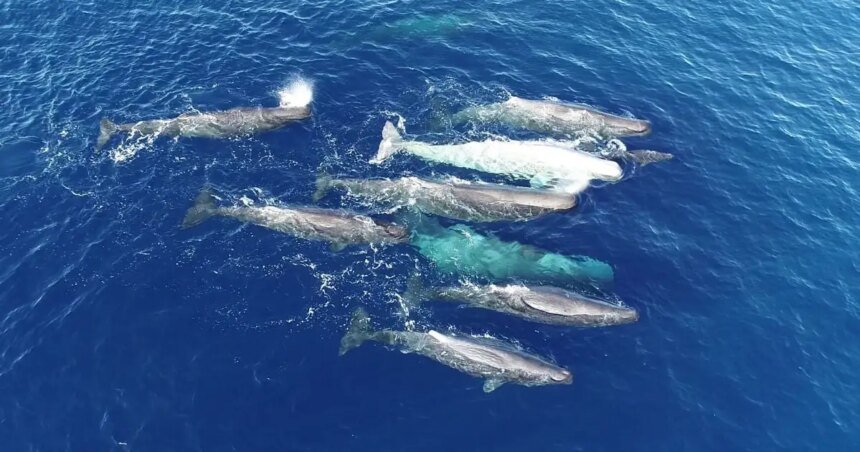
In the depths of the Mediterranean Sea, where the human eye cannot reach, conversations take place that we can only hear through recording devices. There, sperm whales move in small social groups, emitting regular series of clicks known as “chicks.”
These clicks are not random sounds; They are like vocal signatures that help whales recognize each other, and perhaps the groups to which they belong.
A new study reveals that sperm whales in the Mediterranean do not use one “dialect” as was thought, but rather two clear dialects, one in the western Mediterranean near the Balearic Islands, and another in the eastern Mediterranean along the Hellenic Trench near Greece.
Most importantly, this difference does not appear to be just a passing vocal variation, but rather may be evidence of cultural evolution within a small, isolated, and endangered group.
The study, published June 23 in the journal Proceedings of the Royal Society B, analyzed 5,291 phonetic codes recorded over 112 days between 2003 and 2021. The recordings came from two main regions: the western Mediterranean around the Balearic Islands in Spain, and the eastern Mediterranean along the Hellenistic Trench in Greece.
The map included in the study shows how the recording sites are roughly divided between two marine basins, separated by a shallow water range extending between Italy, Sicily and Tunisia.

Clicks are like accents
Sperm whales in the Mediterranean are a special case. It is genetically isolated from its relatives in the Atlantic Ocean, and it is believed that its number does not exceed a few thousand, and the International Union for Conservation of Nature Red List classifies it as threatened with extinction. Therefore, understanding their sounds is not just a scientific curiosity, but may also help reveal their social structure, movement, and protection needs in a sea increasingly crowded with ships, noise, and dangers, according to the study’s lead author and postdoctoral researcher in animal ethology at the University of Bristol, Taylor Hirsch.
The story begins with “codas,” a short pattern of successive clicks that resembles a rhythm. In many parts of the world, groups of sperm whales use different codes, as if each group had its own dialect. These codes are transmitted through social learning between individuals, and therefore scientists believe that they are part of the vocal culture of these whales, and not just fixed, innate sounds.
Taylor said in statements to Al Jazeera Net: “Previous studies had indicated that sperm whales, on average, are dominated by a famous code of the “3+1” pattern: three close clicks, then a slightly longer pause, then a fourth click. But the new study found that this picture is simpler than the truth; “The same pattern exists, but it doesn’t play out the same way everywhere.”
The researcher explains that western Mediterranean whales tend to issue a slower version of the “3+1” code, along with “2+1” codes. In the east, a faster version called “3++1” appears, in addition to distinct codes of eight clicks, with the intervals between them gradually increasing. That is, the whales of the West say the same rhythm slowly, while the whales of the East say it quickly, and add other patterns to it that are almost unheard of in the West.
According to the research team, this difference is important because it indicates that Mediterranean whales are not completely one vocal group. Although it belongs to a small and isolated grouping, it seems that within this same grouping there is a cultural diversity that is taking shape, or perhaps has already formed to a clear degree between East and West.

Did a new dialect appear in the East?
The research team points out that the most interesting finding is that some Eastern groups sometimes used slow Western codes, but the opposite almost never happened; Researchers rarely recorded Eastern fast codes in the West. This unbalanced trend made the team suggest that the slower western dialect may be older, and that the faster eastern dialect appeared later, perhaps after sperm whales expanded into the Mediterranean from the direction of the Strait of Gibraltar towards the east.
Researchers believe that what is happening here is somewhat similar to what we see in bird dialects or even in human languages when a small group lives in isolation. Isolation may sometimes reduce diversity, but it may also open the door to the emergence of new patterns that are transmitted by social learning, not by genes alone. These results do not mean that whales “speak” in the sense of human language, but they reveal that their sounds carry a social structure and cultural history.
But the study is not without important limitations, as it did not directly monitor cultural development over generations, but rather inferred it from current and historical vocal patterns. Data also came mainly from two regions, with a distinct lack of recordings from the central Mediterranean. This gap makes the picture incomplete; There may be other sound patterns that have not yet been recorded.