Published on 6/29/2026
This week’s sun was not just an orange disk that shines every morning, but rather a moving world teeming with storms, magnetic fields, and giant spots, which is what Emirati astronomy photographer Tamim Al Tamimi succeeded in documenting with his lens in a series of high-resolution images that revealed another facet of our closest star, far from the calm image seen by the naked eye.

These images come at a time when the attention of solar scientists is turning to active solar system No. 4478, which has become the largest solar spot currently, and its size is several times the diameter of the Earth. It has even become observable with the naked eye when using approved solar eclipse glasses or safe observational means, in a phenomenon that does not occur often during the solar cycle.
Two different sides of the sun…but the truth is the same
The first pictures were taken by Al-Tamimi using a hydrogen-alpha filter, which is a specialized filter that allows a very narrow portion of the light emitted by hydrogen atoms to pass through at a wavelength of 656.3 nanometers.
Read also
list of 2 itemsend of list
Thanks to this filter, the sun appears as a vibrant world. Sunspots turn into black magnetic vortices, highlighting solar filaments, explosions, and active regions that cannot be seen in white light.

The image shows 5 main groups of sunspots, the most prominent of which is sunspot number 4478, which dominates the upper part of the solar disk, along with other sunspots that appeared smaller and quieter, while the image revealed clear differences in magnetic activity between each region and another.
The second image, taken in visible light using a special optical solar filter, reveals the traditional face of the sun; Sunspots appear only as dark spots due to their lower temperature compared to the surrounding surface, while most of the details of plasma and explosions detected by the hydrogen-alpha filter disappear.
This type of imaging allows a direct comparison between what the eye sees through the solar filter and what specialized monitoring techniques reveal.
The moment when fire emerges from the edge of the sun
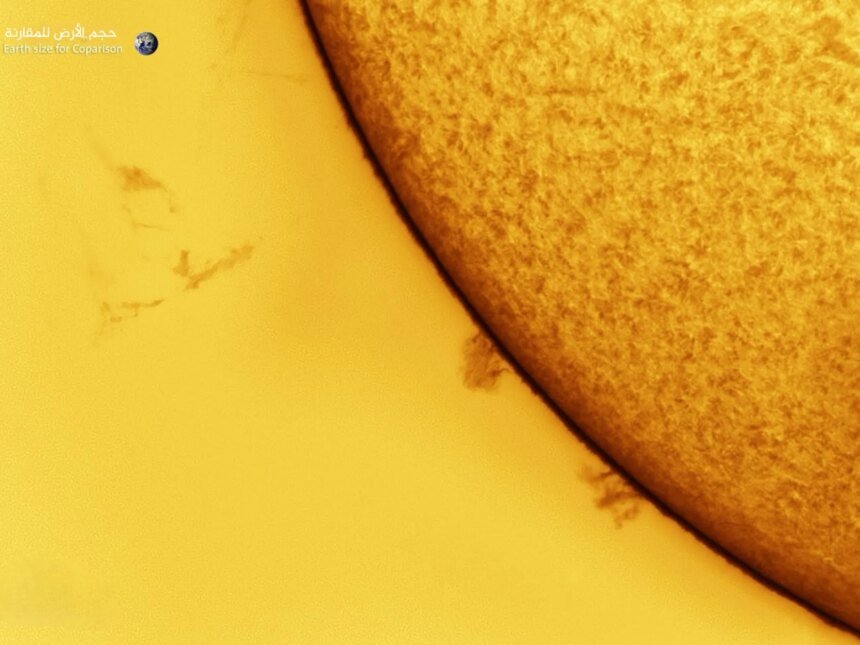
The third image, which shows flames emanating from the edge of the Sun, is perhaps the most exciting, as solar protrusions appear as massive arcs of burning plasma rising tens of thousands of kilometers above the surface of the Sun before returning to it due to magnetic field lines.

Although these structures appear static in the image, in reality they are constantly moving, and within minutes they may develop into explosions or coronal mass ejections that spew billions of tons of plasma into space.
These scenes can only be photographed using precise optical systems, because ordinary white light completely immerses these details, while the hydrogen-alpha filter allows the radiation coming from the sun’s color layer to be isolated, so these structures appear like sculptures of flame.
Look at the sun with caution
Photographer Tamim Al-Tamimi confirms that monitoring such phenomena must always be done using specialized equipment, whether through approved optical solar filters installed in front of the telescope or binoculars, or by solar projection on a white screen, or by using specialized solar telescopes.
Al-Tamimi strongly warned against directing any binoculars or telescope towards the sun without appropriate protection, because this could lead to permanent eye damage within fractions of a second.

Between science and art, Tamim Al Tamimi’s photographs prove that astronomical photography is no longer just a recording of celestial bodies, but has become a visual language that translates what is happening above the surface of the sun into captivating scenes, reminding us that the closest star to us is not a stationary disc in the sky, but rather an enormous cosmic laboratory in which storms and explosions form every day, and that capturing a moment of this changing world requires knowledge, patience, and a lens that knows when to press the photography button.