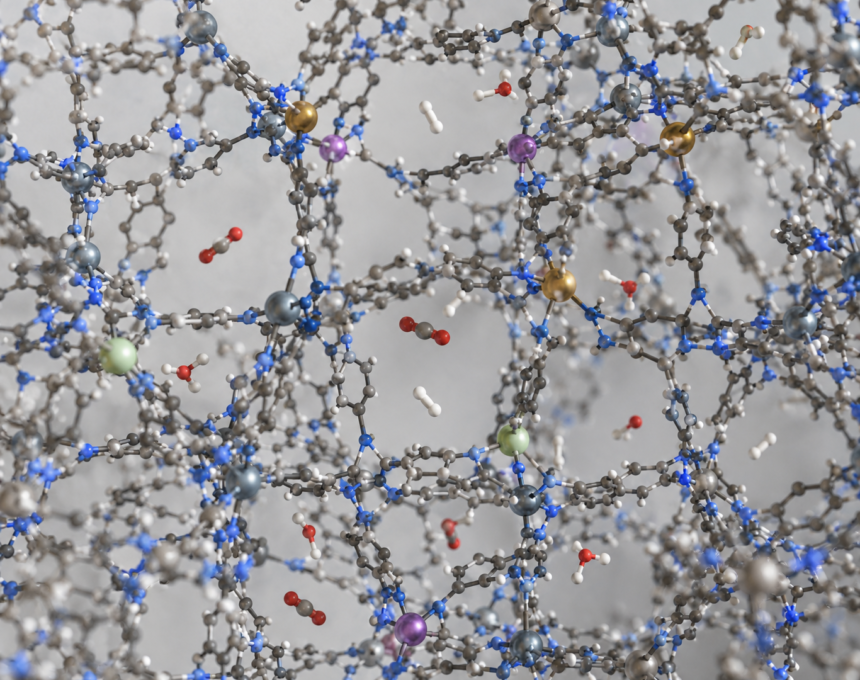
An international team of researchers has discovered a new chemical technique that improves a future material for an advanced type of porous glass known as MOF glass, which has the ability to trap gases such as carbon dioxide.
The researchers were inspired by their new idea from traditional glass-making techniques dating back thousands of years, which rely on the use of sodium and lithium as chemical modifications to purify it and control its properties.

An old chemistry trick
Dr. Dominic Kopecky from the University of Birmingham, in his statements to Al Jazeera Net, says: “Glass has been part of human civilization for thousands of years. From ancient Mesopotamia to modern fiber optic cables, small amounts of chemical modifiers make it easy to process glass and change its functional properties.”
Dominique adds: “As for the old chemical trick, which we were inspired by, it is inspired by one of the oldest stories in the glass industry, which says that Phoenician merchants were traveling by sea near present-day Lebanon, and they were transporting nitrate, which is a mineral rich in alkali salts. When they stopped on a beach, they used pieces of this metal to support cooking pots over the fire. After the fire had burned all night, they noticed a new liquid substance flowing from the sand, and it is said that this was one of the first moments of making artificial glass.”
“Quartz-based inorganic glass has been known to humanity for thousands of years, while MOF hybrid glass has only been known for a few decades, so our research shows that ancient glassmaking ideas can still inspire the design of completely new materials today,” he adds.

MOF Glass
MOF glass consists of metal atoms bonded to organic molecules, which are able to trap gases such as carbon dioxide, hydrogen, and even water.
Dominic tells Al Jazeera Net: “Simply, we found a new way to change the structure and properties of a special type of porous glass made of metal-organic frameworks, which is characterized by combining some of the properties of crystals, which are characterized by their regular pores, and some of the properties of glass, which can be formed and processed.”
He adds: “The essence of this phenomenon lies in the fact that alkali ions, such as sodium and potassium, disrupt the solid structure of quartz in the sand. This allows the material to melt at a lower temperature, and changes the properties of the resulting glass.”
“In our research, we used a similar idea, but applied it to a much newer type of material: hybrid glass, which contains organic and inorganic components,” Dominic explains. “We added sodium and lithium compounds to the MOF glass, and showed that these ions are able to modify its structure and properties.”
Capture carbon dioxide and hydrogen
On how the detector glass traps carbon dioxide and hydrogen, and absorbs water, Dr. Dominic says that a metal-organic framework is a material consisting of metal ions bound to organic molecules. Many of their tires contain tiny pores, similar to molecular sponges, capable of trapping or separating gases.
Dominic adds that such glass is often easier to shape into useful shapes, such as films or coatings. “This is why we have mainly focused on CO2 absorption as a way to measure and understand porosity, and a broader interest in gases such as carbon dioxide and hydrogen, but I would stress that our research presents a strategy for controlling porosity, not an off-the-shelf technology for trapping gases,” Dominic adds.
Dominic adds to Al Jazeera Net: “On the other hand, we also found that water interacts strongly with sodium-modified glass, and can be used to remove part of the modifier, allowing additional porosity. One of my long-term dreams is to create glass-like materials – perhaps even something as familiar as windows – capable of extracting water from the air.”
He concludes by saying: “There is still a lot of research needed to understand whether and how this can be achieved, but our work brings us a step closer to designing a hybrid glass with this function. As for the potential applications of this type of glass, it is used in gas separation, carbon dioxide capture, membranes, catalysis, and in ion transport. However, these materials are still in their early stages, as our work provides a new chemical strategy and scientific basis; more research will be required to improve, scalability, and performance for applications.” process”