Published on 6/27/2026
|
Last update: 19:32 (Mecca time)
On July 5, 1997, NASA’s NEAT project observed a small object moving among the stars from the Haleakala Observatory in Hawaii, later named 1997 NC1.
This discovery at the time was only a new addition to the thousands of known asteroids, but orbital calculations revealed that this body would return in June 2026 to provide one of the most important safe approaches of a large asteroid to Earth in recent decades.

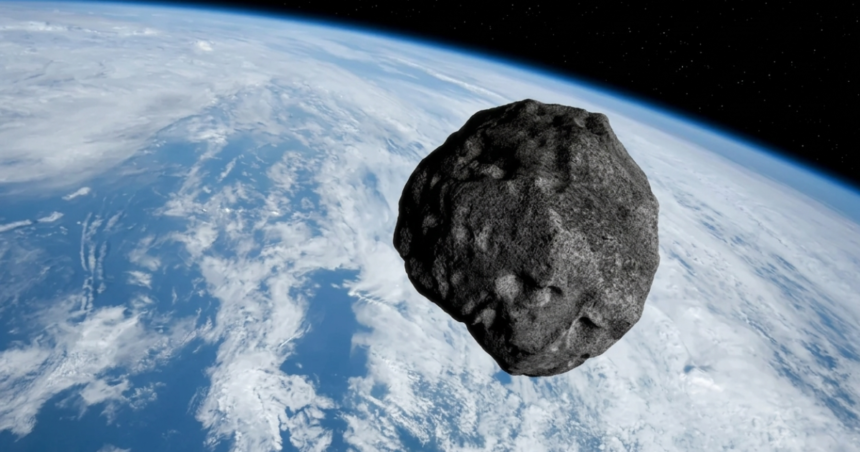
Today, June 27, 2026, the asteroid passes at a distance of approximately 2.56 million kilometers, or about 6.7 times the distance between the Earth and the Moon. It is an astronomically close distance, but it is completely safe, as NASA and the European Space Agency have confirmed that there is no possibility of it colliding with the Earth. This is its closest pass since before the year 1600, and it will not come this close again before the year 2133.
Read also
list of 2 itemsend of list
Why is this asteroid getting all this attention?
The asteroid 1997 NC1 is classified as one of the near-Earth Aten asteroids, which is classified as a “potentially dangerous asteroid,” a classification that may raise concern for non-specialists, but it does not mean that a collision is imminent, but only indicates that its orbit is close enough to Earth’s orbit to be subject to constant monitoring.
Estimates of its diameter range between 750 and 1,600 metres, making it larger than most known near-Earth asteroids.
It also moves at a speed of approximately 8.9 kilometers per second, or more than 32 thousand kilometers per hour, which is sufficient speed to cover the distance between Doha and Cairo in less than a minute if it were moving within the atmosphere, but it is a normal speed for objects revolving around the sun.
The importance of the event lies not only in the passage of the asteroid, but also in the possibility of observing it, as the asteroid’s brightness may reach approximately the tenth magnitude, which makes it beyond the limits of vision with the naked eye, but it becomes a suitable target for small telescopes and large astronomical telescopes.
During these days, it appears in the region between the constellations Ophiuchus and the tail of the Serpent Cauda, and amateurs can observe its true movement among the stars in just minutes, as it apparently moves at about 40 arcseconds per minute, and therefore it will not appear as a fixed star, but rather as a point of light slowly creeping in front of the background of the sky, which is a rare sight that does not occur often with large objects.
NASA radars reveal a new surprise
This passage represents the first real opportunity to observe the asteroid with radar, which is why NASA’s Deep Space Network used the Goldstone antennas in the Mojave Desert in California to try to determine its true shape, after years of conflicting estimates about its size, composition, and reflectivity.
Initial monitoring results, announced on June 25, revealed that the asteroid is rotating slowly and consists of two connected lobes, while its diameter appears to be less than one kilometer, which helps scientists resolve previous discrepancies between Spitzer telescope measurements and the “New WISE” mission and spectroscopic observations.

Asteroid scientist Lance Penner of NASA’s Jet Propulsion Laboratory said that these observations will also help improve the calibration of previous measurements and understand the physical properties of the asteroid more accurately.
A rock older than the Earth itself
The value of “NC1 1997” lies not only in its proximity, but also in its age, as this asteroid is a preserved remnant of the material from which the solar system was formed more than 4.5 billion years ago, that is, before the Earth appeared in its current form, and long before the existence of oceans and life.
This is why scientists view such objects as “cosmic fossils,” as they preserve components that are almost as they were at the dawn of the solar system.
Although the asteroid will not pose any danger to Earth in this passage, its study helps scientists improve planetary defense systems, understand how planets form, and prepare for any objects that may pose a real danger in the future.

Every time an ancient body like this passes near Earth, we remember that our planet is not isolated in the universe, but rather lives within a vibrant celestial system for billions of years.
What today appears to be just a point of light moving among the stars may contain within it a silent record of the beginnings of the solar system. Therefore, observing these objects is not motivated by fear, but rather by scientific curiosity, which has always led man to a deeper understanding of his place in this vast universe.