Erosion
Christina Nordh
Published 16.24
Storms, floods and lack of drinking water.
Climate change is no longer a distant threat.
The generation that inherited the crisis is now heading towards its first election.

YSTEAD–SOLDER UP. 300 meters of landmass has disappeared in 60 years in Löderup.
The erosion i Skåne is tough, along pretty much the entire coast.
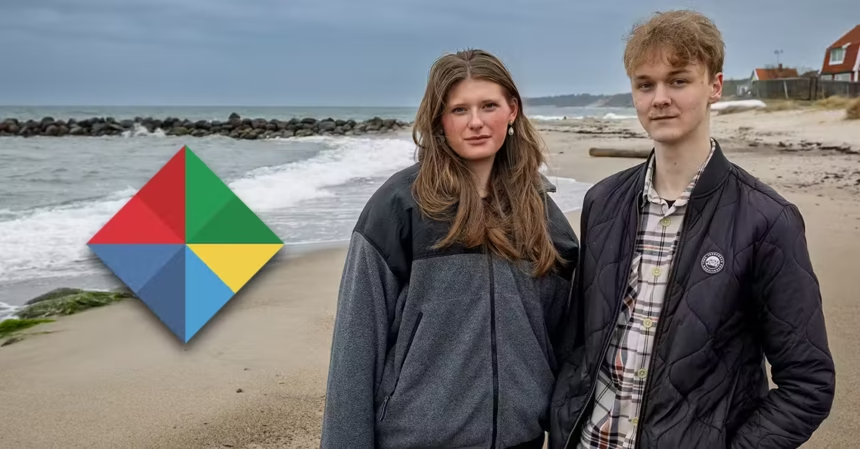
– Some places have basically been completely guttedswallowed by the water, says Totta Ehrenpohl, 18.
She sees it on her walks along the water in Ystad. It’s like the sea has taken big bites out of the beach.
– I usually go there with my dog. And sometimes there is water almost up to where you can walk on the beach. It is clear that there is a fear. For those living on the coast, land has collapsed. Our coast is disappearing.
She believes the erosion will continue – and that it will get worse.
– You notice it already now, that it’s not like when I was little.

She and Felix Svensson, also 18, are sitting in a morning-tired cafe near Stortorget in Ystad.
The election this autumn is becoming a reality, now they will be able to vote for the first time.
– Great fun, I’m excited to be a part of society, says Totta.
– I am also excited. Now politics becomes much more interesting, I have influence. You can say: “So how do we solve it now? Now you have to deal with me, because I care”, says Felix.
Which parties they will vote for is not yet decided, but they have a handle on the issues they think are most important: crime and punishment, health care, migration and the economy.


The severe erosion in Skåne then?
The issue that is increasingly important in the small fishing villages along the coast. The erosion has become harder to ignore. Climate change is here and becoming more and more noticeable.
– I think there is more climate change than we want to admit. Maybe it’s only parts of the earth that are affected, even if we don’t see it particularly clearly, you still know they exist, says Totta.
– Sooner or later we will all feel the impact of climate change. I find it hard to understand people who deny it. They can see changes themselves almost constantly, says Felix.

What to do about climatethe changes?
– Everyone can do something, absolutely. Then if it has a greater meaning … maybe not, says Totta.
Felix, who has moved from Ystad and now lives in picturesque Fyledalen in Tomelilla municipality, emphasizes that in the past you could trust that there was enough food and water for everyone.
Skåne has rightly been called Sweden’s granary. Here is the most fertile soil in the country and almost half is arable and pasture land in the county, according to Statistics Sweden.
– Nowadays, it is perhaps not as much a guarantee for us as before. It’s a hard feeling, says Felix.
– We need to start preparing for possible consequences. Like increased water levels because ice sheets are melting and more storms. Where I live now, trees fall all the time. And what do you do when the harvest can no longer be saved due to the drought? We have had “a thousand” droughts now, says Felix.

Which do you think is the most important climate?the question?
– I think it is very sad that so many animals are becoming extinct and that animals are losing their habitat precisely because it has become much warmer. It feels a little sad that you don’t care about it more. It is a very important question. Animals have been taken for granted. After all, all animals have a huge impact on the entire ecosystem. We have not taken care of that issue at all, says Totta.
– I would probably say the water levels. That they rise and bring with them a great many problems. That people are forced to flee, that you may not be able to farm the land. I would also like that the natural life that exists should not be put in any greater danger, says Felix.
He says that he thinks it would be very sad to lose today’s Skåne to climate change.
– If there are problems here, then there are the same problems everywhere. Many people barely have access to food – and crops are destroyed, Totta points out.

After all, they do not see the future bleak.
– I believe that we humans have most of the resources and the willingness to cooperate in order to live on this planet for a long time. Some people talk about settling on Mars, but that’s not really possible. Those who talk about exoplanets … they are a long way away and it is difficult to just establish a colony, says Felix.
– In the 1950s, it was thought that you would have flying cars by now, Totta chimes in.
– Today we have Tiktok, says Felix and grins.
The sound volume has increased in the cafe, the rest of Ystad has woken up. We drive to Löderup beach, just under three miles to the east, where the erosion is the most severe in Scania. Here, 300 meters have disappeared in around 60 years.
The beach is empty of people, the late March wind is icy cold and the waves are whipping in over large boulders. They have been placed in two rows on the shoreline as extra protection against erosion.
A newly built pistachio green house has its own barrier, in the form of a strong stone shoring.
At the same time, the sea is gaining ground, wave by wave.
Here, part of Totta’s message to the politicians is already a reality.
– You won’t become more popish because you don’t care about the climate – because it will affect us in the long run.

This is how you differentiate between weather and climate
Climate is about the long-term average of weather conditions in a particular location, often over 30 years. Unlike the short-term and changeable weather, climate gives us an overall picture of temperature, wind, rain and snow over a longer period of time.
A changing climate leads to various effects, such as floods, torrential rains and heat waves – phenomena that affect both people, communities and ecosystems.
Negative effects of climate change and biodiversity loss are two parallel crises that are strongly interconnected and have a clear link to human activities.
Ongoing climate change is today a significant influencing factor for all types of ecosystems.
Source: SMHI
Forced to fill up with sand – year after year
The erosion on the south coast is severe – several houses are in the danger zone.
– We humans have built too close to the water. We don’t understand that the beach will move, says Per Danielsson, national coordinatororganizer for beacherosion at .
He says that the severe erosion in Skåne began in the 1960s.

– Then they started to make some hard protections, which look roughly like bridges. And then it got even worse, because they put sticks in the wheel for sediment transport and other things. Then it began to erode even more.
The sand disappears from Ystad eastwards towards The sand hammervia Löderup.
– You usually talk about two phenomena when it comes to erosion: the slow coastal parallel transports and the storm events which are more direct from the outside.
Now the coastal municipalities are trying to stop the erosion with the help of beach nourishment. A work of Sisyphus. Sand deposited there disappears and is replenished – again and again.

– You have to remember that erosion has always been there and shaped the landscape. It has been formed since thousands and millions of years ago. It’s us people who build too close to the shore and don’t understand that it will move.
How will it be in the future?
– The sea will rise, so it will get worse. We will have to work more actively with perhaps moving roads and buildings. When you do something on the coast, you have to be aware that it might only work for 30-40 years.
The most recent severe storm, Babet, hit Scania’s coasts hard in 2024 and caused damages worth just over SEK 80 million to the municipalities. The worst damage was erosion, something rarely covered by insurance.