Published on 6/26/2026
China is preparing legal tools to respond to external economic pressures, raising concerns among investors in its economy, the world’s second-largest after the United States, the Wall Street Journal reported.
The newspaper reported that lawmakers in Beijing are preparing a draft law that grants powers to public prosecutors in China to file civil lawsuits against foreign companies and individuals “who harm the country’s interests,” according to what the newspaper reported from official Chinese media.
Read also
list of 4 itemsend of list
The newspaper indicated that the new law will join a series of legal mechanisms that China has used in recent years to confront economic sanctions.
There is no definition of what harms interests
The Wall Street Journal said in its report that the new draft law did not specify the actions that are considered harmful to China’s interests and require punishment for those who carry them out.
She added that, if passed, this law will strengthen existing Chinese legislation that already allows companies and individuals in China to file civil lawsuits against foreign parties to seek compensation for losses caused by foreign sanctions.
The law may require foreign parties to pay compensation or be subject to criminal penalties if they do not do so, according to the newspaper, and foreigners who face civil lawsuits may be prevented from leaving China.
The newspaper quoted the American Chamber of Commerce in China, which represents more than 800 companies, that its members will closely monitor how the law is implemented on the ground.

Pressure from Europe
These developments come at a time when the relationship between Beijing and the European Union has become tense, in addition to the dispute over customs duties with the administration of US President Donald Trump.
European leaders, including French President Emmanuel Macron, called for steps to reduce the large deficit in the European Union’s trade balance with China.
The European Commission deemed last May that the bloc’s trade deficit with China had become “unsustainable.” In April alone, the deficit amounted to 31.9 billion euros (about 37 billion dollars), according to the European Statistical Office, Eurostat.
Beijing warned, according to Agence France-Presse, that it would take “countermeasures” if the bloc goes ahead with the draft “industrial acceleration” law, which excludes some products manufactured outside it from public procurement and restricts the acquisition of European companies.
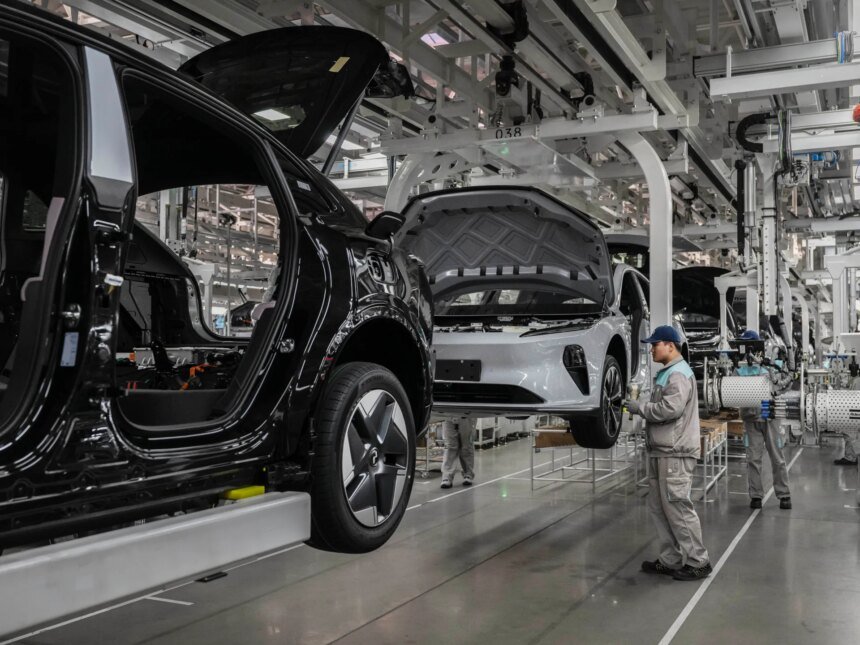
Chinese companies accounted for more than 10% of new car sales in Europe for the first time last month, with consumers turning to models that offer higher specifications at lower prices.
Although the European Union has sought to protect local automakers by imposing additional customs duties on Chinese cars starting in 2024, these duties only apply to fully electric cars. Because duties on hybrid cars were lower, this category outsold all-electric cars.
German Volkswagen, the largest car manufacturer in Europe, is considering cutting up to 100,000 jobs and ending production in 4 German factories, under pressure from intense competition with cheaper Chinese cars.
European officials believe, according to what was reported by the German News Agency, that Chinese car companies receive a variety of government support, ranging from grants, financing, and cheap land, which they see as a form of government support for Chinese companies.
Source: German + French + Wall Street Journal