
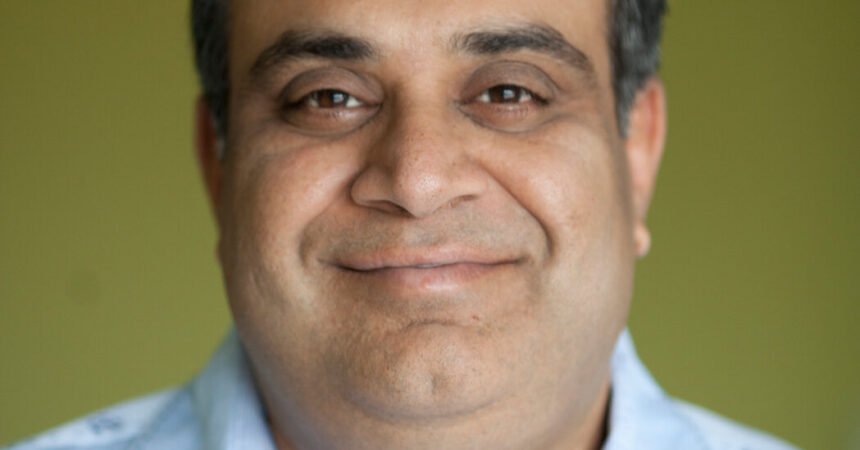
Om Malik, a technology journalist and investor whose blog, Gigaom, which he founded in 2001, established him as one of the most important voices in Silicon Valley and helped signal a shift in how the media covered the tech industry, died on Wednesday in Palo Alto, Calif. He was 59.
An announcement on his website, Om.co, said that his death, at a hospital, came “after a long health journey with his heart.”
Mr. Malik started his blog just as the dot-com bubble burst, leading to a recession that also took down many of the journalism start-ups that wrote about tech, like The Industry Standard and Inside.com. He was among the most prominent of the writers who quickly filled the gap, covering Silicon Valley with a mixture of hot scoops and sharp opinions that quickly made Gigaom a must-read.
“The Android OS leaves me feeling like one feels three hours after having Chinese food: a tad empty,” he wrote in a 2010 post that neatly summarized Google’s struggles to move beyond its roots as a search platform. “Google has to learn the art of engagement — something particularly challenging.”
By 2006, the site had 500,000 readers a month, and Technorati, a blog-tracking platform, ranked it among the 50 most influential blogs. In 2015, when Gigaom shut down, it claimed 6.4 million monthly readers.
The emergence of blogs like Gigaom and of opinionated tech writers like Mr. Malik, Kara Swisher and Jason Kottke helped define the next iteration of technology journalism, moving it away from establishment publications and toward singular voices.
Having cut his teeth as a culture and tech journalist in the 1990s for outlets like Forbes.com and Red Herring, Mr. Malik was both a believer in the power of technology as a social force and a skeptic of its tendency to evangelize about itself.
In 2003 he wrote the book “Broadbandits: Inside the $750 Billion Telecom Heist,” a fierce indictment of the broadband industry, which had grown rapidly during the late 1990s.
Long before Facebook came in for attacks from both the political left and right, he called out, during a 2013 interview with Bloomberg TV, what he said was “absolutely an air of amorality” on the part of its founder and chief executive, Mark Zuckerberg. In the same interview, he criticized the venture capitalist John Doerr for “patently trying to hijack the political process.”
Mr. Malik began his blog somewhat by accident. While still writing for Red Herring, a tech-focused business publication, he found himself writing articles about then-niche topics, like mobile internet and social media, that the magazine didn’t want. He wrote about them anyway in emails to friends, then archived the emails on a Blogger page.
“I might have found my art form, right?” he said in a 2016 interview with the Techies website. “It was not traditional journalism, it was not writing news. It was a little bit of opinion. I think my whole past was building up to me being a blogger.”
He had a rare ability to see around corners, and to pick out from the horde of new companies the ones that were going to make real change. He was an early champion of Slack, the workplace messaging service, and in 2006 he was the first blogger to write extensively about Twitter. He was not a fan.
“The annoying SMS messages from nocturnal friends is not the only thing which bothers me about this service,” he wrote, “but also the fact that texting a message (reply) to twttr ends up on their website.”
The flexibility of blogging — and its relaxation of traditional standards of journalistic ethics — allowed Mr. Malik to play roles beyond mere writer. In 2006 he founded Giga Omni Media, a media and research company, which became home to Gigaom and other blogs. He sold it in 2015. (The original Gigaom blog shut down, but Mr. Malik migrated some of its original content to Om.co, where he continued writing until earlier this month.)
He joined True Ventures, a firm that funds start-ups, in 2008, and became a full-time partner in 2014.
By the late 2010s, he had established himself as a singular figure in the tech industry: an investor, an adviser, a writer and, above all, a moral compass on issues like privacy and the power of big tech.
“I kind of joke about this, but I think Silicon Valley has become the Babylon of the 21st century,” he told Techies. “I think we have a moral responsibility now I don’t think tech ever had to think about it before.”
Om Prakesh Malik was born on Sept. 29, 1966, in New Delhi, into what he later described as a solidly middle-class Indian family. His father was an Army officer and his mother taught high-school Sanskrit.
Mr. Malik later said that he knew when he was 14 that he wanted to be a journalist. But he studied chemistry at St. Stephen’s College in New Delhi, graduating in 1986.
He worked for a variety of Indian magazines early in his career, including VP Fun, which he described as the country’s version of Tiger Beat, the bubbly teen publication.
He moved to London in 1992 and to New York the next year, with no job and just a few freelance assignments in hand. He wrote for a string of publications aimed at the American Indian community and founded Desiparty.com, an entertainment website.
Eventually he began writing about telecommunications for Forbes, and in 1997 became one of the founding staff members of Forbes.com, the magazine’s first venture into tech coverage. In 1999, he left journalism to work for an investment bank, but returned after just eight months because he found he missed writing.
He wrote for Red Herring and Business 2.0 before starting his blog just a few weeks after the Sept. 11 attacks.
Mr. Malik never married or had children. Information about his survivors was not immediately available.
In December 2007 he suffered a heart attack, an episode he revealed on his blog a week later, with his typical directness and humor.
“Friends and family have purged my apartment of smokes, scotch and all my favorite fatty foods,” he wrote. “I am even going to be drinking decaf.”