Published on 6/26/2026
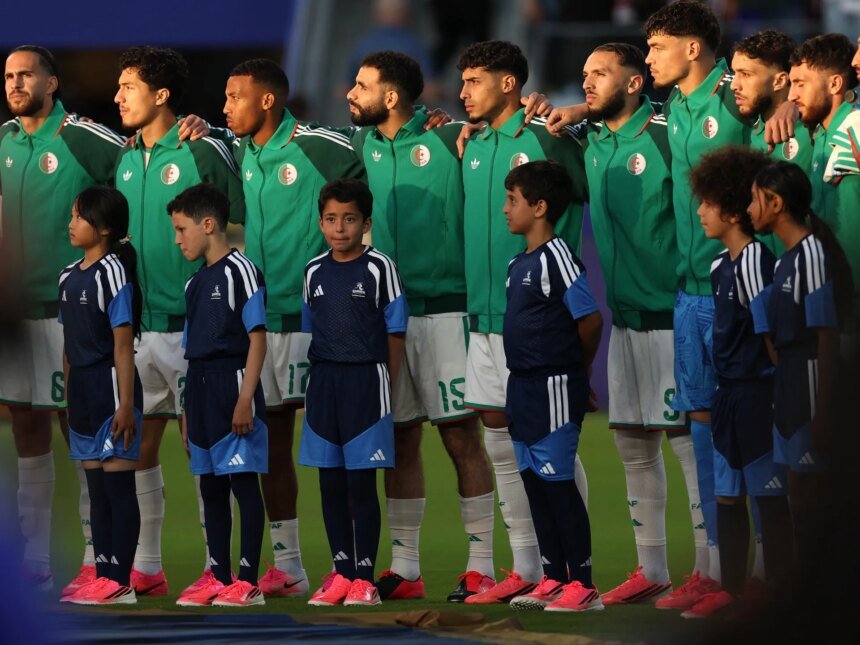
The decisive confrontation that will bring together the Algerian and Austrian teams in the third and final round of the tenth group competitions in the 2026 World Cup, scheduled for June 28, is of special interest. It not only determines the identity of the finalists, but also presents an unusual equation that may make occupying second place less tempting than usual.
These questions revolve around whether the two parties will resort to tactically “arranging” the outcome of the match to secure their common interests, which automatically places the confrontation under the microscope of the International Federation of Association Football (FIFA), which imposes strict control on the matches of the final round to prevent any behavior that violates the principle of equal opportunities and fair play.
Read also
list of 2 itemsend of list
The two teams arrive at this confrontation tied with three points each. The numerical calculations for Group Ten indicate that the result of the tie guarantees the qualification of Algeria and Austria together to the next round. Austria has 3 points (goal difference of 0) and Algeria has 3 points (goal difference of -2), behind leaders Argentina with 6 points.
Algeria began its journey with a heavy loss to Argentina, 3-0, before regaining its balance with a valuable victory over Jordan, with a score of 2-1. As for Austria, it started the tournament with a 3-1 victory over Jordan, then lost to Argentina by two goals to none.
While the competition for qualification places seems natural, the new World Cup system, which includes 48 teams, has produced more complex calculations regarding the path to the knockout stages.
Second place…a possible route to Spain
The French website “RMC” devoted a space to talking about the possibilities that indicate that the second-place finisher in Group 10 may clash with the winner of Group 8 in the round of 32, which is the position that Spain seems closest to occupying, even though it has not officially won the lead before its last match against Uruguay.
For this reason, finishing the group in second place may not be the most comfortable option, especially since some current scenarios give the third-placed team a relatively less complicated path in the upcoming rounds.
If the third-place finisher from this group is able to qualify among the best three, he may face the United States, the leader of Group Four, in the round of 32, or the leader of Group Seven, which Egypt currently leads.
The draw may also place it against the leader of Group Two, Switzerland, or the leader of Group Eleven, Colombia, according to the current standings. However, this path may also lead him to face the leader of Group Twelve, England, which makes the picture open to several possibilities.
Third place is not a guarantee
Although third place may seem tempting from the perspective of the draw, reaching the next round from this position remains dependent on being among the best eight teams that occupy third place among the twelve groups.
Statistical models show that the team that finishes the first round with three points and a goal difference of (-1) has an 84.2% chance of qualifying, while this percentage drops to 63.4% when the goal difference is (-2), then to 41.8% if it is (-3), before falling to only 26.9% when it is (-4).
Austria has a clear advantage in these calculations thanks to the better goal difference, as its chances of reaching the round of 32 are estimated at 97.5%, compared to 82.9% for Algeria, according to “Football Met Data” data.
The figures also indicate that the probability of Austria finishing the group in third place is 27.7%, compared to 72.3% for Algeria. If this position is occupied, the chances of qualifying among the best third-place finishers increase to 25.2% for Austria and 55.2% for Algeria.
A draw might serve Austria more
It seems that the result of the tie may be more in the interest of the Austrian team, as it secured second place thanks to its superior goal difference. As for Algeria, the calculations seem more complex, and being satisfied with the break-even point may not be enough to guarantee a comfortable situation.
Also, any bet on accounts or waiting for other results may carry a great risk for the “Desert Warriors”, especially since a loss will significantly increase the chances of them leaving the tournament, as estimates indicate that the percentage of exclusion in this scenario may reach 44.8%.
Despite the complexity of the possibilities, the two teams will enter the match with an important advantage in knowing all the results of the other groups in advance, as the confrontation will be held after the first round matches have completely ended, which allows the two technical staff to accurately see the number of points and goal differences required to reserve the qualification ticket, whether through second place or among the best third-place finishers.
Chances of qualifying for the third-placed team in each group
- The first group: South Korea – 69.7%.
- Group Two: Bosnia and Herzegovina – 100% (qualified).
- Group Three: Scotland – 13.4%.
- Group 4: Paraguay – 99.9%.
- Group Five: Ecuador – 100% (qualified).
- Group Six: Sweden – 100% (qualified).
- Group Seven: Egypt, Belgium, Iran, or New Zealand – 47.1%.
- Group Eight: Spain, Cape Verde, Uruguay, or Saudi Arabia – 28.2%.
- Group Ninth: Senegal or Iraq – 54.8%.
- Group 10: Algeria or Austria – 51.1%.
- Group Eleven: Portugal, Democratic Republic of the Congo, or Uzbekistan – 46.6%.
- Group 12: England, Croatia, or Ghana – 89.1%.
These numbers confirm that the qualification battle is still open to all possibilities, and that the identity of a number of those qualifying for the round of 32 will not be decided until the final whistle of the final round.