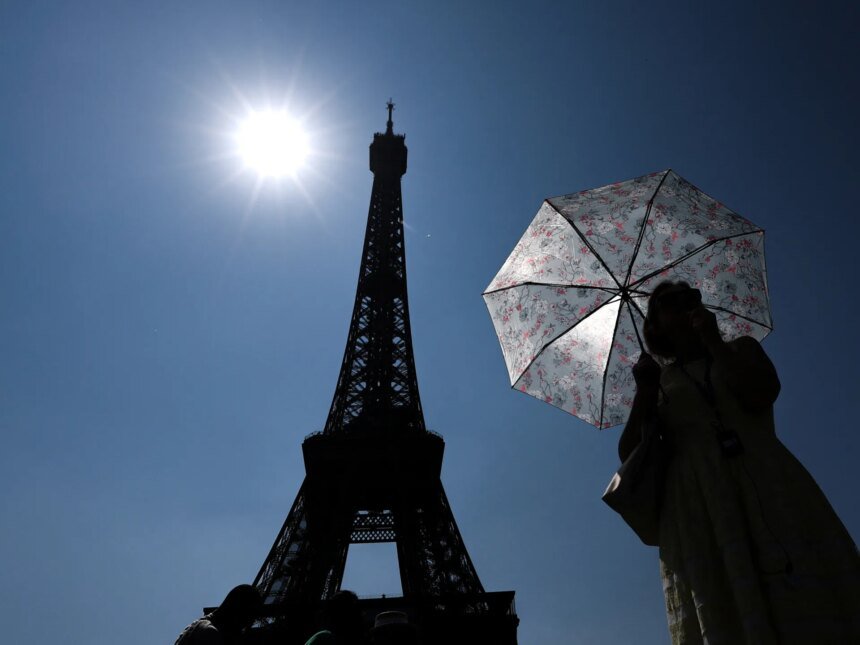
Published On 6/24/2026
The intense heat wave continues in Europe on Wednesday, as temperatures reached unprecedented levels, leaving tens of thousands without electricity and resulting in a rise in air conditioner sales, on a continent that is not equipped to deal with this scorching heat.
Temperature levels exceeding 35 degrees are expected to affect at least 94 million people in Europe on Wednesday, most of them in France and Spain, according to Agence France-Presse calculations.
Experts attribute these extreme weather conditions to atmospheric and air circulation patterns that keep hot air confined in place for days, and these factors are exacerbated by climate warming.
The national temperature index for maximum temperatures in France, which represents the average of the highest temperatures recorded at 30 reference stations, reached 38.2 degrees Celsius on Tuesday, exceeding the previous record level (37.7 degrees) dating back to August 5, 2003, and it came at that time in the midst of a heat wave that lasted for about two weeks and killed about 15,000 people.
With the inclusion of 4 additional French regions within the highest level of heat warning on Wednesday, about 44 million people are affected by the exceptional heat wave, according to Agence France-Presse calculations.
In addition to the 31 provinces currently covered by the orange alert, more than 90% of France’s population is exposed to high temperatures expected to range between 39 and 41 degrees on Wednesday from Brittany to the Paris region, and in most parts of the southwest.

Power outage
The heat wave caused a power outage to about 68,000 homes in northwestern France on Wednesday, according to what the authorities reported, in the first major power outage the country witnessed during the recent heat wave.
While the concerned teams worked throughout the night to repair the malfunction that occurred late Tuesday, power is not expected to be fully restored until the end of the day at the earliest.
About 106,000 subscribers to the French electricity grid were without power as of Tuesday evening, while scorching temperatures strained infrastructure built before the worsening climate change caused by human activity, which made heat periods longer, more frequent and more intense, according to scientists.
Sales of fans and air conditioners have increased dramatically and have been lost from many stores, in a country where most buildings are not designed to withstand high temperatures.
On Monday, the Carrefour supermarket chain sold 30,000 of these units by 6:30 p.m., meaning “1,000 times what is sold on a normal day,” according to what CEO Alexandre Bompard said.
Amazon’s sales nearly doubled last week compared to the same period in 2025, while the electronics store “Fnack Darty” recorded growth of more than 10%.
Thierry, an electrician from southwestern France, said he had received a flood of requests to install “emergency” air conditioning equipment.
He explained, “In theory, an application must be submitted to the property owners association” in residential complexes, “but people do not want to wait.”
“It is difficult to live alone” and without air conditioning, said Martine Belloc, a 62-year-old retiree from Bordeaux, who went on Tuesday to “La Manoco,” a center equipped to receive the elderly.

We feel suffocated
John Beller, a 45-year-old American engineer, said that he and his wife were suffering from the stifling heat in the French capital. “Visiting Paris in this heat is unbearable,” he told AFP, carrying a small fan.
He continued, “We feel suffocated in the streets, in the metro, and even in our rented apartment,” adding that he and his wife will move to an air-conditioned room in a hotel.
In Italy, the Ministry of Health issued a red alert regarding a heat wave in 16 cities on Wednesday, including Milan and Rome.
The heat wave is expected to extend to eastern Europe in the coming days. The Polish Meteorological Service issued warnings of high temperatures in the west of the country from Thursday to Saturday, expecting temperature levels to exceed the record recorded in 1921 of 40.2 degrees.
Croatia’s famous Adriatic coast was also placed under the highest heat warning level on Friday and Saturday.
Hungary, which is subject to the second level of warning, announced that it will be raised to the highest level from Saturday to Tuesday as temperatures continue to rise.
According to a scientific study published this week, the current heat wave is “significantly exacerbated by human-induced climate change,” without which current temperature levels would be 2 to 4 degrees lower.
But some relief may begin from the west on Wednesday, as the Spanish Meteorological Service said that temperatures will drop in most parts of the country.
No quick breakthrough
But a rapid drop in temperatures is not expected in most parts of western Europe. Starting from Wednesday until at least Friday, the regions of central and southern Holland will be subject to an orange alert due to the intense heat wave.
Amsterdam residents who hold a city card can swim for free in 6 outdoor swimming pools, while the Dutch national railway company will reduce its flights on a number of lines starting Wednesday.
In Britain, Assistant Secretary-General of the National Association of Head Teachers, James Bowen, told AFP that “almost all schools across the UK will have to make some sort of adjustment this week amid the extreme heatwave.”
“I think it’s fair to say that the school infrastructure in the UK is not well prepared for this level of heat,” he added.
After some tourist sites that are witnessing increasing demand in France, such as the Louvre Museum and the Eiffel Tower, decided to reduce visiting hours, the management of one of the most famous monuments in Belgium, the Atomium Space Museum in Brussels, announced that it would close its doors to visitors earlier than usual, from Wednesday to Friday.