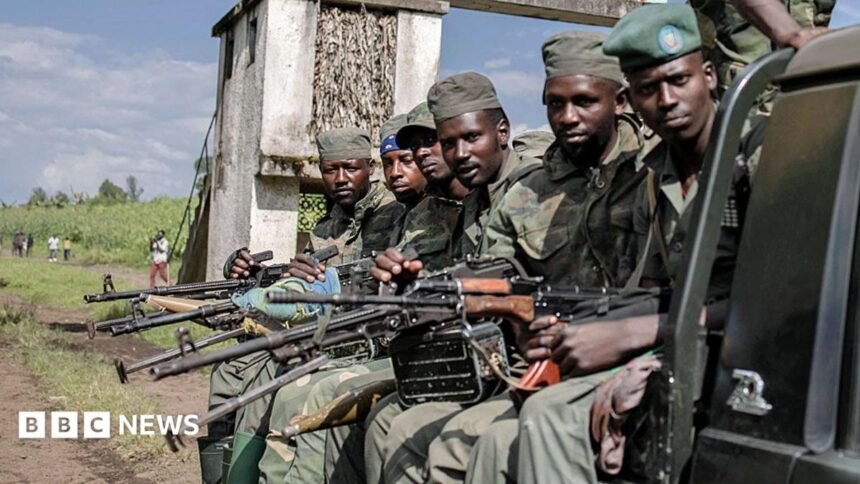

The M23 rebels have captured huge tracts of DR Congo’s east
The M23 rebels have captured huge tracts of DR Congo’s east
The Democratic Republic of Congo has filed a case against Rwanda at the International Court of Justice (ICJ), accusing its neighbour of breaching multiple international treaties.
In a statement, DR Congo said Rwanda had dispatched forces and backed armed groups to carry out unlawful military operations on its territory following the 1994 Rwandan genocide.
On Friday, Congolese Justice Minister Guillaume Andali said his country is seeking accountability for alleged breaches of conventions covering genocide prevention, racial discrimination, women’s rights and torture.
Rwanda has not yet responded to DR Congo’s filing, but it has long-dismissed evidence that it backs rebel groups in the country.
UN experts and Western governments are among various parties who say Rwanda is supporting the M23, a major armed group in DR Congo’s east.
The country’s application asks the ICJ, based in the Netherlands, to order Rwanda to cease its alleged crimes and award reparations to the Congolese authorities and its victims.
The ICJ will now examine the claims.
This is not the first time DR Congo has filed a case against Rwanda at the ICJ.
An initial case was dropped by the Congolese authorities in 2001. In 2006 the ICJ dismissed a second case, saying it could not proceed because Rwanda had not recognised its jurisdiction.
The decades-long conflict in DR Congo is rooted in the 1994 Rwandan genocide.
About 800,000 people – mostly from the Tutsi community – were slaughtered by ethnic Hutu extremists.
Fearing reprisals, an estimated one million Hutus then fled across the border to what is now DR Congo. This stoked ethnic tensions as a marginalised Tutsi group in the east – the Banyamulenge – felt increasingly under threat.
Rwanda’s army twice invaded DR Congo, saying it was going after some of those responsible for the genocide, and worked with members of the Banyamulenge and other armed groups.
One of the Hutu groups, the Democratic Forces for the Liberation of Rwanda (FDLR), which includes some of those responsible for the Rwandan genocide, is still active in eastern DR Congo.
Rwanda describes the FDLR as a “genocidal militia” and says its continued existence in eastern DR Congo threatens its own territory.
Rwanda accuses the Congolese authorities of working with the FDLR – DR Congo denies this.
The conflict flared last January, when the M23 captured large parts of the mineral-rich east, including the regional capital Goma.
The fighting has continued despite Rwanda and DR Congo signing a peace deal, spearheaded by the US, in December.
You may also be interested in:
What’s the fighting in DR Congo all about?
Trump’s ‘historic’ peace deal for DR Congo shattered after rebels seize key city
DR Congo’s failed gamble on Romanian mercenaries

Go to BBCAfrica.com, external for more news from the African continent.
Follow us on Twitter @BBCAfrica, external, on Facebook at BBC Africa, external or on Instagram at bbcafrica, external
Related topics
BBC Africa podcasts
Focus on Africa
This Is Africa