Published on 6/26/2026
|
Last update: 07:38 (Mecca time)
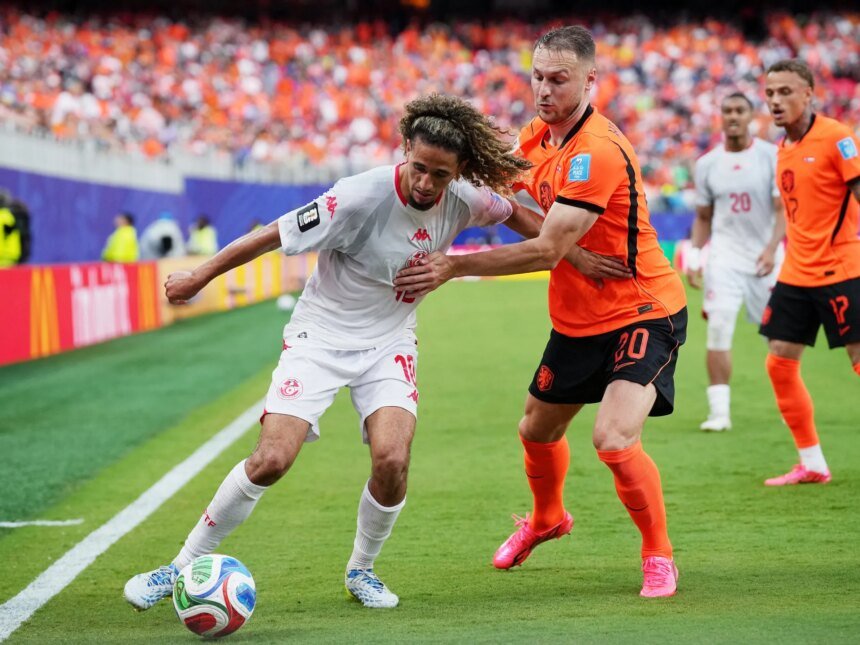
The Dutch team ended the campaign of its Tunisian counterpart in the 2026 World Cup with a well-deserved 3-1 victory in the third round of the group stage, leaving the “Eagles of Carthage” without any points, after 3 consecutive defeats, in the worst numerical participation in the team’s history, after conceding 12 goals, which is the largest number of goals conceded in a single edition of the World Cup.
Hervé Renard made four changes to the squad that lost in the last round to Japan. Mohamed Amin Ben Hamida, Rani Khedira, Hazem Al-Masturi and Ismail Al-Gharbi participated, replacing Omar Raqiq, Sebastian Tonakti, Dylan Bron and Elias Saad.
Read also
list of 2 itemsend of list
On the other hand, Ronald Koeman made one change to the squad that beat Sweden, with defender Nathan Ake participating in place of Micky van de Ven.
French coach Renard entered the match with a 5-3-2 tactical scheme, prioritizing securing the defensive areas and reducing the danger of the Dutch attack. However, the plan was not sufficient to compensate for the large difference in technical quality and tactical organization between the two teams.
As happened in the previous two matches, Tunisia conceded an early goal, confirming its continued suffering at the beginning of the matches, after conceding within the first 10 minutes in all three of its matches.
On the individual level, Elias Skhiri continued to deliver a disappointing tournament, after he struggled again in defensive control, and lost many bilateral battles, in addition to a clear slowness in handling the ball under pressure, before his suffering worsened by scoring an accidental goal against his country’s national team, embodying part of the defensive crisis that has plagued Tunisia throughout the tournament.

The Dutch team imposed its control over the course of the first half, and ended it with a two-goal lead without a response, in light of a clear Tunisian surrender, whether in terms of pressure or the ability to keep up with the speed of ball circulation and the opponent’s offensive transitions.
Better appearance
However, the Tunisian team appeared better at the beginning of the second half, benefiting from Hazem Al-Masturi’s goal, which restored some hope, and at the same time revealed one of the few positive points in the Tunisian participation, which is the effectiveness of crosses and headers. The team scored its only two goals in the tournament from two headers, and this goal also became the second of 4 header goals scored by the Tunisian team in the history of its participation in the World Cup.
Coach Renard felt that he could return to the match, so he took a tactical adventure, abandoning the 5-3-2 defensive formation to 4-4-2, after removing Ismail Al-Gharbi, Rani Khedira, and Mohamed Amin Ben Hamida, and bringing in Elias Al-Achouri, Mortada Ben Ounas, and Mohamed Belhaj Mahmoud, in an attempt to increase the attacking intensity and improve the spread in the middle of the field.

Although the shift gave Tunisia a relatively better presence in terms of spread, it did not succeed in reducing the technical difference with the Dutch team, which maintained its calm and control, before Jan-Paul van Heecke scored the third goal, effectively ending the “Eagles of Carthage’s” hopes of returning.
With the result and lead guaranteed, coach Ronald Koeman took advantage of the period between the 71st and 85th minutes to make his five changes, giving the opportunity to a number of new elements, in the absence of any real pressure from the Tunisian national team.
On the other hand, coach Renard continued to search for offensive solutions during the final minutes, pulling Anis Ben Slimane and pushing Firas Chaouat to exploit air balls inside the penalty area, before giving young Sebastian Tonakti the opportunity to appear, hoping to benefit from his abilities in tight spaces, but this effort lacked effectiveness, and did not change the reality of the match.
The Netherlands national team possessed the ball by 71.7% in its match against Tunisia, setting a new record in its history, as it exceeded the previous record recorded in 1994 when it possessed the ball by 70.8% against Saudi Arabia.

In conclusion, the match confirmed that the Tunisian team’s problems in this edition went beyond the tactical drawing to include individual differences, defensive solidity, speed of reaction, and the ability to keep up with the high level of play against the major teams.
As for the Netherlands, it achieved a logical victory that reflects its technical and tactical superiority, while the Tunisian team left the tournament in a narrow way, after a participation that will impose a comprehensive review at various levels.