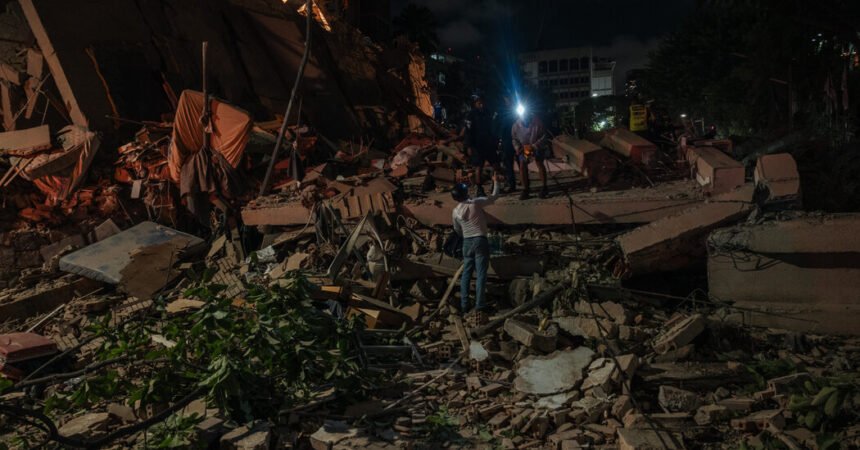
Deadly twin earthquakes struck Venezuela in succession on Wednesday evening, leveling buildings and transforming areas of its populous northern states into scenes of destruction.
The extent of casualties and damage was beginning to become clearer on Thursday morning as rescuers combed through rubble. At least 164 people were killed and hundreds more were injured, officials said. Many others have been reported missing.
President Delcy Rodríguez said that initial reports of deaths did not include the worst-hit state of La Guaira.
How big were the quakes?
Seismologists recorded the earthquakes’ epicenters in the Venezuelan state of Yaracuy, west of Caracas. Tremors were felt more than 100 miles away.
The initial one hit at 6:04 p.m. Eastern time on Wednesday with a magnitude of 7.2. The epicenter was near San Felipe, a city of about 220,000 people.
Around 39 seconds later, a second, stronger quake with a magnitude of 7.5 hit nearby. It was the most forceful earthquake to strike Venezuela since 1900.
According to the United States Geological Survey, the earthquakes struck at a relatively shallow depth, making them particularly dangerous. They were the result of the Caribbean tectonic plate grinding against the South American one.
Two smaller follow-up earthquakes were recorded near Caracas, and seismologists assessed that at least one aftershock at a magnitude of 5.0 or greater over the next week is likely.
How many people have died?
Ms. Rodríguez said in a phone call to state television on Thursday morning that at least 164 people had been killed. Hundreds more were reported injured.
The strongest tremors struck the northern states of Yaracuy, Carabobo, Aragua and La Guaira, which include some of Venezuela’s most populous regions.
According to the U.S. Geological Survey, many houses in those areas are made of unreinforced brick masonry and adobe blocks, leaving them particularly vulnerable.
In some neighborhoods of Caracas, buildings collapsed and the power went out. Witnesses described buildings shaking violently, windows rattling and water pipes bursting.
Photos and videos verified by The New York Times show concrete buildings reduced to rubble and others severely damaged. In the port city of La Guaira, a scruffy gateway to the capital, buildings as tall as 10 stories high collapsed and high-rise tower blocks were seen tilting.
Simón Bolívar International Airport, which is in the same state and serves Caracas, was closed by authorities after it suffered heavy damage. Video shows collapsed ceilings in one of the terminal buildings.
The images of destroyed buildings emerging from Venezuela suggest that many of them were made of brittle concrete without adequate steel reinforcement, said Christian Málaga-Chuquitaype, a structural engineer at Imperial College London. “These buildings fail exactly as we are seeing: pancake failures, with one floor dropping on top of the other,” he said. When these buildings fail, they shatter, he added, making them among the most dangerous places to be in an earthquake.
How are emergency crews responding?
Venezuelan authorities have mobilized hundreds of emergency responders to look for survivors. Ms. Rodríguez declared a state of emergency, called on doctors and nurses to report to work to care for the injured and said that hotels and shelters would be opened for those left without homes.
At the site of one collapsed building in El Paraíso, a neighborhood of Caracas, rescuers pulled a young girl and a dog from the rubble. In the capital’s Chacao municipality, the mayor said that at least 22 people had been rescued.
Venezuela’s fragile infrastructure — including rail, electricity and health care systems that have suffered from years of corruption and mismanagement — were also hammered by the quakes, further hampering response efforts.
The United States and several Latin American countries said they would send humanitarian aid and rescue personnel. Ms. Rodríguez said that some of those teams, as well as others from the Dominican Republic, El Salvador, Mexico and Qatar, would begin arriving on Thursday.
The earthquakes caused over 100 buildings to collapse in the city of La Guaira, the U.N.’s main humanitarian agency said, overwhelming local authorities.
What is the political situation in Venezuela?
Venezuela is reeling from years of economic turmoil and crippling U.S. sanctions, and the earthquakes pose an immediate challenge for the president, Ms. Rodríguez.
In an audacious raid in January, U.S. forces captured and deposed the autocratic president, Nicolás Maduro, transporting him to the United States to face federal drug charges. President Trump handpicked Ms. Rodríguez as his successor and promised that the change would “unleash prosperity” by reviving Venezuela’s oil industry.
Six months on, there has been little sign of dramatic economic turnaround under Ms. Rodríguez, whose approval rating fell to 25 percent in May. Public coffers remain largely empty, leaving the government ill equipped to fund basic services.
Although the Trump administration has issued special exemptions from sanctions for companies interested in doing business in Venezuela, none has publicly committed to bringing significant capital into the country. Annual inflation is falling but remains the world’s highest, the currency has continued to decline in value, and though wages have increased, they are still too low to to lift many out of destitution.