Saw the region’s report: “Do an independent review”
Updated 20.17 | Published 20.11

Response times for the most serious alarms were not affected by the ambulance staffing crisis last summer, according to Region Stockholm’s own report.
But statistics that Aftonbladet has seen show that several patients judged to be critically ill had to wait over 1.5 hours for an ambulance during one of the crisis weeks.
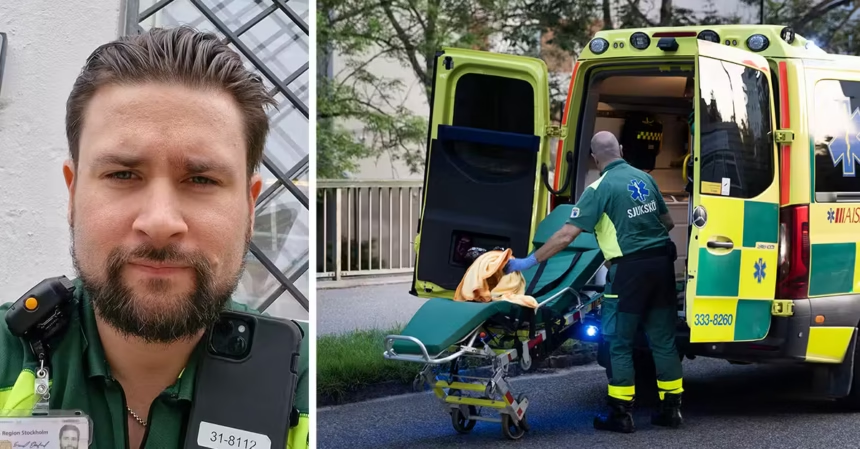
– It is incredibly dangerous for patients, says Emil Skoglund, ambulance nurse and union representative.
At the end of July last summer, ambulance workers struck Stockholm emergency alert. The staff shortage they warned managers about in the spring – in connection with the region taking back the entire operation under its own auspices – was a fact.
Mass text messages went out daily to employees with gaps that needed to be filled. On the evening of July 22, there was only one ambulance in operation at the station in the city, something The evening paper and several other media reported on.
The next day, the region held a crisis meeting and intensive work was started to get the situation in order.
In August, the regional board decided to make its own evaluation of the summer’s ambulance crisis. The report later established that the crisis affected the ambulance staff, who were forced to work an illegal amount of overtime.
But urgently ill Stockholmers had not had to wait any longer for help.
The response time for the so-called prio 1 alarms, which apply to the most urgent cases such as cardiac arrest, acute bleeding or other life-threatening illnesses, had not been affected. As in the previous summer, the median value for how long a patient had to wait for an ambulance was around 13 minutes.
That’s right. But that doesn’t give the whole picture.

Had to wait 30 minutes longer
In the region’s report, they looked at the rash throughout the summer. But Aftonbladet has now obtained statistics that show the times week by week, compared to 2024.
And for the percentage of calls where patients had to wait the longest, one percent, a difference is visible. During the summer of 2024, the response time was shorter than 70 minutes over six weeks. In the summer of 2025, it only happened for one week – in week 35.
Other weeks, the response times were between 70 and 91 minutes.
Week 30, the same week that the crisis broke in the media, they skyrocket.
Even in weeks 31 and 32, the response times are slightly higher compared to 2024. In week 33, the response time for the one percent who had to wait the longest was 86 minutes or more. To compare with the same week the year before when the figure was 65 minutes.

That a prio-1 patient has to wait 90 minutes or more for an ambulance is bad, says Emil Skoglund, ambulance nurse and elected representative for the Vårdförbundet.
– It is incredibly dangerous for patients. We have to cope with better times in Stockholm.

That’s how long Stockholmers had to wait for an ambulance during the crisis week
The response time for the ambulance throughout the summer was approximately 13 minutes, which is in line with previous summers.
The figures show four median values for ambulance response times, P50, P90, P95 and P99. The numbers given are minutes.
In week 30, when the crisis became news in the media, the response times looked like this:
Number of calls: 1171.
P50: 13.5 minutes. In 50 percent of the cases, the calls were faster than 13.6 minutes and 50 percent were slower. 585 patients had to wait longer.
P90: 35 minutes. In 90 percent of the cases, the calls were faster than 35 minutes and 10 percent were slower. 117 patients had to wait longer.
P95: 52 minutes. In 95 percent of the cases, calls were faster than 52 minutes and 5 percent were slower. 65 patients had to wait longer.
P99: 91 minutes. In 99 percent of the cases, the calls were faster than 91 minutes and 1 percent were slower. 13 patients had to wait longer.
Criticism of the region’s report: “Misleading”
He was the one who sounded the alarm to the media about the crisis last summer. He is disappointed with the region’s report, which he thinks should have included the more detailed figures he has now seen.
– But it fits well with the severe staff shortage we had during the weeks with between 10 and 20 stationary ambulances per day.
Ten percent of the highest priority patients – about a hundred per week – had to wait at least 33 minutes or more for an ambulance – during all the weeks of the summer. Something Emil Forsberg believes is too bad for a big city.
– We ourselves felt that we often had to travel longer distances to get to the patients. Several of us had calls in Stockholm’s inner city where patients with cardiac arrest had to wait for 30 minutes or more. It may be a normal response time if you live in northern Sweden with great distances, but not in a big city. It shows how systematically understaffed we are, he says.
Looking at the median value for the entire summer to evaluate last year’s ambulance medical care is misleading, he believes. This is because the need for ambulance care, as well as the staffing situation, can vary greatly.
– The fact that the response time was okay throughout the summer matters less to those who were acutely ill and needed an ambulance sometime during the worst weeks and had to wait much, much longer.

“No deviations were found”
Aftonbladet has contacted the region’s press service to ask our questions to the person responsible for the report, and is referred to Ulf Lockerwand, operational strategist at the regional management administration, who produced it.
According to him, the report gives a fair picture of the summer’s ambulance medical care, where he compared the median value over the entire summer with recent years.
– Yes, I absolutely think so. Both for the patients and ambulance staff. The important thing is that the ambulance arrives on time for the most seriously ill, priority 1 cases. And the important thing is that those response times were not affected.
The report is based on key figures from the ambulance and interviews with employees in the operation. He has not taken part in the more detailed statistics.
Wouldn’t it have been reasonable to look more closely in detail at the worst weeks?
– They could certainly have developed it in detail, but as far as I understood there were no deviations.
“Patients are not just statistics”
Peter Hill, business developer for prehospital care in the region, says that the median value used in the report is standard for measuring ambulance care. According to him, looking at individual weeks and the longest response times is “not statistically interesting”.
– The longer response times can often be due to the fact that there were special obstacles for the ambulances to drive forward. It could be that there is a tree on the road or that the police have set up roadblocks, for example. That is one of the reasons why you measure the median times the way we do. If you’re lucky, there’s an ambulance on the street outside, he says.
In that case, to understand what is behind it, you have to go in and look at each individual case, he says.

And that should have been done, think several in the region that Aftonbladet spoke to.
But neither the summer of 2024 nor 2025 shows reasonable ambulance medical care, says Emil Skoglund. He wants to see a new – independent review – of the ambulance service, looking at how response times have developed over the past ten years.
– You should have been much more curious about what it looked like last summer. Our patients are not just statistics, they are people who deserve care.
But first you have to get through the summer. Paramedics are already receiving mass SMS about unmanned passes for July and August.
“The situation is strained and there are many gaps,” says a text message from an ambulance station.