Published on 6/24/2026
|
Last update: 14:48 (Mecca time)
The Pakistani Ministry of Foreign Affairs confirmed that technical negotiations between the United States of America and Iran will resume next week through joint mediation with Qatar, stressing that the memorandum of understanding signed in Islamabad includes establishing a direct line of communication between Washington and Tehran to avoid crises and misunderstandings.
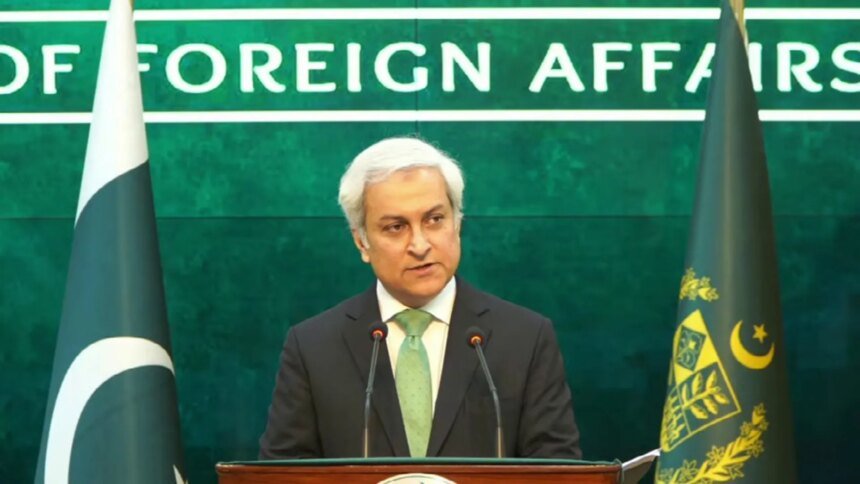
Pakistani Foreign Ministry spokesman Tahir Andrabi said – during a press conference in Islamabad – that contacts are continuing with the American and Iranian teams for the effective implementation of the terms of the memorandum, and that the technical meetings have not stopped despite the participants taking intermittent breaks.
He explained that the technical committee, which held its meeting in the Swiss resort of Burgenstock on June 22, will continue its work during the coming weeks, with the participation of experts from Pakistan and Qatar to coordinate with the American and Iranian sides regarding the implementation of the understandings reached.
On June 18, Pakistan announced the signing of a historic memorandum of understanding between the United States and Iran via an electronic mechanism, which was followed by the holding of the first high-level committee meeting in Bergenstock in the presence of officials from the two countries in addition to Qatar and Pakistan.
The meeting included Pakistani Foreign Minister Ishaq Dar, Army Commander Asim Munir, US Vice President J.D. Vance, Iranian Parliament Speaker Mohammad Baqir Qalibaf, and Qatari Prime Minister and Foreign Minister Sheikh Mohammed bin Abdul Rahman Al Thani.
According to the Pakistani Foreign Ministry spokesman, the meeting helped the two parties reach understandings regarding the implementation of the memorandum of understanding, and led to the adoption of a joint statement setting the political and mediation framework for the upcoming negotiations.
The spokesman indicated that the road map agreed upon aims to reach a final agreement within 60 days, with the establishment of a high-level committee for political supervision and mediation, and the submission of periodic reports on the implementation of the terms of the memorandum.
Direct line of communication
He added that the agreement includes a direct line of communication between Washington and Tehran to avoid misunderstandings and facilitate the movement of ships through the Strait of Hormuz, in addition to establishing a cell to resolve disputes related to the Lebanese file with the participation of Pakistani and Qatari mediators.
These clarifications come after statements by Pakistani Prime Minister Shehbaz Sharif, in which he stressed that the memorandum of understanding does not address Iranian ballistic missiles, and that Islamabad will continue its mediating role until a settlement is reached that guarantees peace and stability.
The Iranian Foreign Ministry also announced the agreement on a joint mechanism that includes Iran, Qatar, Pakistan, the United States and Lebanon to prevent escalation, and linked the cessation of attacks on Lebanon to the process of implementing the memorandum of understanding.
The Pakistani spokesman revealed a series of contacts held by Deputy Prime Minister and Foreign Minister Ishaq Dar during the past ten days with officials from Switzerland, Turkey, Egypt, Saudi Arabia, the European Union, Italy, Japan, China, Canada, Bahrain, Azerbaijan, Iran and Uzbekistan.
He pointed out that Cairo hosted, yesterday, Tuesday, a quadripartite meeting of the foreign ministers of Pakistan, Saudi Arabia, Turkey, and Egypt, devoted to reviewing the progress made in implementing the Islamabad Memorandum of Understanding and the outcomes of the Burgenstock meeting.
He added that these efforts reflect a growing conviction within the international community of the importance of dialogue and diplomacy in reducing regional escalation, and that Pakistan sees the success of the current mediation as an opportunity to consolidate stability in the region.
The spokesman stressed that his country will continue to work with Qatar to bring views closer between Washington and Tehran, pointing out that the direct line of communication and the time-bound road map constitute the cornerstone of the next stage of negotiations.

Ensuring the security of the area
Iranian Parliament Speaker Mohammad Baqir Qalibaf said that his country’s policy is based on the principle that the security of the region must be guaranteed by its own countries, stressing that achieving regional stability requires cooperation between the countries of the region on the basis of respect for sovereignty and non-interference in internal affairs.
Qalibaf explained that Iran is ready to cooperate with countries in the region according to this framework, in a way that enhances common security and reduces regional tensions.
He added that the ceasefire and ending the war in Lebanon are of similar importance to Iran as the importance of the ceasefire and ending the war against Iran, in reference to the interconnectedness and interconnectedness of the security files in the region.
In a related context, Pakistani Interior Minister Mohsen Naqvi met his Iranian counterpart, Iskander Momeni, on Wednesday, and pledged that Pakistan would continue to make efforts to achieve lasting peace in the Middle East.
Pakistan’s Geo channel reported that the Interior Ministry said in a statement that the two sides held detailed discussions on Pakistani-Iranian relations and the latest regional developments in the wake of reaching a peace agreement.
Naqvi congratulated his Iranian counterpart on the joint declaration signed in Switzerland, saying that this agreement would not have been achieved without the sincere efforts made by the Iranian government and its negotiating team.
The two ministers expressed their satisfaction with the reduction of tensions in the region, and agreed to enhance bilateral cooperation in several areas, including security, combating terrorism, cybersecurity, and immigration.
Momeni announced that he will visit Pakistan soon, with the aim of strengthening cooperation between the Interior Ministries of the two countries.

International support
At the international level, the Chinese Ministry of Foreign Affairs called for the implementation of the memorandum of understanding agreed upon between the United States and Iran, stressing the need to adhere to the agreements reached between the two sides in a way that contributes to reducing tension and enhancing regional stability.
Russian Foreign Minister Sergei Lavrov also announced that his country is ready to contribute to reaching a comprehensive and long-term agreement between the United States and Iran, stressing Moscow’s support for any diplomatic efforts aimed at reducing tension between the two sides.
Lavrov added that Moscow hopes that the resumption of free navigation through the Strait of Hormuz will contribute to enhancing energy and food security for the countries of the Global South, noting the importance of ensuring the stability of vital sea lanes in the region.
The Russian Foreign Minister stressed that “Russia’s opponents must understand that Moscow’s warnings in the field of security cannot be ignored,” pointing out that his country does not rule out the participation of neighboring countries in negotiations related to the concept of security in the Gulf region.
These statements come as international diplomatic efforts continue to contain multiple crises, including the Iranian file and security in the Gulf, in addition to the war in Ukraine, amid increasing calls to revive negotiation paths and political solutions.