Grandparents, young children, siblings.
Venezuelans living around the world turned to social media to post photographs of missing relatives, desperately hoping that someone recognized them in the aftermath of two devastating earthquakes that struck the country on Wednesday.
Some people finally learned that their loved ones were alive but injured and their whereabouts unknown. Some received news of deaths, and many more were still unaccounted for.
Okarina Castaño, who works at a bank in Miami, said her brother, Carlos Castaño, called her early Thursday.
Mr. Castaño lived in Los Corales, a coastal area east of the Caracas airport, where heavy damage was reported.
“‘I’m alive, we’re alive. We just got out of the rubble, we made it,’” Ms. Castaño said he told her. “But I think my mother-in-law didn’t.”
He had been trapped in the rubble all night. Although his wife, Eliana Palacios, 40, and their 12-year-old daughter, Danna, had made it out with injuries, he did not know where they were taken.
He had been frantically searching hospitals, Ms. Castaño said.
The family had also lived through a major landslide in 1999 that killed thousands in the same area, she added. The experience had been traumatizing.
“My brother is in shock,” Ms. Castaño said. “He tells me he’s in a lot of pain.”
Brigeanner Soto, a Venezuelan who lives near Dallas, was desperate for information about her sister Gabriela Orfao, 18.
Gabriela and other siblings lived in a 14-story building called Punta Brisas in Macuto, about 12 miles east of the Caracas airport.
Ms. Soto said she had received some audio messages from neighbors, but communication was slow and spotty.
So far, she learned that the neighbors were able to rescue one of her sisters, Camila, who was taken to a hospital and undergoing surgery on her hip, she said. But they had not been able to reach Gabriela.
“Gabriela was too far underneath, and they needed heavy machinery to reach her,” Ms. Soto said. “They need heavy machinery because there are a lot of people who are still alive, but there is so much rubble that they can’t get them out.”
Absent any immediate official rescue response, survivors were the ones sifting through the rubble to find those trapped underneath, she said.
“We have tried to find the way to send help, to find them,” she said. “We haven’t slept from the moment this happened, and we are very desperate.”
In a telephone interview from Venezuela, Angie Reyes said she was trying to find her colleague, Daniel Vivas, 43, whom she had not heard from since before the earthquake.
Mr. Vivas lived on the sixth floor of a building in La Guaira, a port city not far from Caracas, that she believed had significant damage. Ms. Reyes said she knew the country’s rescue workers had very limited capacity and was worried that no one would arrive in time to help Mr. Vivas.
“We’re stuck like this until the international community arrives,” she said.
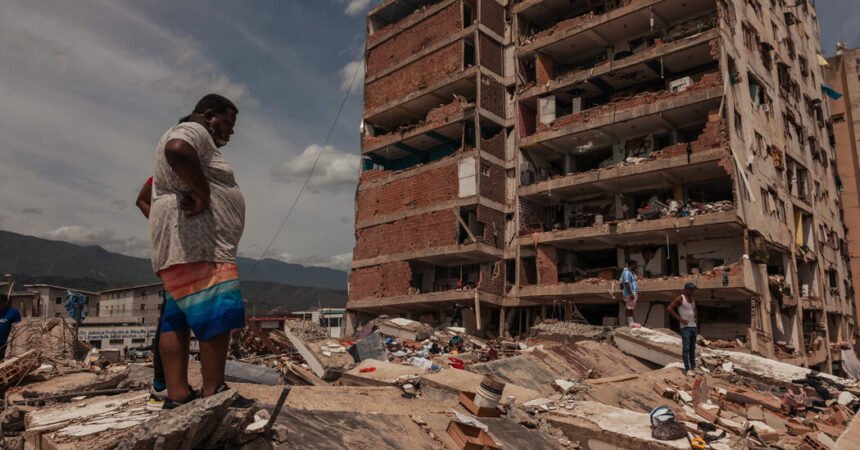
In Caracas, Vladimir Navas stood outside the remains of a six-story building in the El Paraíso neighborhood, looking for his in-laws. He said he thought they had probably been home watching a World Cup game, and the prospects of finding them alive were looking increasingly bleak.
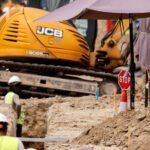
People operating heavy machinery were lifting large chunks of rubble outside the building on Thursday, trying to reach the people trapped inside. Some dead pets had been found, and at least seven residents were missing, said Henry Ascanio, a colonel at the Caracas Fire Department.
“There’s no possibility that they got out,” Mr. Navas said of his in-laws, Freddy Carrero, 86, and Eliana Hernández, 82. “You can’t hear anything. If anyone is alive in there, it’s a miracle.”
Julie Turkewitz contributed reporting from Bogotá, Colombia.