
A block north of Lincoln Center’s main plaza, where its famed fountain is hidden by a gaudy eyesore housing a dance floor for summer events, lies an unlikely oasis: Alice Tully Hall.
More often used as a music venue, Alice Tully has become a space for sophisticated dance, courtesy of the inaugural Lincoln Center Contemporary Dance Festival. For years, there has been too much ballet at Lincoln Center, which I say as someone who loves the form. Modern dance is part of the center’s history, too, and now it is finally being given a stage.
The festival, part of the Pasculano Collaborative for Contemporary Dance, opened with three international productions by choreographers who aren’t more of the same old, same old seen in New York. Jeremy Nedd and Yinka Esi Graves, in particular, showed themselves to be dance artists with discerning visions.
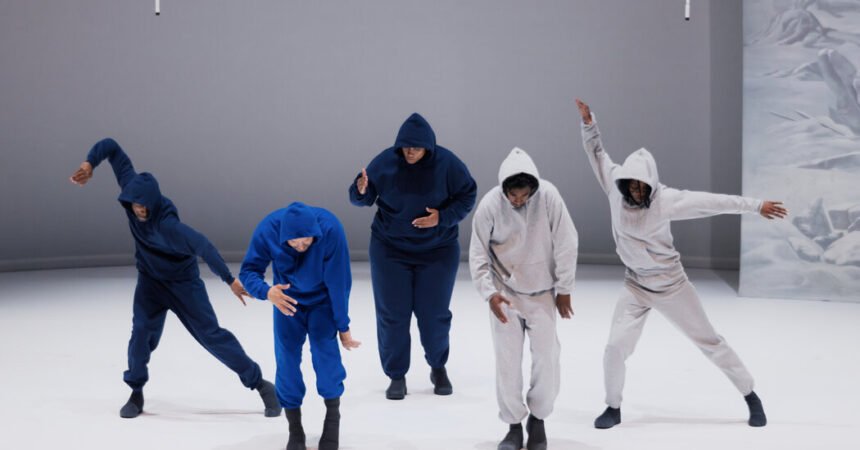
In Nedd’s articulate and soulful “from rock to rock … aka how magnolia was taken for granite,” five dancers draped over one another on the floor like a boulder. The point of departure is the Milly Rock, a viral dance born from the song and video by the Brooklyn rap artist 2 Milly.
Eventually the performers, wearing sweatsuits, rose to sway in collective motion, their knees softly bending as their arms snaked across their torsos in hypnotic, repetitive swoops. At first, they danced in their own worlds with hoods pulled over their heads. But eventually the mood shifted.
As the work placed the Milly Rock under a microscope, the performers bared their faces. Nedd, a Brooklyn-born choreographer who lives in Switzerland, doesn’t simply shine a spotlight on an addictive social dance, he takes a sly look at the way social dances, unprotected by copyright law, can be misappropriated. At one point, a dancer, wearing platform shoes made of cement, plodded heavily and loudly across the stage.
The set, with its curving wall, had a glacial feel; at times fog blew through. But when the dancers joined forces for the Electric Slide, glee washed over their faces and radiated from their bodies. They splintered out of a unison formation and, spinning and swirling across the stage, went their own ways.
And as the dance flowed on, it warmed up, galvanized by songs including the dreamy and soulful anthem “Free” by Deniece Williams. In this winning work, Nedd gives social dance independence and places it on the mantle of high art.
In the festival’s second presentation, “The Disappearing Act,” flamenco was examined and reclaimed by Graves, an artist born in London with family from Ghana and Jamaica. Graves explores the Afro-diaspora presence in flamenco — its lineage, its traces — which she has studied for years. Throughout her 70-minute piece, she illuminates the dance form’s African roots.
Joined by a drummer (Donna Thompson), a singer (Antonia Fernández) and a guitarist (Raúl Cantizano, the production’s music director), Graves danced as if possessed, with a ghostly, shape-shifter ability to rattle the air with stops and starts. Her fingers flickered with dizzying speed like the frantic wings of moths drawn obsessively to the light.
Graves, referencing Miss La La, a circus artist whom Degas famously painted in 1879 (her body is visible but not her face), wore a fuchsia romper that expanded into a jumpsuit as its folds of fabric were let out to extend over her legs and arms. As the dance built momentum, Graves used her quicksilver feet to pound out complex rhythms, swishing her legs and morphing her body into positions sharp and taut, or elastic and elongated.
Increasingly, she seemed to glow — until her presence was somehow diaphanous. She pulled off the impossible: making it seem like she had disappeared inside of her performance.
The festival’s third show, “1 Degree Celsius” by Sung Im Her/Her Project, danced around the theme of climate change. Seven performers busily inhabited a stage as their rhythmic footsteps and wilting, dipping bodies found community or distance alongside driving music and pulsing lights.
It began with Her, a South Korean choreographer, rolling slowly on the floor, a mound with splaying fingers and twisting feet. Soon others crossed the stage in unified formations that disintegrated as bodies gradually bent forward and back as if slipping away from gravity’s grip.
The title refers to a warming planet. But Her’s action-filled choreography syncs up with environmental concerns in only nebulous ways. The dance, with its patterns of walking, rolling and falling, is soon overtaken by a predictable flow of structure and geometry.
“1 Degree Celsius” may be framed as a choreographic call to action for a planet in peril, but while effortful, the work has a slick veneer that works against any notion of actual strife. The music’s beat pumps loudly until the final moments when the lights dim and all you hear is the performers, huffing and puffing in the dark. Hard dancing can zap the lungs of power, but “1 Degree Celsius” ends up as little more than generic dancing — hard, yes, but unconvincing in its struggle to really heat up the stage.