Published on 6/24/2026
|
Last update: 14:32 (Mecca time)
The first half of 2026 witnessed a remarkable strategic shift in the course of the Russian-Ukrainian conflict, as the centrality of the confrontations moved from direct lines of contact to intense and mutual targeting of the energy and oil infrastructure deep within both countries. Field scenes and satellite images collected reveal a systematic focus on striking the veins of economic and logistical supply.
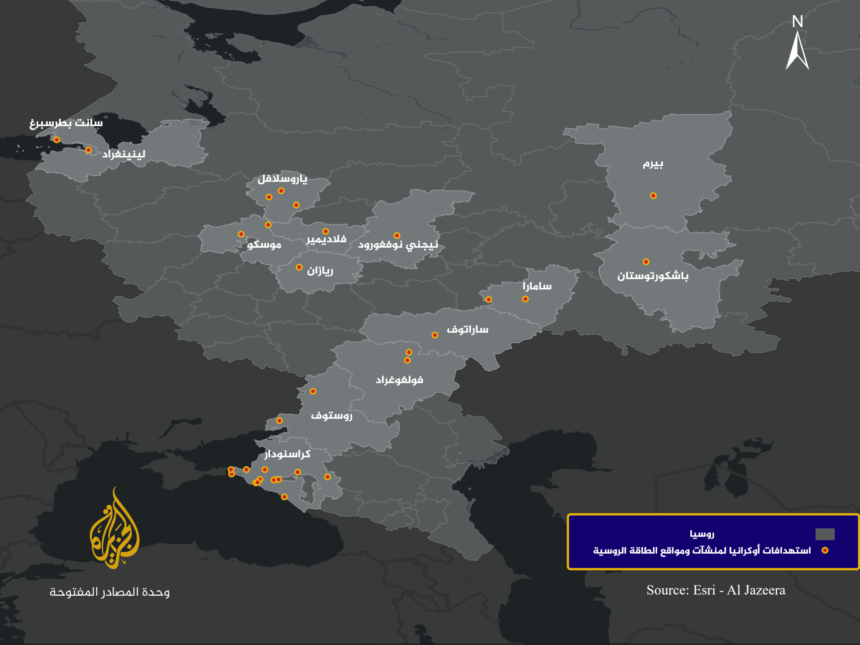
In this context, the Al Jazeera Network’s Open Source Unit worked to prepare a map showing the locations of the energy targets observed in the period from last January to this June. The map included about 40 vital sites extending from the Gulf of Finland and the Baltic Sea in the north, all the way to the shores of the Black Sea and the Sea of Azov in the south.
Read also
list of 3 itemsend of list
Variation in targets
Analysis of geographic data on documented targets of energy facilities indicates a clear difference, as Ukrainian targeting inside Russia focused on directing strikes with suicide marches at distances that sometimes exceed 1,100 kilometers from the border, directly targeting the veins of the Russian economy and its oil exports.
Indicators show that the Target Bank mainly focuses on oil refineries, huge fuel tanks, and central pumping stations, in addition to strategic export ports.

In contrast, Russian targeting inside Ukraine has tended significantly towards goals of a field nature linked to direct domestic consumption. Such as gas stations in regions such as Zaporizhzhya, Kharkiv, Kiev, and Kherson, in addition to targeting vital facilities of the “Naftogaz” company in Kharkiv, warehouses in Yahotin, Kyiv region, and underground gas facilities in Belchy-Voletskoe-Uhirsky, as well as gas infrastructure facilities in Chernihiv and thermal power plants of the “DTEK” company.
Strikes to stifle export
An analysis of data on the targets monitored by the Open Source Unit revealed a pattern of repeated attacks on specific Russian facilities.
The Tuapse oil refinery is one of the most targeted targets in successive strikes, given that it is Russia’s only major refinery on the coast of the Black Sea. It was targeted by marches in early and late May 2026, as well as 3 separate targets during April 2026, which hinders the movement of refining and exporting derivatives through this vital waterway.
In the Russian capital, the Moscow (Kapotnya) refinery was subjected to a series of close strikes, as a huge fire was detected in it on the morning of Tuesday, June 16, after it was targeted by drones. It was then re-targeted intensively again last Thursday, June 18, resulting in successive explosions that affected major tanks. Ukrainian President Volodymyr Zelensky described the targeting as a justified response.
In Novorossiysk, southwest of Russia, the Grochovaya oil transport and storage station, affiliated with the state-run Transneft network, was attacked for the first time on May 23, and then the Ukrainian marches struck again more violently on June 8, resulting in the destruction and charring of fuel tanks at the facility, which was acknowledged by the Ukrainian General Staff.
In the Krasnodar Territory, the Tamanevtigaz station, which is a huge complex for transporting liquefied hydrocarbons, was targeted in early May 2026. Then the Ukrainian Security Service repeatedly struck it and destroyed its tanks on June 13 of this year.
In the same region, on June 6, satellite images recorded widespread destruction in the Ust-Labinsk warehouse and damage to a number of the 28 tanks that make up the site. The Ukrainian president confirmed at the time that his country’s drones traveled 500 kilometers to destroy the warehouse.
Continuous heat spots
Satellite images documented structural damage and clear indicators reveal the extent of the impact of the attacks on the continued operation of the facilities they affected. In early May, satellite images taken by the European Sentinel satellite showed columns of smoke rising and fires burning for six days in a row at the Russian Perm refinery, from April 29 to May 4, 2026, which illustrates the extent of the damage and the difficulty of controlling the fire.

In Volgograd Province, photos taken on June 10, 2026 showed structural destruction and complete charring of a giant oil tank with a capacity of 50,000 cubic meters inside the Krasny Yar production and distribution station, compared to its intact condition on May 21.
These analyzes intersect with an official announcement by the General Staff of the Ukrainian Armed Forces, which confirmed that its operations on June 8 resulted in the ignition of two oil tanks and the destruction of the quality assessment structure at Grochovaya, in addition to the destruction of the giant tank at the Krasny Yar station, in a clear effort to confuse Russian supply chains.
Expanding the circle of fire
On the Sea of Azov front, the destruction affected oil facilities in the Streletska Bay in Sevastopol, the port of Temryuk, and the port of Kavkaz. Satellite images on June 6 also documented destruction and burning in supply facilities inside the Moscow-controlled port of Mariupol, in an attack that resulted in the killing and wounding of a number of sailors.
1,100 kilometers from Ukraine, Kiev targeted the St. Petersburg station and the port of Novorossiysk. Satellite footage on June 3 showed a wide black smoke cloud over the coastal piers of the station located on the Gulf of Finland in the Baltic. Satellites also monitored on May 23 traces of an oil spill and clear marine damage in the port of Novorossiysk.
Providing alternatives to Qurum bridges
In addition to oil installations and ports, the Ukrainian strikes targeted vital crossings to sever military supply lines towards the Crimean Peninsula and the axes of the south, such as targeting the Chongar land bridge with successive strikes on June 6, 9, and 15. The Gencheysk and Novoazovsk bridges were also bombed.
But the Russian authorities were quick to find alternative engineering solutions, including establishing temporary floating crossings, as happened after the Chongar land bridge was targeted.
Russian confession
In the face of this geographical expansion of the Ukrainian attacks, Moscow acknowledged for the first time in early June that its energy sector had been affected, as Alexander Novak, Russian Deputy Prime Minister, stated during the St. Petersburg Economic Forum that Russia’s oil production had recorded a noticeable decline since the beginning of this year compared to its previous levels.
Novak justified this decline by saying that a number of Russian oil refineries entered into “unplanned maintenance work,” a diplomatic expression that clearly intersects with refineries disabled by attacks.
The data as a whole indicate that the current infrastructure war puts both parties facing complex logistical and economic challenges. While Kiev seeks to dry up the sources of funding for the Russian war effort by striking the refining, pumping and export pillars, Moscow is trying, through its ongoing field strikes, to put pressure on the Ukrainian interior and undermine local logistical support facilities.